Meet the U.S.'s 2 new almost-saints
The U.S. bishops voted Wednesday in favor of advancing two beatification causes at the local level.
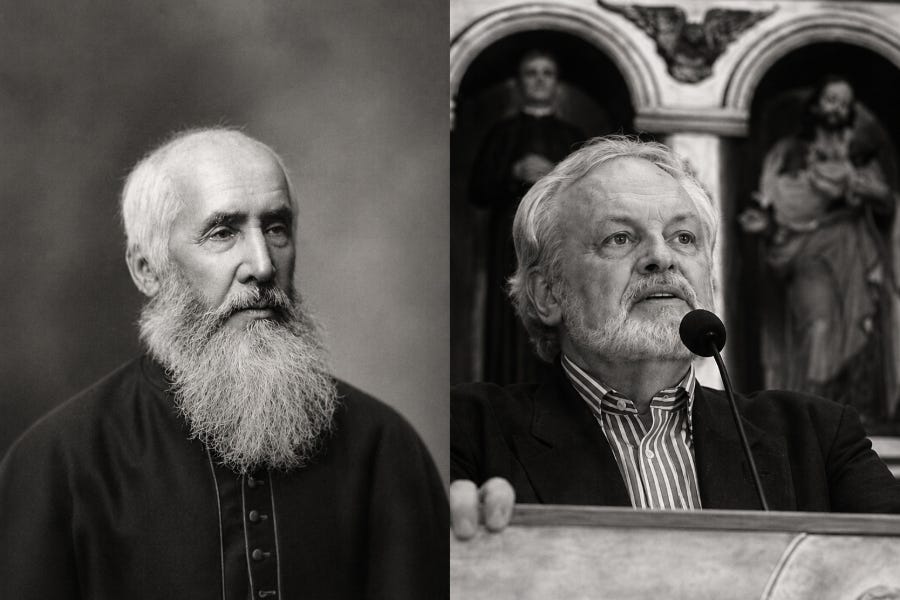

The two candidates are outwardly quite different. One was a Slovenian priest who built up the Church in northeastern Minnesota in the early 20th century. The other was a 21st-century New York businessman who helped inspire several nations to consecrate themselves to the Hearts of Jesus and Mary.
And yet, Msgr. Joseph Buh and John Rick Miller arguably share at least one trait: an exceptional zeal that prompted those around them to wonder if they were in the presence of a saint.
Here’s a brief look at their lives.
The patriarch of Duluth
Jožef Frančišek Buh was born on March 17, 1833, in Sadobie, a settlement that was then part of the Habsburg Austrian Empire but today is in the small Central European state of Slovenia.
Buh’s mother tongue was Slovenian, but he learned German — the language of government and higher education — at school. At the age of 25, he was ordained a priest in Ljubljana, today the capital of Slovenia.
After ministering locally, Buh made contact with Fr. Francis Xavier Pierz, a Slovenian missionary serving among Native Americans in the Great Lakes region of North America.
With Pierz at his side, Buh set sail on April 10, 1864, from Le Havre, France, bound for New York. From there, he traveled to Minnesota, where he began working with the Ojibwe people — also known as the Chippewa — learning their language in a matter of months. He also quickly earned their respect, receiving the names Little Book, perhaps in reference to his breviary, and Long Beard, because of his luxuriant facial hair.
Buh also served Slovenian immigrants, who were drawn to northern Minnesota by the prospect of iron mining jobs. He helped to create a miners’ union with another Slovenian priest. He also established a boarding house for the unemployed on the Iron Range.
As Buh toiled away, the Church’s structures developed around him. In 1875, Pope Pius IX established the Vicariate Apostolic of Northern Minnesota. In 1889, Pope Leo XIII carved the Diocese of Duluth out of that territory, appointing the Irish-born priest James McGolrick as its first bishop. McGolrick tapped Buh as his vicar general.
Buh helped to found more than 50 parishes, earning the nickname the “patriarch of the Diocese of Duluth.” In 1899, the pope recognized his efforts by granting him the title of monsignor.
Buh died in Duluth on Feb. 2, 1922, at the age of 88. At his funeral, Bishop John McNicholas — McGolrick’s successor as Bishop of Duluth — described Buh as a “saintly priest” who held that “no journey on foot, no distance by horseback was too long or too trying provided a soul was to be helped at the journey’s end.”
Buh was revered locally, but it was not until 2023 that the possibility of a beatification cause began to be explored in earnest. In 2024, his mortal remains were moved from Calvary Cemetery to the Cathedral of Our Lady of the Rosary.
In a booklet dedicated to Buh, Duluth’s Bishop Daniel Felton wrote: “Be it the will of God, this holy missionary priest living in his missionary time will become the missionary saint interceding for us in our own missionary time.”

The businessman turned evangelizer
John Rick Miller was born in New York City on July 10, 1948. He grew up in a prayerful atmosphere, cultivated especially by his father’s grandparents. But when he went to college, he left his childhood faith behind.
In the following decades, Miller immersed himself in the corporate world. But in 1988, he had a profound spiritual experience at Medjugorje that inspired him to dedicate the rest of his life to evangelization.
Miller formed the conviction that the answer to the world’s ills lay in consecration to God.
“When we consecrate ourselves to God,” he said, “a pact is established between the Father and His child. It is an act that will never be broken by God, but one that is our responsibility to uphold. It is a bond of love and protection.”
“Consecration is the personal offering of ourselves and everything we have to Almighty God. It is a total surrender and entrustment of our lives.”
In 2007, he met with Colombia’s President Álvaro Uribe. The South American country was in the midst of a decades-long internal conflict marked by kidnappings, drug trafficking, and guerrilla warfare.
Miller convinced Uribe that the solution to Colombia’s woes was consecration to God. According to a website dedicated to Miller, Uribe personally consecrated himself, followed by members of his family, government officials, military, and police. The Church in Colombia also renewed its consecration to the Sacred Heart of Jesus and dedicated the country for the first time to the Immaculate Heart of Mary.
In 2008, Miller began to focus on establishing prayer groups in Central and South American countries. Members prayed for the protection of their respective nations and the return of lapsed Catholics to the faith. A year later, he founded the Mission for the Love of God Worldwide, an international organization known in Spanish as the Misión por el Amor de Dios en Todo el Mundo.
By 2010, the Mission had expanded to Australia and across the U.S., from Florida to Mississippi, Louisiana, and California. An estimated 1.25 million people engaged in the Mission’s daily prayers.
The Ecuadorian Episcopal Conference recognized the Mission in 2011 as a private association of the faithful. But a year later, Miller was diagnosed with esophageal cancer, which limited his travels.
By 2013, the Mission calculated that it had inspired the consecration of 18 cities and states, 16 archdioceses and dioceses, 16 military and police forces, 140 companies, and 72 schools and universities.
In February 2014, Miller made his final mission trip. The destination was Mexico, which he considered the world’s greatest Catholic nation. In an interview during the visit, he said the Mission had a twofold purpose. The first was to convince people to make a change in their lives, by recognizing their identity as children of God. The second was to convince the baptized not to be “one-hour-a-week Catholics” but active evangelizers.
Asked what practical advice he would give a Catholic seeking to change, he said: “After many years of searching, I have one definitive answer: to know God as your Father and to begin a daily dialogue with God, and to build this relationship. So one day, suddenly out of nowhere, you feel the embrace of God and there is no longer any doubt in your mind that God exists and he loves you. From that day on, your life changes.”
Miller died in Delray Beach, Florida, on May 30, 2015, at the age of 66. Archbishop Thomas Wenski presided at his funeral at St. Mary’s Cathedral in Miami. He was laid to rest at Our Lady of Guadalupe Church in Doral, Florida. Our Lady of Guadalupe was the Mission’s patroness.


pray for us!