Who could be Leo’s pick for Secretary of State, whenever it comes?
If Leo makes a change at the top of his largest department, it creates a series of complicated choices downstream.
One of the remaining great unknowns of the Leonine pontificate is when the pope could choose to replace the heads of Vatican departments remaining from the Francis papacy.
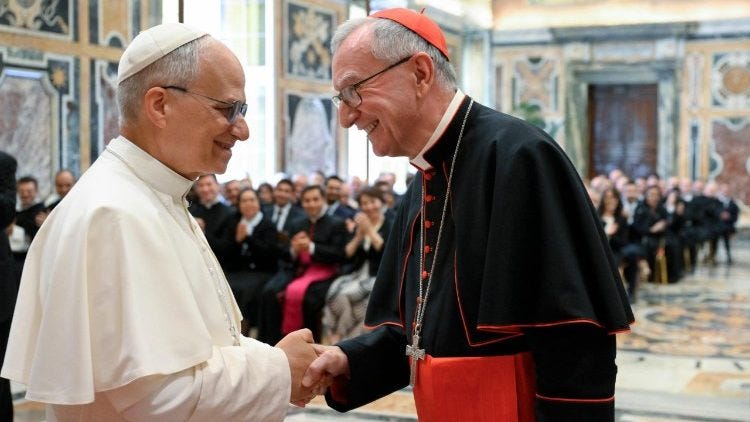
At the largest and most influential of these, the Secretariat of State, Pope Leo XIV could replace Cardinal Pietro Parolin as Secretary of State as early as this summer, according to several diplomatic and Vatican sources who spoke to The Pillar.
The move, if it happens, would replace the Vatican’s second-highest official and the pope’s closest institutional advisor. According to several of these sources, Pope Leo has privately expressed some reservations about Parolin’s effectiveness as the epicenter of curial organization, a dynamic that may have led the pope to start considering replacing him.
While no one knows except the pope when he might choose to replace the 71-year-old Parolin, speculation has already begun about his potential successors.
The Vatican City rumor mill currently favors a traditional appointment of a curial official with diplomatic experience, with Archbishop Paul Gallagher and Archbishop Fortunatus Nwachukwu considered the leading candidates. But the trend of senior appointments under Leo so far suggests at least the possibility of a candidate from outside the traditional curial personnel pipeline.
In any event, if the pope does decide to make a change at the top of his largest department, it could also create a series of potential headaches, or at least complicated choices, downstream.
—
Cardinal Parolin has been serving as Secretary of State since 2013 when Pope Francis appointed him to the position seven months into his pontificate.
Early into Leo’s pontificate, it was rumored Parolin could be moved out of Rome to the Patriarchate of Venice or the Archdiocese of Milan to take on a major Italian diocese, despite his relatively advanced age. At the time, commentators speculated that Parolin’s accumulated baggage over more than a decade in charge of the Secretariat of State, including his involvement in the Vatican-China deal and the London property scandal, would be enough for any pope to consider starting fresh.
But as the months passed, neither move materialized.
Parolin was widely known to have a tense relationship with the sostituto of the Secretariat of State, Archbishop Edgar Peña Parra. The sostituto, while nominally Parolin’s deputy, is effectively the pope’s chief of staff, with much more day to day contact with the pontiff, and Peña Parra was known to have a much closer relationship with Francis than Parolin.
Peña Parra’s appointment as apostolic nuncio to Italy and the appointment of Archbishop Paolo Rudelli, believed to have come at Parolin’s suggestion, as Peña Parra’s successor, were seen as a victory for Secretary of State, and a sign he could see his tenure extend for another several years.
Parolin’s influence appeared to extend beyond Rudelli’s appointment: the new nuncio to the United States, Archbishop Gabriele Caccia, is also widely considered close to Parolin.
Given that trajectory, many assumed that Pope Leo XIV would even allow Parolin to remain in his post until he reached the nominal Vatican retirement age of 75 in three years and a half.
However, several diplomatic and Vatican sources have told The Pillar that Parolin now seems likely to be replaced sooner, rather than later — even as soon as this summer.
According to several sources, there are questions about Parolin’s effectiveness and influence as the central point of contact and coordination across and between Vatican departments, a dynamic that some sources suggest has prompted the pope to begin considering potential successors to Parolin.
The main question is whether Leo will appoint someone from within the established Vatican pool of personnel — a diplomat or former diplomat serving in the curia — or whether Leo will look outside, as he has done with other senior appointments so far.
The Secretariat of State is the Vatican’s second-highest office, after the pope, and is generally considered the pope’s closest institutional advisor. Most secretaries of state have come from within the Vatican diplomatic corps. The few exceptions to this tradition have at least served as curial officials, such as Cardinal Jean-Marie Villot, who served in the role under three popes between 1969 and 1979, and Cardinal Tarcisio Bertone, who served between 2006 and 2013, under Pope Benedict XVI and briefly under Pope Francis.
Benedict’s choice of Bertone was unconventional, and personal: at the time, Bertone was serving as Archbishop of Genoa, having previously been secretary of the then-Congregation for the Doctrine of the Faith under then-Cardinal Ratzinger, with whom he worked closely for years. Bertone’s tenure in the Vatican top job was, however, ultimately marked — even defined — by pervasive corruption, financial scandals and other controversies.
Francis, by contrast, chose the traditional route, selecting a career diplomat in Parolin. Their relationship cooled over time, however, and rumors of a possible replacement grew toward the end of Francis’s pontificate. Parolin’s tenure was not without its own controversies, including his central role in the China-Vatican agreement and the London property scandal.
Finding a successor for Parolin may not be simple. Rumors in the Vatican point to at least two potential names: Archbishop Paul Gallagher, secretary for Relations with the States of the Secretariat of State and Archbishop Fortunatus Nwachukwu, secretary of the Section of First Evangelization at the Dicastery for Evangelization.
Both share a similar profile: career diplomats with extensive experience as apostolic nuncios and in the Roman curia. A choice between them would suggest Pope Leo is inclined toward the traditional route of selecting a Vatican diplomat.
For all the speculation, Gallagher is 72, though, older even than Parolin, which means he would likely serve as a transitional Secretary of State. Even if the pope allowed him to remain in office until 77 — and Pope Leo has already said publicly that he would prefer curial officials not to serve beyond retirement age or, except in rare cases, past 77 — Gallagher would serve for only about four and a half years.
This would be a briefer tenure than anyone to hold the role since Cardinal Domenico Tardini, who served as Secretary of State between 1958 until his death at 73 in 1961.
However, Gallagher’s potential appointment would have its logic. If the pope sees a certain urgency in replacing Parolin but does not yet feel he knows the pool of apostolic nuncios enough to choose among them, Gallagher is widely respected throughout the curia and in diplomatic circles and could represent a safe pair of hands to manage a transition.
Naming him would also preserve Leo’s flexibility to appoint a longer-term Secretary of State once he identifies the right candidate. Moreover, Gallagher is widely seen as a competent and well-liked official within the curia, and is relatively uncontroversial, traits that have marked several of Pope Leo’s senior appointments so far.
Nwachukwu, for his part, is the most senior African curial official and has one of the longest resumes among Vatican officials. After serving in several nunciatures and in the section for relations with states of the Secretariat of State between 1994 and 2007, he became chief of protocol of the Secretariat of State that same year.
In 2012, he was appointed apostolic nuncio to Nicaragua, a position he held until 2017, when he was made the apostolic nuncio to the English Caribbean, Suriname, and the Netherlands Antilles. In 2021, he became the Holy See’s Permanent Observer to the UN in Geneva, Switzerland, and has held his current office as secretary in the Dicastery for Evangelization since 2023.
Nwachukwu is also widely seen as a competent official, with diplomatic and intellectual credentials and of a conservative theological persuasion but a generally moderate temperament.
His time as nuncio to Nicaragua drew some criticism, however, with some observers viewing him as too close to the country’s government — and, in particular, to first lady turned co-president Rosario Murillo.
Nwachukwu is also 66 years old, and, therefore, could potentially serve for a decade or more, as most secretaries of state have done since the Second Vatican Council.
Pope Leo could also take a less conventional route and choose someone who is not a current curial insider or an apostolic nuncio. It would be, in terms of Vatican praxis, an unorthodox move, but several of Leo’s appointments suggest that he’s not shy in bringing figures from outside the Roman curia into senior Vatican roles.
For example, last month he appointed Montserrat Alvarado, president and COO of EWTN News, as the new prefect of the Dicastery for Communications, despite her having never previously served in a Church institution.
He also appointed Archbishop Luis Marín de San Martín, OSA, a longtime Leo collaborator dating back this time in leadership of the Augustinian order, as papal almoner. Although Marín was serving in the curia as undersecretary of the Synod of Bishops before Leo’s election, he appeared more likely to stay in his position until his retirement or be appointed as a bishop in Spain than to receive a major a curial promotion.
The pope likewise appointed Australian Bishop Anthony Randazzo as prefect of the Dicastery for Legislative Texts. Randazzo worked in the then-Congregation of the Doctrine of the Faith from 2004 to 2009, meaning he had been outside the Roman curia for 16 years by the time of his appointment.
Moreover, several Vatican sources told The Pillar that Norwegian Bishop Erik Varden might be soon appointed to lead a Vatican dicastery. The pope is also reportedly considering appointing at least one Peruvian bishop close to him to a curial position this year.
That does not necessarily point to a full overhaul of the curial appointment process, however. Leo appeared to follow more traditional criteria of promoting from within by appointing the Dicastery for Promoting Human Development’s secretary, Sr. Alessandra Smerilli, FMA to succeed Cardinal Michael Czerny, SJ as prefect. He also named Archbishop Filippo Iannone, O. Carm, who was serving as prefect of the Dicastery for Legislative Texts, to succeed him as prefect of the Dicastery for Bishops.
Still, many of Leo’s appointments so far suggest that he’s willing to think outside the box. The Secretariat of State is, of course, somewhat unique in the constellation of Vatican departments, but it might be possible that his choice for Secretary of State proves to be an untraditional one.
If Leo’s curial appointments offer any indication of the profile he might favor, Leo’s Secretary of State could be someone known primarily for competence rather than for belonging to a doctrinal camp, someone with missionary or at least international experience, very possibly the member of a religious order, and a strong intellectual and institutional resume.
—
Of course, assuming Cardinal Parolin were to be moved on from the job he has had for the last 13 years, the pope will face the task of deciding where his former top diplomat should go next.
At 71, Parolin is not yet of retirement age.
Forr now, rumors in Rome suggest he could become archpriest of one of Rome’s papal basilicas.
Rome has four papal basilicas: Saint Peter, Saint John Lateran, Saint Mary Major and Saint Paul Outside the Walls. Each of them is headed by an archpriest, typically a cardinal or someone created cardinal shortly after appointment.
Saint John Lateran’s archpriest is traditionally the Cardinal Vicar of Rome – currently Cardinal Baldo Reina – However, the other three papal basilicas are sometimes used as a kind of dignified retirement post for cardinals or curial officials.
For example, Cardinal Francesco Marchisano was the archpriest of Saint Peter’s Basilica between 2002 and 2006 after serving as secretary of several dicasteries and president of the Pontifical Commission for Sacred Archeology for 13 years.
Cardinal Stanisław Ryłko became the archpriest of the Basilica of Saint Mary Major in 2015 after serving for 13 years as president of the Pontifical Council for the Laity. His predecessor, Cardinal Santos Abril, became the basilica’s archpriest in 2011 after three decades as an apostolic nuncio. Abril’s predecessor was Cardinal Bernard Law, who was appointed in 2004 after resigning as Archbishop of Boston amid accusations of sexual abuse cover-up.
Among the current archpriests of papal basilicas, only Cardinal James Harvey, 76, archpriest of the Basilica of Saint Paul Outside the Walls is past the nominal retirement age. However, Cardinal Mauro Gambetti, archpriest of Saint Peter’s Basilica has been linked with a move to an Italian diocese for months, leaving potentially two archpriest positions for Pope Leo to fill.
While Gallagher has been floated as a possible Secretary of State, other Vatican sources told The Pillar he might be in line for the kind of semi-honorific post given to an official of his age and standing, especially if it came with the prospect of a red hat, possibly as archpriest of the Basilica of Saint Paul Outside the Walls or as the prefect of a minor dicastery, such as the Dicastery for the Laity, Family and Life.
The question of who might succeed Gambetti at Saint Peter’s is more complicated. Vatican sources told The Pillar that Parolin himself might be appointed to the position. However, other senior sources told The Pillar that the pope intended to move Cardinal Rolandas Makrickas, current archpriest of the Basilica of Saint Mary Major to the position, while other rumors point to the appointment of Archbishop Diego Ravelli, Master of Pontifical Liturgical Celebrations.
Gambetti’s tenure at St. Peter’s has been contentious, marked by security concerns, controversial financial decisions, and restrictions on the celebration of individual Masses at the basilica’s side altars. That may lead the pope to prioritize an experienced administrator capable of stabilizing the situation in the basilica, a role Cardinal Makrickas played in Saint Mary Major, first as extraordinary commissioner of the basilica, then as coadjutor archpriest, and finally as archpriest.
Such a move could complicate Parolin’s prospects: there does not appear to be an obvious senior dicastery to which he could be appointed, and indeed any dicastery after the Secretariat of State is considered in Vatican circles to be a step down. And the possibility of becoming Archbishop of Milan or Patriarch of Venice appears increasingly unlikely.
Still, if Makrickas were named archpriest of St. Peter’s, that could open up St. Mary Major for Parolin — or the pope could simply decide to give Parolin the most senior of the four basilica posts outright.

