Who is the new papal almoner - and how has the role changed?
It seemed only a matter of time before Luis Marín de San Martín received weightier responsibilities.
Bishop Luis Marín de San Martín was watching from the window of the Augustinian order’s headquarters in Rome when the velvet curtains parted on the loggia of St. Peter’s Basilica and a cardinal emerged to announce the name of the new pope.
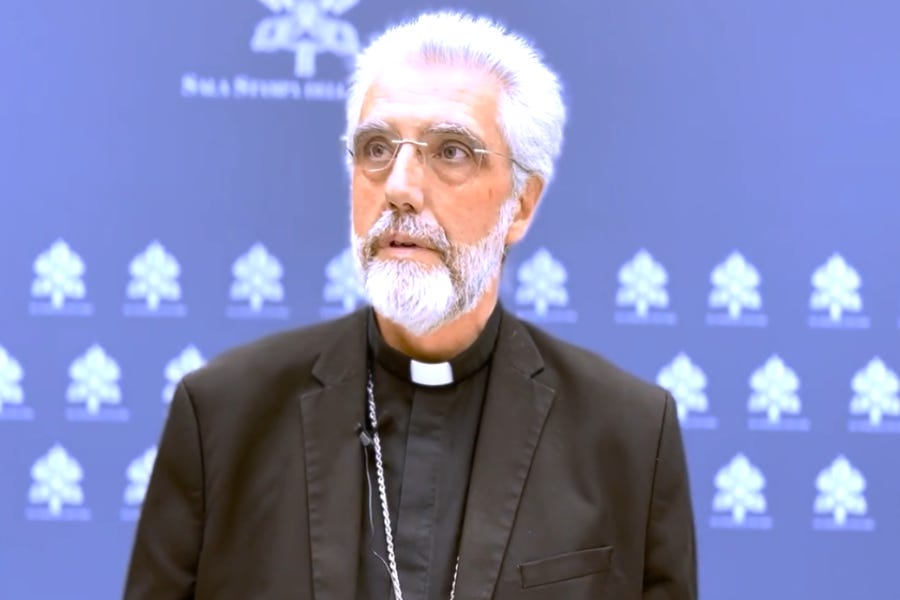
When he heard the words “Robertum Franciscum,” Marín immediately realized the cardinals had chosen a man he knew better than almost anyone at the Vatican: Cardinal Prevost, now Pope Leo XIV.
In the following days, the Spanish bishop became a sought-after commentator on the first Augustinian pope, helping to shape early perceptions of Leo XIV.
It was clear from their public interactions that Leo XIV held Marín in high regard, evidently grateful to have a familiar face — with its distinctive white beard and rimless glasses — close by.
Given the pope’s esteem, it seemed only a matter of time before the 64-year-old undersecretary of the General Secretariat of the Synod received weightier responsibilities.
On March 12, Leo XIV appointed Marín as the new papal almoner, succeeding the Polish Cardinal Konrad Krajewski, who will return to lead his home archdiocese of Łódź.
Who is the now-Archbishop Marín? And what is the role that he’s inheriting?
Who is Archbishop Marín?
Luis Marín de San Martín was born in Madrid on Aug. 21, 1961. He attended the city’s prestigious Colegio San Agustín, run by the Augustinian order. After his studies, he enrolled in the order, taking temporary vows in 1982 and solemn vows in 1985. He was ordained a priest in 1988.
Marín’s first priestly assignments were in San Sebastián de los Reyes, a suburban area north of Madrid, the lofty Sierra de Madrid, and the capital itself. He remembers these as “years of incredible richness,” in which he discovered “the greatness of the priestly vocation, the task of evangelization, and the need for coherence.”
Marín embarked on further theological studies, gaining licentiates from the Comillas Pontifical University in Madrid and the Pontifical Gregorian University in Rome. He earned a theology doctorate from Comillas with a dissertation on the ecclesiology of Pope St. John XXIII.
Marín would go on to write several books about “the Good Pope,” becoming an authority on John XXIII’s vision for Vatican Council II. It was partly this background that led to his later role as an organizer of the global synodal process launched by Pope Francis in 2021.
In the 1990s, Marín served in parishes, oversaw the formation of future priests, and led theological institutes. In 1999, he was appointed provincial councillor of the Augustinian Province of Spain.
In 2002, Marín became prior of the Monastery of Santa María de la Vid in northern Spain, where St. Dominic lived before he founded his own religious order. It was in this period that Marín first met Fr. Robert Francis Prevost, the then-prior general of the Augustinian order, during the latter’s visits to community houses in Spain.
In 2008, Marín received a summons to Rome from Prevost. There, Marín served as the order’s general archivist, living in the same community house as Prevost. They enjoyed what Marín recalled as “five years of wonderful coexistence.”
In 2013, Marín became the Augustinian order’s assistant general and president of the Augustinian Institute of Spirituality.
After Prevost was sent to lead Peru’s Chiclayo diocese in 2014, he would call on Marín to help in the continuing formation of local priests. Marín observed how Prevost loved to drive around the city, being greeted warmly wherever he went.
Pope Francis named Marín as the undersecretary of the Synod of Bishops on Feb. 6, 2021. Marín was ordained a bishop on April 11, 2021, at Madrid’s Almudena Cathedral. Cardinal Mario Grech, head of the General Secretariat of the Synod, was scheduled to preside, but was unable to travel to Spain due to COVID-19 restrictions. Madrid’s Cardinal Carlos Osoro Sierra was the principal consecrator instead. Marín took the episcopal motto Deus caritas est (“God is love”).
He quickly became a well-liked figure at the General Secretariat of the Synod, with an easy-going personality that made him a good teamworker who could build consensus. When Marín spoke about synodality, he generally avoided jargon, stressing its spiritual aspect and roots in Church history.
In a 2022 address, he described the synodal transformation of the Church as “an irreversible process, with different speeds, full of nuances and in need of clarification, but with no turning back.”
He added: “We should not be frightened by the different speeds, nor should we be anxious to achieve immediate results; the important thing is to assume a new, more coherent way of being Church, advancing serenely along this path of renewal and hope. If possible, with enthusiasm.”
What is a papal almoner?
From the earliest times, popes had trusted collaborators who carried out charitable work on their behalf. They were typically deacons.
The post of papal almoner was first mentioned in a bull issued by the 12th-century Pope Innocent III. An office of papal charities, responsible for care of the poor, was first organized by the 13th-century Pope Gregory X.
Leo XIII, the long-reigning 19th-century pope, came up with a creative way to fund the office, through the sale of papal blessing parchments — a practice that continues to this day.
Papal almoners were typically low-profile figures, despite holding the rank of archbishop and being members of the papal household. But the role became dramatically more prominent under Pope Francis, who had been known for his closeness to the poor as the Archbishop of Buenos Aires.
The Argentine pope wanted a papal almoner who would seek out the poor and attend to their needs, without waiting to be asked. He chose Fr. Konrad Krajewski, who had previously served as Papal Master of Ceremonies.
Pope Francis famously advised Krajewski to “sell your desk.” Being the papal almoner was no longer a desk job, but an adventurous calling. The pope gave Krajewski a red hat, making him the first papal almoner to be a cardinal.
Stories began to emerge of Krajewski’s daring and unconventional methods of delivering aid. In 2019, he climbed down a manhole to restore electricity to a building occupied by 450 squatters, including 100 children. The action prompted a political storm in Italy.
But Krajewski insisted the gesture was not political. “I am the almoner, and I worry about the poor, those families, children … they finally have light and hot water,” he said.
Later, he would personally deliver truckloads of humanitarian aid to front-line areas in Ukraine.
Pope Francis further enhanced the papal almoner’s role in 2022, when he issued the apostolic constitution Praedicate evangelium, which turned the office of papal charities into the Dicastery for the Service of Charity. Krajewski became the dicastery’s prefect, in addition to his role as almoner.
Praedicate evangelium defined the dicastery as “a special expression of mercy” that “carries out in every part of the world the work of aid and assistance offered in the name of the Roman Pontiff.”
Krajewski will likely be a hard act to follow as papal almoner, given his ingenuity and courage. Archbishop Marín is a slightly older man, with a different temperament and background. But those who know him say he has a spiritual groundedness and serenity that should enable him to leave his own mark on the role.


“In a 2022 address, he described the synodal transformation of the Church as “an irreversible process, with different speeds, full of nuances and in need of clarification, but with no turning back.”
He added: “We should not be frightened by the different speeds, nor should we be anxious to achieve immediate results; the important thing is to assume a new, more coherent way of being Church, advancing serenely along this path of renewal and hope. If possible, with enthusiasm.””
What an absolutely bizarre thing to say.
Has a great background for collaboration and understands the Second Vatican Council through the eyes of the man who called the council. I have a feeling we will see the Dicastery for Charity enter a different stage and I don't believe it is the end of the road for this son of St. Augustino. I hope a red hat is imposed on his head and continues to collaborate closely with his brother.