Who will lead Germany’s bishops after Bätzing?
German media are converging on a candidate
Bishop Georg Bätzing announced Monday that he is stepping down as chairman of the German bishops’ conference.
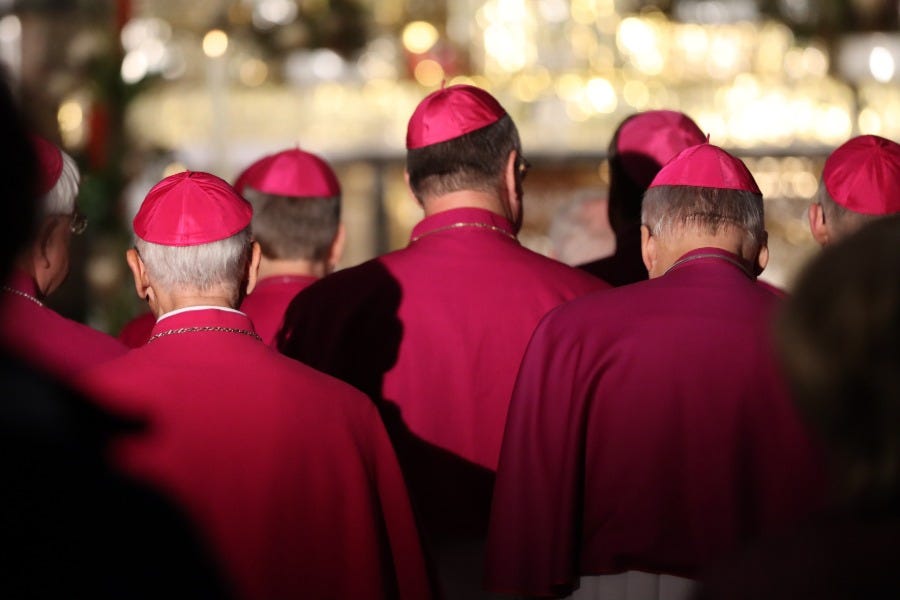
In a letter to bishops, Bätzing said he would “not be available for re-election” when the German episcopate meets in Würzburg on Feb. 23-26, at the end of his tumultuous six-year term.
The 64-year-old Bishop of Limburg said he had made the decision “after consultation and careful deliberation.” In a nod to divisions among the bishops that deepened during his tenure, Bätzing thanked those who had “supported me with appreciation and constructive criticism over the past six years.”
“It has been six intense years in which we bishops, together with many others from the people of God, have been able to make a difference and realize a sustainable future for the Church in our country,” wrote Bätzing, who oversaw Germany’s controversial “synodal way.”
“Now it is time to hand over this important task for the work of the bishops’ conference to others. And I am sure that things will continue to go well.”
How are the German media summing up Bätzing’s tenure? And who are they tipping to replace him as chairman of the bishops’ conference?
Six years of turmoil
Bishop Bätzing was thrust into the limelight in 2020, when Cardinal Reinhard Marx unexpectedly announced he would not be standing for a second term as bishops’ conference chairman.
Marx’s departure was a surprise because he had just presided over the launch of the synodal way, an initiative seeking far-reaching changes to Catholic teaching and practice in the wake of an abuse crisis in Germany. Bätzing, then just 58, took over responsibility for the synodal way as opposition to the project built in Rome, where he had relatively little experience.
Weeks after Bätzing’s election, Germany entered its first COVID lockdown. He was required to formulate and defend the Church’s response to the pandemic, which included the closure of churches and suspension of public Masses.
Following the COVID-19 crisis, Bätzing was able to focus on synodal way. But his uncompromising commitment to its radical agenda alienated the minority of German bishops who rejected its premises. His championing of the synodal way also caused rifts with bishops outside of Germany, notably Poland’s then-bishops’ conference president Archbishop Stanisław Gądecki. This was perhaps ironic for a bishop whose motto was congrega in unum (“gather together.”)
In an op-ed for katholisch.de, the German Church’s official news site, journalist Mario Trifunovic argued that Bätzing’s determination helped to drive the synodal way to its conclusion despite Roman resistance.
“He ensured that conflicts were not postponed but addressed openly,” Trifunovic wrote, acknowledging that Bätzing’s approach upset those who thought he was too close to the lay Central Committee for German Catholics, which co-sponsored the synodal way alongside the bishops’ conference.
Norbert Demuth of the German Catholic news agency KNA highlighted Bätzing’s role in winning the bishops’ unanimous backing for a 2024 statement condemning the Alternative for Germany party.
Demuth suggested Bätzing also “achieved a small breakthrough” when he secured the appointment of a woman, Beate Gilles, as bishops’ conference general secretary — a global first.
A less favorable assessment came from Peter Winnemöller, a journalist associated with the New Beginning initiative, founded as an alternative to the synodal way.
Winnemöller argued that the root cause of Bätzing’s “disastrous” tenure was “the politicization of the office” of chairman.
Summing up a widely expressed view in the German media, the Augsburger Allgemeine’s Daniel Wirsching said that “a mediator and moderate reformer is likely to be in demand” as the next bishops’ leader.
“Basically, someone like Pope Leo XIV,” he wrote.
Tips for the top
In the hours after Bätzing announced the end of his tenure as chairman, the German media converged to a surprising degree on a single candidate as his successor.
Archbishop Udo Marcus Bentz of Paderborn was, they suggested, a clear frontrunner. This is intriguing because, at the age of 58, Bentz is one of the youngest German bishops. He was only appointed archbishop in December 2023, after serving as an auxiliary bishop of Mainz from 2015.
His motto is Gloria Deo – Pax Hominibus (“Glory to God and peace to men”), suggesting a commitment to conciliation. Addressing the bishops at their last plenary meeting in Fulda, he urged them not to “get bogged down in crisis mode.” He said the Church should summon the courage “to grow in new and different ways.”
Thomas Schüller, a prominent canon lawyer, has tipped Bentz as Bätzing’s successor, suggesting he would cautiously advance the synodal way agenda, while trying to heal divisions among bishops.
Die Zeit, meanwhile, highlighted Bentz’s connections to Germany’s Chancellor Friedrich Merz, a Catholic from the Sauerland region, large parts of which are in the Paderborn archdiocese. The newspaper dubbed Bentz “the Chancellor’s chaplain.”
If Bentz is elected, English-speaking media are likely to highlight his connection to the “Westphalia chicken dance,” which took place in his presence in Paderborn Cathedral. He reportedly had no prior knowledge of the performance, which featured semi-clad dancers waving plucked chickens wrapped in diapers.
Here are the remaining candidates highlighted by the German media:
Bishop Heiner Wilmer of Hildesheim, 64, once touted as a potential prefect of the Dicastery for the Doctrine of the Faith. Known for his frequent papal audiences, Wilmer has served as a Roman sounding board for developments in the German Church.
Bishop Franz-Josef Overbeck of Essen, 61, who represented Germany at the synod on synodality, alongside Bätzing and Bishop Bertram Meier. Overbeck is known in the wider Church for his stark description of the state of his diocese at a Vatican press conference. A firm supporter of the synodal way, he would stand in continuity with Bätzing if he were elected chairman.
Bishop Peter Kohlgraf of Mainz, 58, is described by German media as a “Mann der Mitte,” or centrist, who could potentially bridge differences within the bishops’ conference. Since 2021, he has led the bishops’ influential pastoral commission, which oversees everything from prison chaplaincy to rural ministry.
Bishop Bertram Meier of Augsburg, 65, who helped bring Vatican officials and German bishops together at the peak of tensions over the synodal way. His ability to sympathize with conflicting viewpoints inspired the nickname “Both-Sides Bertram.”
Bishop Stefan Oster of Passau, 60, belongs to the minority of German bishops who oppose the synodal way. That makes his election unlikely, but he has qualities that could appeal to bishops from the opposing camp: his fresh-faced vigor and commitment to both online and in-person evangelization. His election would represent “a sharp shift in direction,” according to Daniel Wirsching.
Rome will be watching the German bishops’ conference election closely, given its outcome will influence Vatican-German Church relations for years to come.
In the coming months, Leo XIV and his advisers will likely be asked to approve the creation of a permanent German synodal body known as the “synodal conference.” The new body would effectively institutionalize the synodal way, potentially serving as a model for other bishops’ conferences.
In preparation for the big decision, the pope has met with an array of German bishops, as well as lay critics of the synodal way. According to the well-connected journalist Ludwig Ring-Eifel, Pope Leo is even considering a trip to Germany next year, during which he would “personally work to overcome the rifts in the Church.”
Ring-Eifel suggests the Vatican would be happy with a new German bishops’ conference chairman who is familiar with the ways of Rome and in harmony with Leo XIV’s “pontificate of depolarization.”
How closely any of the leading candidates fit that bill will be debated right up to the bishops’ vote in Würzburg.

"If Bentz is elected, English-speaking media are likely to highlight his connection to the “Westphalia chicken dance,” which took place in his presence in Paderborn Cathedral. He reportedly had no prior knowledge of the performance, which featured semi-clad dancers waving plucked chickens wrapped in diapers."
-Still my favorite article from last year.