Why a papal trip to Peru might be no picnic
The pope's adopted country has seen a long list of recent scandals and controversies, political and ecclesiastical.
Peruvian President José María Alcázar will meet Pope Leo XIV at the Vatican on June 18, when he is expected to formally invite the pontiff to visit Peru in November.
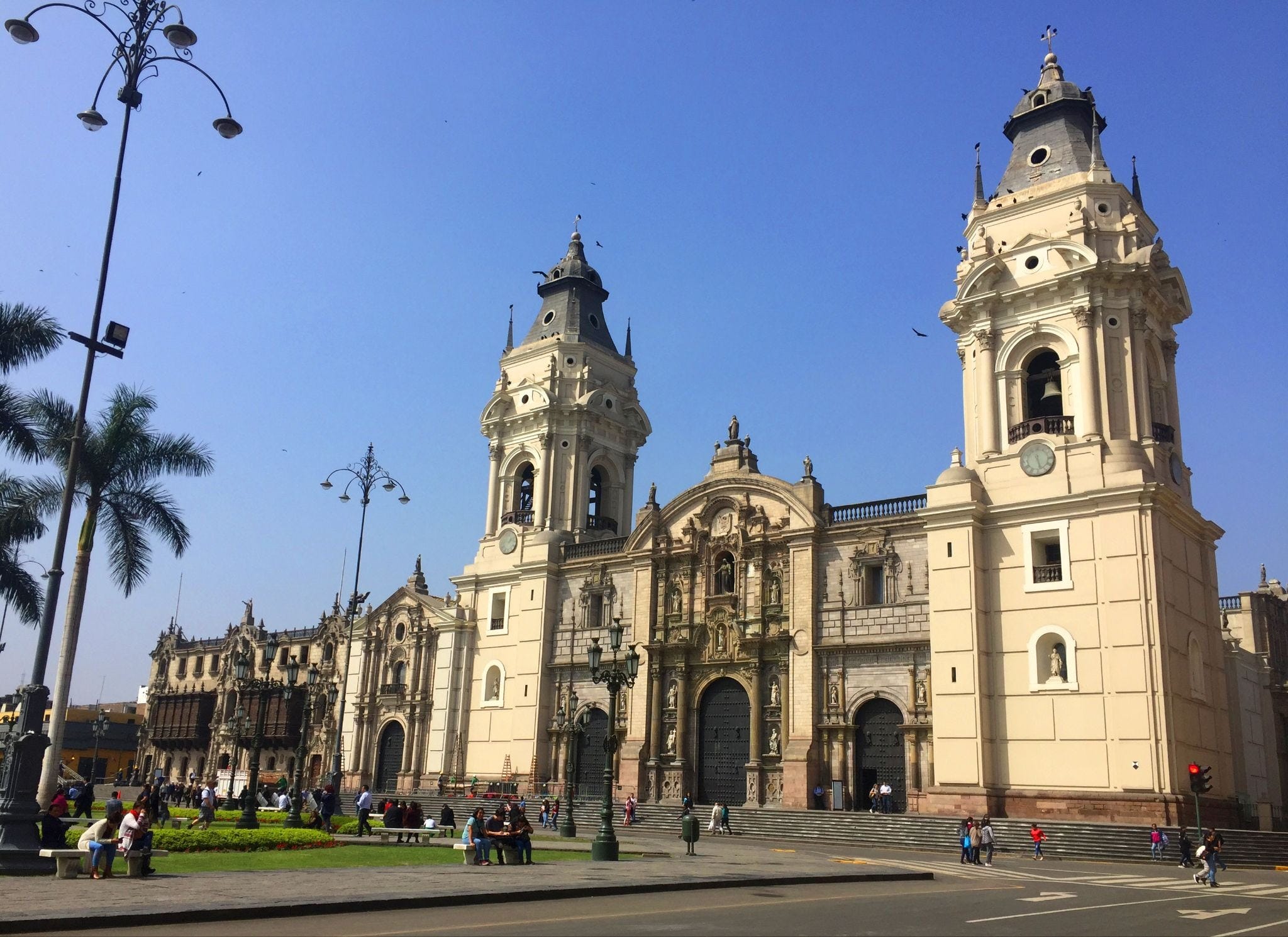
Both the Peruvian bishops’ conference and Alcázar have said the trip is expected to take place that month, with the president stating that it would likely occur between Nov. 10 and 16.
But a papal visit could be complicated by Peru’s fraught political climate and a series of scandals involving members of the country’s hierarchy, where Leo served as a missionary and bishop for nearly three decades.
—
Conservative candidate Keiko Fujimori, the daughter of Peruvian autocrat Alberto Fujimori, is favored to win a razor-thin presidential run-off against Roberto Sánchez, a self-proclaimed social Christian, who has claimed to have been influenced by liberation theology and is supported by far-left parties.
Fujimori holds a lead of roughly 30,000 votes over Sánchez in an election that saw more than 18 million votes cast. Though she has not yet been officially declared the winner, she is widely expected to emerge victorious. Electoral authorities have said the final count could take up to a month.
If confirmed, the result would mark the third consecutive Peruvian presidential election decided by less than half a percentage point. Keiko Fujimori lost narrowly in 2016 and 2021, after also being defeated in 2011 by a margin of nearly 3%.
Peru has endured a decade of political instability, with nine different presidents taking office over the past 10 years. Six Peruvian presidents this century have ended up in prison, faced criminal investigations, or been implicated in self-coup attempts.
Moreover, Peru’s unusually permissive impeachment mechanism has exacerbated the crisis. The country’s parliament is consistently fragmented among small and often unstable parties, which frequently break into even smaller factions, fueling political confrontations, corruption allegations, and impeachment proceedings.
Pedro Pablo Kuczynski was elected as president of Peru for a five-year period, winning by 0.24% over Keiko Fujimori in 2016.
Kuczynski underwent a first impeachment attempt just a year and a half into his presidency. After defeating the impeachment, Kuczynski pardoned Alberto Fujimori, Keiko’s father, in prison since 2005 for his role in several massacres and corruption cases during his presidency.
The move was widely decried as a quid pro quo after Fujimori’s party voted against the impeachment.
Just three months later, Kuczynski’s party became embroiled in a corruption scandal that ultimately led to his resignation, shortly before the Peruvian Congress was set to vote on a second impeachment attempt.
He was succeeded by his vice president, Martín Vizcarra. Vizcarra was himself impeached in November 2020 amid allegations of corruption during his time as a governor between 2011 and 2014, becoming the second Peruvian president in less than three years to be removed from office. He was replaced by Manuel Merino, then president of Congress.
Vizcarra’s impeachment led to massive protests, as many in the country saw his dismissal as a legislative coup. The protests led to Merino’s resignation just five days later. Manuel Sagasti, who had replaced Merino as president of the Peruvian Congress, was then appointed as president.
Sagasti led the country until July 2021, when Pedro Castillo took power after defeating Fujimori again by just 0.26%.
Castillo’s presidency was also short-lived. He faced two separate impeachment trials in December 2021 and February 2022. He was set to face a third impeachment trial in December 2022, which was largely expected to succeed.
Castillo responded by announcing the dissolution of Congress, the installation of a state of emergency, and a curfew.
Castillo’s actions were widely condemned as a self-coup. Most of his cabinet resigned, Congress impeached him, and he was arrested hours later while attempting to reach the Mexican embassy to seek asylum.
Castillo was succeeded by his vice president, Dina Boluarte, whose presidency was marked by extraordinarily low approval ratings, with some surveys showing support at virtually 0%. Although she survived six impeachment attempts, Congress ultimately removed her from office in October 2025 by a vote of 121–9.
She was replaced by the president of the Peruvian Congress, José Jerí, who would himself be impeached in February 2026 for several corruption and sex scandals. He was replaced by Alcázar, who will presumably serve as president until July 28, the date in which his successor, presumably Fujimori, will start her presidency.
Fujimori is therefore likely to assume the presidency in a country that remains deeply divided, much as it was when she narrowly lost the previous election. Her party holds only a minority of seats in both chambers of Congress and appears to have few viable options for building a stable legislative coalition.
Fujimori won the first round of the presidential election with just 17.19% of the vote in a field of more than 30 candidates. As in 2021, Peru’s fragmented political system produced a dispersed result, with nine candidates winning at least 3% of the vote. In the 2021 election, nine candidates likewise received at least 4%.
While Fujimori has acknowledged her father’s authoritarian tendencies, she has generally stopped short of condemning specific human rights abuses committed during his presidency, including the forced sterilization of Indigenous women, massacres linked to the government’s counterinsurgency campaign against the terrorist group Shining Path, and the persecution of political opponents.
Given that backdrop, and Fujimori’s relatively limited political base, it is conceivable that by the time Pope Leo XIV visits Peru in November, her administration could already be facing impeachment proceedings or another major political crisis.
While such a scenario remains speculative, Peru’s recent political history suggests that it cannot be entirely ruled out that Fujimori may no longer be president by the time Pope Leo XIV visits the country in November.
—
With such a divided and complicated political environment, Pope Leo emerges as perhaps the sole potentially unifying figure in the country, of which he retains citizenship from his time as bishop there.
In some South American countries facing severe political crises, the Catholic hierarchy has at times provided a focus of national cohesion. Venezuela’s bishops, for example, have often acted as a moral and institutional reference point amid the country’s prolonged political and humanitarian crises.
In Peru, however, the hierarchy has often found itself drawn into the same political battles that have divided the country. In fact, Leo might reasonably consider the recent litany of ecclesiastical controversies and scandals to be barely less messy than the country’s recent political history.
The Church has also been shaken by corruption and abuse scandals, while the fallout from the dissolution of the Sodalitium Christianae Vitae (SCV), a now-dissolved religious community founded in Peru, continues to generate local controversy.
In fact, the pope himself has previously been accused of mishandling an abuse case during his time as Bishop of Chiclayo — though those accusations did not appear to be borne out.
Three sisters - Ana María, Aura Teresa and Juana Mercedes Quispe - claim that Prevost failed in 2022 to open an investigation into the accusations of sexual abuse dating back to 2007. They said that any documentation that may have been sent to Rome was purposely designed to look inadequate so as to prevent action on the case.
The Diocese of Chiclayo has maintained that the accusations had been handled according to canonical norms and in line with Church policy — and that the then-Cardinal Prevost had met with the young women in April 2022, and encouraged them to take their case to the civil authorities, while opening an initial canonical investigation.
The diocese further said that the results of their initial investigation were sent to the Dicastery for the Doctrine of the Faith (DDF), along with notice that the civil investigation had been shelved for lack of evidence and because the statute of limitations had expired.
The priest accused of abuse eventually was laicized, but the sisters have objected to the fact that he was allowed to petition for laicization instead of undergoing a canonical trial — a resolution routinely deployed by the dicastery in Rome.
The pope was also involved during his time as a bishop in the investigation against the SCV.
Criticism of the movement emerged in the early 2000s, with allegations that founder Luis Figari had committed sexual, physical, and psychological abuse within the community, and charges that Figari’s conduct had impacted the ethos of the community.
In 2011 and 2013, allegations that Figari had sexually abused minors and adults had been received by the Archdiocese of Lima. The publication of a 2015 book, “Half Monks, Half Soldiers,” sparked broader criticism of the organization, with more allegations against Figari, and the claim that the group’s approach to formation and obedience was coercive, manipulative, or abusive.
Then-Bishop Prevost met with alleged victims of the group in 2018, at a time not many took their claims seriously. The alleged victims also credit him with arranging a meeting with Pope Francis in 2022 that triggered another Vatican investigation that eventually resulted in the suppression of the group.
In August 2024, the Vatican formally expelled Figari — by then long prohibited from contact with the community he founded. Over the next two months, more than 10 additional members of the community were expelled, among them Archbishop Jose Antonio Eguren, the former archbishop of Piura and Tumbes in Peru.
Several former members and associates of the SCV have questioned the actions of its apostolic commissary, Msgr. Jordi Bertomeu, an official of the Dicastery for the Doctrine of the Faith who became one of Pope Francis’ most trusted lieutenants on clerical abuse cases.
Some former members have accused Bertomeu of acting out of ideological prejudice rather than genuine concern for victims, and have challenged the canonical validity of several of his decisions.
While Bertomeu has moved forward in his role as commissary, and has led a process of financial reparation for some of the alleged victims, the pope appointed three adjunct commissaries in November 2025.
Other controversies in the local Church have also taken place. In April of this year, the Peruvian bishops’ conference announced that its secretary general, Bishop Antonio Santarsiero OSJ, would temporarily step down from his position while an investigation is conducted following the emergence of abuse allegations against him concerning several alleged victims, including a minor.
Last year, The Pillar broke the news in June 2025 that the Archdiocese of Lima was accused of mishandling an investigation into Fr. Nilton Zárate Rengifo, who had been accused of harassing a religious sister, solicitation in the confessional, and attempted absolution of an accomplice in a sexual sin, but had not been subject to a formal canonical process.
After the allegations against Zárate broke, the priest sent a letter to Lima’s Cardinal Carlos Castillo Mattasoglio, formally requesting his dismissal from the clerical state.
In 2020, Castillo appointed Fr. Luis Sarmiento as rector of the archdiocesan seminary, despite the fact that he had in 2018 been dismissed as a formator, because of a pattern of inappropriate behavior with seminarians. About a year after his 2020 return to the seminary as rector, Sarmiento was accused of sexual misconduct by a number of seminarians. Instead of opening a canonical investigation against the rector, Castillo opted to dismiss the seminarians who came forward with the allegations, keeping Sarmiento in his post until 2023.
Spanish outlet El País reported in January 2025 that Castillo’s predecessor in the Peruvian capital, Cardinal Juan Luis Cipriani, was the subject of a Vatican-imposed penal precept restricting his ministry following accusations of sexual abuse dating back to the early 1980s, first raised in 2018.
However, Cipriani claims that Pope Francis verbally lifted the restrictions on his ministry in a Feb. 4, 2020 private audience that was not recorded in the Vatican’s daily bulletin. Francis reappointed Cipriani as a member of the Dicastery for the Causes of Saints the following year.
In September 2025, Bishop Ciro Quispe López of the Territorial Prelature of Juli resigned after an apostolic visitation in his diocese, which investigated allegations of corruption and misconduct against him.
Several media reports claimed that Quispe had 17 different female romantic partners, including religious sisters and novices. The bishop was also accused of stealing $25,000 intended for a UN-funded social program in the city of Juli.
Additional allegations include awarding inflated contracts from the prelature to some of his romantic partners, including an architect hired for several diocesan projects.
According to local media reports, Quispe is also said to have removed furniture from a diocesan retreat center and transferred it to a chicken barbecue restaurant he owned in another city.
—
If Pope Leo’s trip to Peru is confirmed, he will arrive amid a complicated political and ecclesial landscape — but one that is nevertheless deeply familiar to him.
Peru was once one of the epicenters of liberation theology in Latin America. In response, Pope St. John Paul II sought to reshape the country’s episcopate, a project closely associated with Cardinal Cipriani and marked by the appointment of a number of theologically conservative bishops, several of whom had ties to Opus Dei.
That trajectory shifted under Pope Francis, who appointed bishops more associated with liberation theology, including Cardinal Castillo in Lima and other prelates generally regarded as more theologically progressive.
The result has been an episcopal conference marked by significant internal divisions, both over how the bishops should respond to Peru’s recurring political crises and over the broader direction of the local Church.
During his time as a bishop in Peru, Bishop Prevost was largely seen as a bridge-builder in the episcopate. Now, as pope, Leo XIV has an opportunity to shape a new generation of Church leadership in Peru. Several major dioceses are currently led by bishops past retirement age, including the Archdiocese of Lima.
Ironically, the prospect of a papal visit may have temporarily delayed that process of renewal. For months, rumors have circulated that Cardinal Castillo could be replaced, but the pope appears reluctant to make major personnel decisions before the trip or before the country’s political situation becomes clearer.
The visit is widely expected to be a moment of national unity. Yet it will also require careful navigation. Leo remains one of the few figures capable of commanding respect across Peru’s political and ecclesial divides, but any intervention on public affairs will be scrutinized. If he avoids discussing the country’s political tensions, he may be accused of silence. If he addresses them directly, his words will inevitably be interpreted as an intervention in the political process.
For many Peruvians, the visit of a pope they consider as one of their own would be among the most positive national events in years. For a few days, it may even eclipse the country’s political and ecclesial conflicts.
But Leo XIV is likely to find that the success of the trip will depend on his ability to walk a political and ecclesial tightrope.

