Pope Leo XIV and Latin Patriarch Cardinal Pierbattista Pizzaballa drew attention at the weekend to the plight of civilians in the West Bank, the Palestinian territory west of the Jordan River.
In his Aug. 16 Angelus address, Leo XIV lamented “ongoing violence against the Palestinian civilian population in the West Bank” and called for new efforts to secure “a just and lasting peace” via the proposed two-state solution to the Israeli-Palestinian conflict.
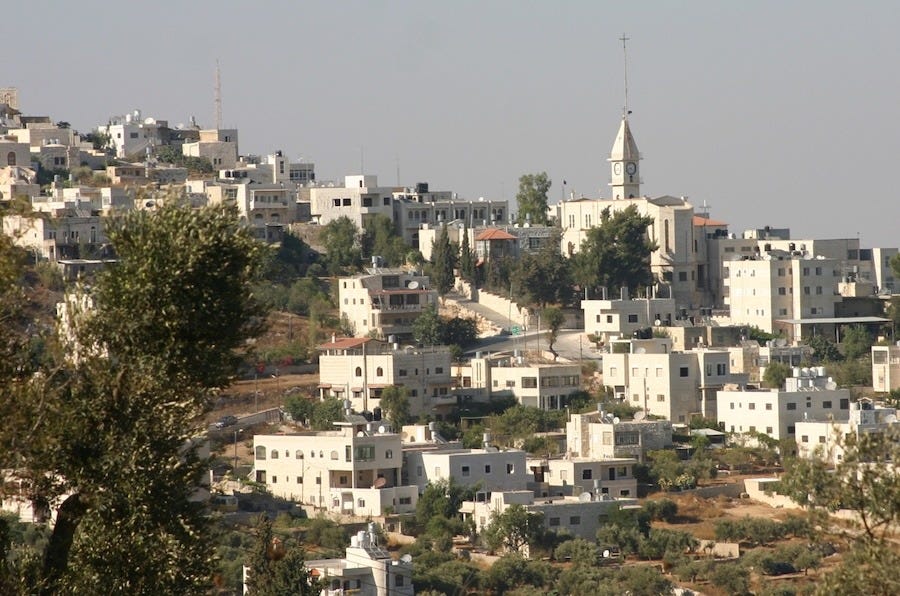
The pope made the appeal the day after Pizzaballa visited Taybeh, a Christian village located northeast of Ramallah, the de facto administrative capital of the Palestinian National Authority.
The cardinal’s visit was notable because it coincided with the major feast of the Assumption of the Blessed Virgin Mary and came amid significant upheaval in the village that is home to roughly 1,200 people.
What makes Taybeh unique? Why are senior Church leaders drawing attention to the situation in the village and the wider West Bank? And what’s likely to happen next?
Where is Taybeh?
One of the keys to understanding the situation in Taybeh and the West Bank as a whole is geography.
The West Bank is one of two main Palestinian territories, alongside Gaza. The West Bank is the larger of the two, both in terms of area and population. In contrast to Gaza, which is located on the Mediterranean Sea, the West Bank is landlocked.
The West Bank’s roughly 3.4 million inhabitants live in an area roughly the size of the U.S. state of Delaware, bounded to the west by Israel and to the east by Jordan, with the Jordan River and Dead Sea forming a considerable part of its eastern flank.
Detailed maps of the West Bank present it as an intricate patchwork of Palestinian-administered areas, Israeli-controlled areas, and settlements. This complexity reflects the territory’s turbulent modern history.
Jordan annexed the West Bank in 1950, but lost it to Israel in the 1967 Six-Day War. In the 1990s, Israel and the Palestine Liberation Organization agreed to divide the West Bank into three administrative zones.
The Palestinian National Authority is responsible for the civil administration and internal security in Area A, which includes the cities of Ramallah and Bethlehem and contains no Israeli settlements.
Area B, which covers smaller towns, is under Palestinian civil administration, while security responsibilities are shared between the Palestinian Authority and Israel.
Area C is under Israeli civil and security control.
Taybeh sits awkwardly within this classification. The built-up area of the village — about 35% of Taybeh’s land — is in Area B. But the remainder — around 65% — is in Area C and includes the Israeli settlement of Rimonim and a military base. This unusual territorial position is an important part of the context for recent events in Taybeh.
Christianity is an ancient presence in the village, which is traditionally identified with the biblical town of Ephraim, where Jesus stayed with his disciples after he raised Lazarus from the dead, as recounted in John 11.
A church dedicated to St. George is believed to have been built in Taybeh in the fifth century.
Alongside Eastern Orthodox Christians, the village is home today to Latin Catholics and Melkite Greek Catholics. The Latin parish, now centered on Christ the Redeemer Church, was established in 1860. Its 19th-century visitors included the future St. Charles de Foucauld.
While Christians are said to form the entire population of Taybeh and also have a significant presence in several smaller West Bank villages, they constitute less than 2% of the West Bank’s total population, which is predominantly Muslim.
Taybeh’s population is in decline because of emigration and a relatively low birth rate.
—
What’s happening now?
Taybeh is often described as the West Bank’s only remaining Christian village. That is why what occurs there creates ripples throughout the wider Christian world.
Global attention has focused on the village since June 2025, when armed Israeli settlers reportedly attacked the nearby Palestinian village of Kafr Malik before moving toward Taybeh, where vehicles were set on fire.
In July 2025, a fire that Christian leaders attributed to settlers broke out near the ruins of the ancient St. George Church and a nearby Byzantine-era Christian cemetery. Jerusalem-based Church leaders including Cardinal Pizzaballa and the Greek Orthodox Patriarch Theophilos III later visited the village in a show of solidarity.
Further incidents were reported during the summer of 2025, with residents accusing settlers of increasing pressure on the village through incursions.
Vatican News reported a new surge in tensions in March 2026. It quoted Fr. Bashar Fawadleh, the pastor of Christ the Redeemer Church since 2021, as saying that incursions had shifted from the east of the village to the west, where critical infrastructure is located.
In June 2026, Fawadleh accused settlers of impeding firefighters seeking to put out a blaze near the village.
According to the Latin Patriarchate, the Israeli military issued an order in July 2026 declaring parts of Taybeh a closed military zone for Israelis and foreigners, amid concerns about further incursions.
In its report on Pizzaballa’s Aug. 15 visit to Christ the Redeemer Church, the Latin Patriarchate highlighted what it suggested was an ambiguity in the order.
It said the village’s designation as a closed military zone “raised questions about access to Taybeh by pilgrims, visitors, journalists, volunteers and other foreigners.”
“Its wording does not explicitly clarify whether the stated exceptions apply to Israelis residing in settlements or outposts within or around the closed area, leaving part of its scope in need of official clarification,” it commented.
In his homily, Pizzaballa assured local Christians of the Latin Patriarchate’s ongoing solidarity.
“We will continue to do everything within our power to preserve the ecclesial presence here, at every level throughout the Holy Land,” he said.
At the same time, he acknowledged that the Church did not have the power to resolve the complex political and territorial questions embroiling Taybeh’s residents.
“I may not have answers at the human and worldly level, but I believe in God. And I am certain that, in Him, we can continue to give birth to life, even here in Taybeh,” he reflected.
What’s next?
Cardinal Pizzaballa frankly acknowledged that Taybeh’s residents are living through a time of great uncertainty.
It’s unclear how long the village will remain a closed military zone. But, as the Latin Patriarchate observed, there are unresolved questions about precisely who can come and go from Taybeh.
It is also unknown what will happen when the designation is eventually lifted. Will settler pressure have receded or return with new force?
The unpredictability of life in Taybeh will inevitably raise the question of emigration for young families. Should they stay and preserve a distinctive Christian presence in the West Bank or move to a new place with fewer restrictions and a greater chance of prosperity?
Taybeh’s mayor estimated in 2010 that thousands of former residents had emigrated to the U.S., Chile, and Guatemala. These established migration networks create a powerful pull factor for those who remain.
Taybeh’s fate is being watched closely well beyond the West Bank. Observers are presenting it as a symbol of the challenges facing deeply rooted but demographically challenged Christian communities across the Middle East.
In a recent interview, Fr. Fawadleh called for vigorous efforts to ensure that the village retains its unique identity until 2033 — when the Church will mark 2,000 years since Christ’s death and Resurrection — and beyond.
“It is a vital, foundational symbol for everyone, especially as we prepare for the 2033 Jubilee, marking two millennia since Jesus Christ walked this earth,” he said.
“Taybeh stands on the front lines of preserving Christianity here in the Holy Land. Jesus chose to seek refuge in Taybeh before his Passion, death, and Resurrection. We must remain a living testament to Christianity and its enduring presence in the Holy Land. The world must stand with Taybeh.”
Leo XIV and Cardinal Pizzaballa have shown clearly that they stand alongside the residents of Taybeh. Whether the world as a whole will do so remains an open question.

