Why did Cardinal Nzapalainga meet Leo XIV?
The audience came just two months after Leo XIV appointed a coadjutor for the 59 year old cardinal amid reports of a Vatican investigation.
Pope Leo XIV met Tuesday with one of Africa’s most prominent Catholic leaders.
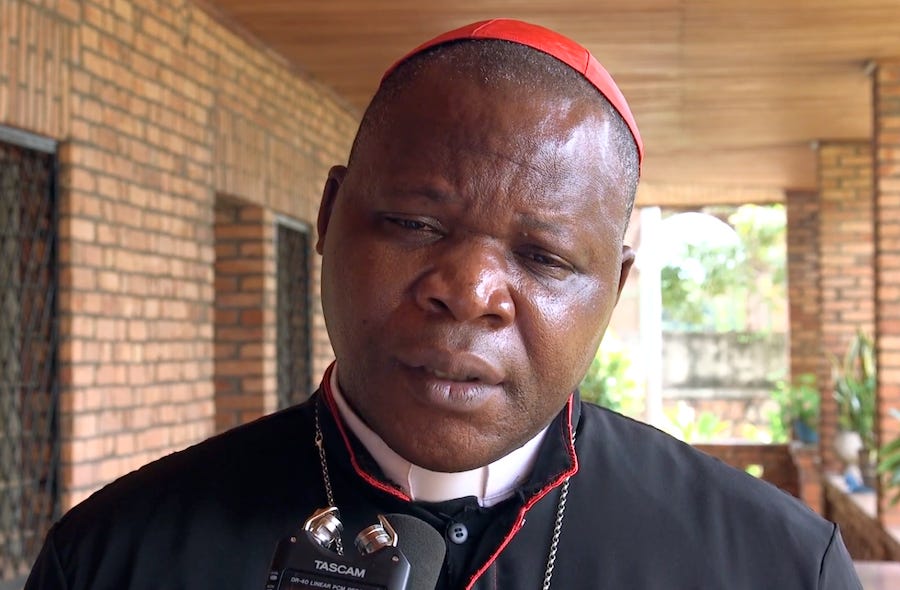
That, in itself, is not surprising. But the background to the June 30 encounter between Leo XIV and Cardinal Dieudonné Nzapalainga of Bangui, Central African Republic, is intriguing.
The private audience came just two months after Leo XIV appointed a coadjutor Archbishop of Bangui, even though Nzapalainga is only 59 years of age and would not ordinarily be expected to submit his resignation to the pope before 2042.
There was no public explanation for the unusual appointment, which came after uncorroborated reports of a Vatican investigation into an alleged crisis in the Central African Church and unconfirmed rumors that the Holy See had requested Nzapalainga’s resignation.
Who is Cardinal Nzapalainga? What are the alleged concerns? And what might happen next?
Who is Cardinal Nzapalainga?
Cardinal Dieudonné Nzapalainga is an internationally renowned champion of peace and reconciliation in the Central African Republic, a landlocked French-speaking nation of more than 5 million people that has suffered civil war for the past 13 years.
Nzapalainga was born in Mbomou, in the southeast of the country, in 1967. His seminary training took place not only in his homeland but also in Cameroon and Gabon. He joined the Spiritans (Holy Ghost Fathers) and made his perpetual vows in 1997.
He was ordained a priest a year later in the Central African Republic, spending the next seven years studying and serving in France. He returned home in 2005 to work as the Spiritans’ regional superior and a pastor in Bangui, the capital city. Civil war had broken out the year before, ending with a fragile peace agreement in 2007.
In 2009, the then-Archbishop Robert Sarah led a Vatican investigation into the conduct of Central African clergy that led to the resignation of the 54-year-old Archbishop Paulin Pomodimo of Bangui. Pope Benedict XVI named Nzapalainga as apostolic administrator of the Bangui archdiocese.
The German pope appointed Nzapalainga as the new Archbishop of Bangui in 2012, months before civil war broke out again. Nzapalainga was also elected president of the Central African bishops’ conference, a post he held for a total of six years.
In 2015, Nzapalainga welcomed Pope Francis to Bangui to open a Holy Door ahead of the Year of Mercy. It marked the first papal visit to the Central African Republic and the first to an active war zone. A year later, the Argentine pope named Nzapalainga a cardinal.
On Nov. 19, 2016, Nzapalainga became the first citizen of the Central African Republic to receive the red hat. At the age of 49, he also became the youngest member of the College of Cardinals.
What are the alleged concerns?
Reports of a new Vatican probe into the Catholic Church in the Central African Republic appear to date back to March 2026.
RJDH, one of the African nation’s best-known domestic news outlets, published a report March 17 headlined “Central African Republic: The Vatican launches an investigation into the country’s Catholic Church.”
Citing “well-placed sources,” the report said that the Vatican had opened an inquiry in response to allegations of “serious irregularities in the governance of the Catholic Church in the Central African Republic.”
The report said that, as in the earlier case, the Holy See’s investigation was being coordinated by the now-Cardinal Robert Sarah.
“The prelate spent time very discreetly in the Central African Republic where, according to information obtained by RJDH, he met with several prominent individuals and organizations,” it said, indicating the visit took place late February.
The news website quoted an anonymous source as saying: “There have been reports, particularly concerning the administrative management of certain dioceses, the misappropriation of funds, and conflicts of interest. Those were the issues that the discussions focused on.”
RJDH said the Vatican fact-finding mission also received input from representatives of the pro-government Galaxie platform, which, it noted, had been highly critical of Nzapalainga, as well as Bishop Bertrand Guy Richard Appora-Ngalanibé, O.P., of Bambari and Bishop Nestor-Désiré Nongo-Aziagbia, S.M.A., of Bossangoa.
The report highlighted differences of opinion within the local Church about whether the Vatican investigation would lead to significant changes. It quoted a nun as saying that “there will be sanctions,” as seen in 2009. But a Church analyst told RJDH the Vatican would rigorously check allegations before making any decisions and nothing could be firmly predicted.
The RJDH report has not been independently confirmed by the Holy See or international Catholic media.
A March 19 post on a Central African Facebook group responded to the RJDH article by lamenting the state of the local Church. It argued that dioceses were marred by serious governance issues, including a lack of transparency, poor management, and alleged corruption.
The post’s author also claimed that clergy were demoralized by internal dysfunction and divisions, including along ethnic lines. The post speculated that foreign clergy would be given the task of overhauling the management of the local Church, which it argued would be a humiliation for Central African Catholics. For context, just over half of the country’s diocesan bishops are foreign-born.
On April 14, the website Corbeau News Centrafrique published an article headlined “Cardinal Dieudonné Nzapalainga’s uncompromising stance irritates the Vatican.”
The site, which is highly critical of the Central African Republic’s government, claimed that Cardinal Robert Sarah had visited the country in February at the request of Pope Leo XIV to investigate reports of division within the local Church.
Corbeau News Centrafrique further alleged — without providing evidence — that Archbishop Giuseppe Laterza, the apostolic nuncio to the Central African Republic, asked Nzapalainga to tender his resignation or face removal.
The website suggested that the cardinal responded by promising to submit his resignation on Holy Thursday (April 2). But when he visited the nunciature that day, he supposedly presented a sealed envelope addressed solely to the pope and allegedly refused an offer to dine with nunciature staff.
“Since that day, the Holy See has taken note of the rebellion of the Cardinal Archbishop of Bangui and is trying to find out who is advising him to expose the nunciature and the Holy See in public,” it claimed.
The Corbeau News Centrafrique article was picked up by English-language Catholic media, but its contents remained unverified.
It would be tempting to dismiss these reports and rumors as thinly sourced gossip. But it’s less easy to discount them entirely following a Vatican announcement April 25.
The Holy See press office announced that Pope Leo XIV had appointed the 54-year-old Jesuit Fr. Joseph Samedi as coadjutor archbishop of Bangui.
At the same time, the pope shook up the structures of the Central African Church by erecting the new ecclesiastical province of Berbérati and naming the Ghanaian-born Bishop Dennis Kofi Agbenyadzi, S.M.A., who has led the Diocese of Berbérati since 2012, as the province’s metropolitan archbishop.
Previously, all nine dioceses in the Central African Republic belonged to the Ecclesiastical Province of Bangui. The move transferred four dioceses to the new province, significantly reducing the Bangui province’s area of oversight.
The coadjutor appointment and the erection of the new province represented a significant Vatican intervention in the local Church. But the Holy See did not say the changes were linked to any investigation or disciplinary process. So that remains conjecture.
It’s also important to note that Nzapalainga appears to have made no public comment on the local media reports or the Vatican changes. He seems to be continuing to perform his duties as usual. On May 30, for example, he celebrated Mass at Bangui’s Our Lady of the Immaculate Conception Cathedral, marking the end of the Marian month.
As politics and religion overlap in the Central African Republic, local reporting about Nzapalainga may be influenced, to some degree, by underlying theological and ethnic tensions within the Church, as well as broader political currents in Central African society.
What might happen next?
In an interview with Vatican media after his appointment as Bangui’s coadjutor Archbishop Joseph Samedi suggested his new role was daunting.
“I accepted this mission with faith and discernment. I’m already asking myself questions about what I’ll need to do as coadjutor bishop, but I’m not troubled by it,” he commented.
Noting that a coadjutor typically works alongside a diocesan bishop before ultimately succeeding him, Samedi said: “At first, we’re going to work together. I need to learn from him how to manage a diocese, what the challenges are, and how to meet them. I have a lot to learn.”
He added: “The first thing is to learn, not to rush. He’s going to show me what needs to be done, how to move forward, how to manage people and difficulties.”
The interview did not address why a coadjutor archbishop was needed in Bangui in the first place. That is far from obvious as Cardinal Nzapalainga would ordinarily lead the Bangui archdiocese for another 15 years before he turns 75, the age at which diocesan bishops are expected to submit their resignations to the pope.
Beyond Bangui, Nzapalainga also has a notable profile in the worldwide Church. He may no longer be the world’s youngest cardinal, but he will continue to be eligible to vote in a conclave until 2047, when he turns 80. He is also one of the Church’s most effective spokesmen for peace, forgiveness, and interreligious dialogue — themes that resonate with the pontificate of Leo XIV.
Given there are no reports that Nzapalainga is suffering from ill health, it’s puzzling that he has been given a coadjutor at this early stage in his tenure and also had four dioceses removed from his overall supervision.
As for Nzapalainga’s June 30 private audience with Leo XIV, we have no idea what the two men discussed. It would be surprising if the recent changes did not come up, but such meetings are, by their nature, confidential.
Are the moves announced in April the prelude to an even bigger reorganization of the Church in the Central African Republic? Or do they mark the conclusion of the investigative process? That will become clearer with time.
Meanwhile, Central African Catholics continue to confront far graver issues.
Fr. Crépin Martial Monga, a priest of the Diocese of Bangassou who coordinated a local peace and reconciliation committee, was killed June 29 outside his parish residence in the town of Zemio.
The murder is a reminder of the deadly risks faced by Central African clergy as they minister to the country’s roughly 1.5 million Catholics amid civil war and crushing poverty.
The rumored upheaval within the local Church must be another difficult cross for them to bear.

