Why did Cardinal Zuppi return to Ukraine?
The Vatican peace envoy first visited the nation in 2023. What drew him back?
Vatican peace envoy Cardinal Matteo Zuppi returned to Ukraine this week for a four-day humanitarian mission.
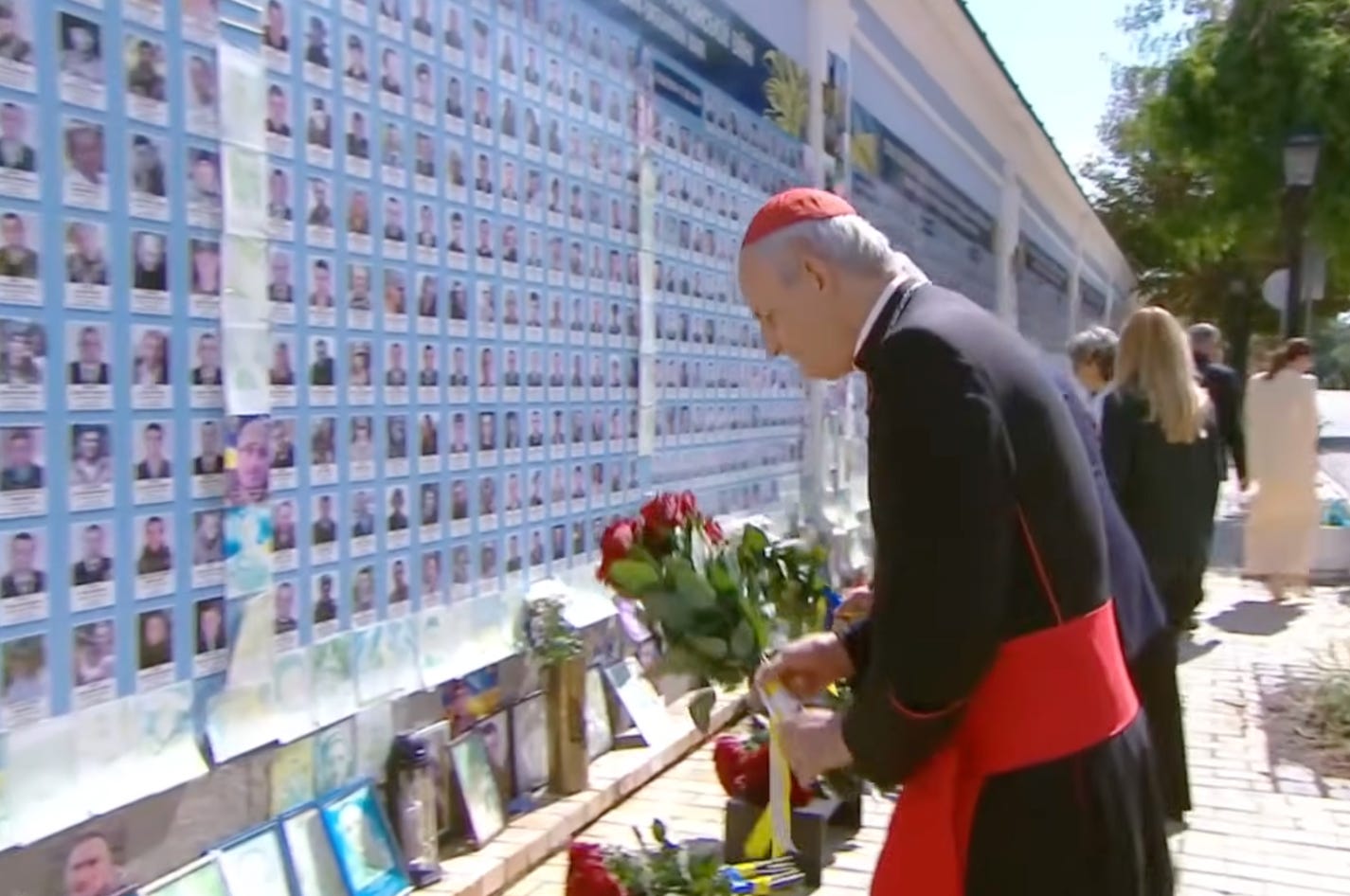
Zuppi, the president of the Italian bishops’ conference, arrived in Lviv, western Ukraine, on the evening of July 13, before embarking on a hectic schedule of visits and meetings that ended July 16, with a drive from the capital, Kyiv, to an airport in Poland and a flight back to Rome.
Zuppi was continuing a peace mission entrusted to him by Pope Francis in May 2023. The Archbishop of Bologna formally took up the role with a June 5-6, 2023, visit to Ukraine, during which he met with President Volodymyr Zelenskyy.
The trip was followed by flights to Moscow, Washington, D.C., and Beijing later in 2023, and a further visit to Moscow in 2024. But a return trip to Kyiv had to wait until this week.
Why did the Italian cardinal make a second journey to Ukraine? What happened over the four days? And what does the trip say about the current state of the Vatican’s peace mission?
Why now?
The Russo-Ukrainian war, which began with the annexation of Crimea in 2014 and escalated with Russia’s full-scale invasion in 2022, has claimed an estimated 350,000 to 500,000 lives and left more than two million people injured.
During the war, Russia has forcibly relocated nearly 20,000 Ukrainian children to areas under its control, claiming to do so for security reasons. The country is also holding around 7,000 Ukrainian prisoners, while roughly 4,000 Russians are in captivity in Ukraine.
The war continues to claim new victims every day. Yet peace negotiations appear to be at a standstill, despite considerable initial efforts by the Trump administration to reach a resolution.
Europe’s deadliest conflict and worst humanitarian crisis since the Second World War shows no signs of ending. The slim prospects for progress may have prompted Pope Leo XIV and his advisers to renew the Vatican’s peace mission. But that is only conjecture, because neither the pope nor Cardinal Zuppi have explained exactly why a new trip to Kyiv was deemed necessary now.
What happened?
Cardinal Zuppi’s initial stop on the first full day of his trip to Ukraine was a visit to the Zakhid-1 penal colony in the Lviv region. The facility houses inmates of 53 different nationalities, including Russian prisoners of war.
That the cardinal chose the penal colony as his first port of call suggests it was a very significant part of his trip. Zuppi himself has not spelled out the thinking behind the choice. But both the Vatican and Ukrainian authorities possibly hoped to encourage Russia to respond by allowing a reciprocal visit to Ukrainian prisoners of war held in Russian-controlled territory.
Video footage showed Zuppi inspecting conditions at the institution, which contained rows of crisply made beds and neatly packed boxes of prisoners’ possessions. The cardinal presented each inmate with three gifts: a keychain, a holy card featuring the Marian icon Salus Populi Romani, and a photograph of Pope Leo XIV. Zuppi said he hoped the prisoners would soon be able to return home to Russia and attach their house keys to the chain, would draw hope from the image of the Virgin Mary, and know that the pope was praying for the war to end.
Later that day, Zuppi met with Maksym Kozytskyi, the governor of the Lviv Regional State Administration, who said the Holy See had an important role to play in facilitating the return of Ukrainian prisoners of war from Russia. Kozytskyi also invited Pope Leo to visit the Lviv region. Ukraine has only received one previous papal visit, from Pope St. John Paul II in 2001.
Zuppi ended July 14 at the Lviv headquarters of the Community of Sant’Egidio, the Rome-based peace organization with which he is closely connected.
The cardinal spent the next day in Kyiv, beginning with a Mass at the apostolic nunciature celebrated by nuncio Archbishop Visvaldas Kulbokas.
July 15 marked the feast of Vladimir (Volodymyr) the Great, the saint credited with the Christianization of Kievan Rus’, the early medieval state located in Eastern Europe. Since 2024, the Day of Ukrainian Statehood has also fallen on July 15.
Zuppi was a guest of honor at a Statehood Day ceremony in St Michael’s Square, attended by Zelenskyy and an array of civic and religious dignitaries. Zuppi read out a prayer in halting Ukrainian.
It said: “I raise my prayer to You, Almighty God, for dear Ukraine. In Your mercy, grant a just peace; may prisoners return home, children embrace their families again, the missing be found, and all be able to weep before the bodies of their fallen loved ones.”
“Inspire in each of us the courage and wisdom to be peacemakers, and the determination to overcome evil with good. St. Volodymyr, pray for us. Most Holy Mother of God, intercede for us.”
Zuppi then embarked on a rapid series of meetings. Among those he spoke with were Andrii Sybiha, Ukraine’s Foreign Minister, Kyrylo Budanov, the Head of the Office of the President of Ukraine, and Iryna Vereschuk, Budanov’s deputy.
The cardinal also met with Dmytro Lubinets, the Ukrainian Parliament Commissioner for Human Rights, and Oleh Ivashchenko, the head of military intelligence and chief of the Coordination Headquarters for the Treatment of Prisoners of War.
In addition to these officials, Zuppi held conversations with citizens whose family members are being held prisoner in Russia.
What’s next?
Three clear requests emerged during Cardinal Zuppi’s four-day trip.
The first was an appeal for the Holy See to help to achieve an “all-for-all” exchange of prisoners of war between Russia and Ukraine.
The second was a call for further Vatican efforts to secure the return of more children from Russian-controlled territory to Ukraine.
The third was for Rome to support Ukrainian demands for Russia to allow access to its prisoner of war camps to verify conditions, amid reports of systematic torture and ill-treatment.
All three requests would be extremely challenging to realize.
Since 2022, the Holy See has sought to facilitate prisoner swaps between Russia and Ukraine, with low visibility but a certain degree of success. Pope Francis helped to establish a mechanism by which lists of Ukrainian prisoners were presented to the Vatican, which passed them to Russia’s ambassador to the Holy See for conveyance to Moscow. The mechanism presumably worked in the other direction as well, enabling Russia to secure the return of some of its captured military.
But large-scale prisoner swaps have generally been credited to the mediation of other countries, such as Saudi Arabia, Turkey, the UAE, and the U.S. An “all-for-all” exchange would likely require the involvement of these or other powers, rather than simply the Holy See alone. Ultimately, it could be part of a deal to freeze or end the conflict, rather than a goal that can be achieved while fighting continues.
The Vatican probably can, however, step up its work to return children from Russia to their Ukrainian homeland. Zuppi’s 2023 travels helped to create a mechanism by which Ukrainian and international humanitarian bodies can raise individual cases with the Russian authorities. According to the Italian bishops’ conference’s newspaper Avvenire, this arrangement has helped more than 1,500 minors to leave Russia.
While Russia has granted bodies such as the Red Cross some access to its POW camps, many sites remain off-limits. One way the Vatican could help verify the conditions of Ukrainian prisoners would be for Cardinal Zuppi to make a parallel trip to Russia that includes a visit to a penal colony. But that would obviously require an invitation from the Russian government, which might not be eager to turn the international spotlight on its camps.
All in all, Zuppi’s latest visit appears to have been an attempt to revitalize humanitarian exchanges between Ukraine and Russia despite a grinding war with no end in sight.
During the trip, the cardinal said: “Even one soldier, one civilian or one child reunited with their family is a step towards peace. Every possible effort will be made. This is the will of Leo XIV. Humanitarian commitment must stand above political or military considerations.”
The prolonged conflict suggests the Vatican is probably right to be focused on small gains, rather than striving for big, headline-grabbing breakthroughs.
