Why did Moscow’s Archbishop Pezzi resign?
Pope Leo XIV has accepted the resignation of the archbishop who served as the de facto leader of Russia’s Catholic community for almost 20 years.
Pope Leo XIV accepted Saturday the resignation of the Italian archbishop who has served as the de facto leader of Russia’s Catholic community for almost 20 years.
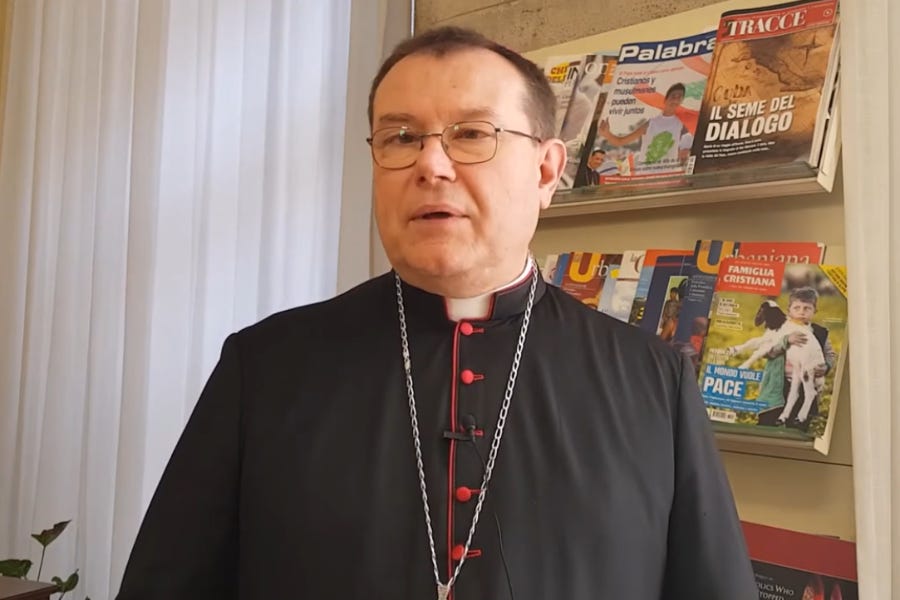
The Vatican announced May 2 that the pope had approved the resignation of Archbishop Paolo Pezzi, F.S.C.B., as head of the Archdiocese of the Mother of God at Moscow.
The move raised eyebrows because Pezzi is only 65 years old — meaning he could have served another 10 years before reaching the standard retirement age for diocesan bishops.
As well as accepting Pezzi’s resignation, Pope Leo named the Russia-born auxiliary Bishop Nicolai Dubinin, O.F.M. Conv., as apostolic administrator of the archdiocese.
Those are the plain facts, but do we know anything more about the leadership transition in Moscow? Before we answer that, let’s take a brief look at the archdiocese’s history and Pezzi’s tenure.
The birth of an archdiocese
The Catholic presence in Moscow dates back to the 14th century, when the city was ruled by princes. But the Catholic Church’s longstanding pastoral structures in Moscow were demolished following the Russian Revolution in 1917.
The city hosted a 1923 show trial of Russia’s Catholic leadership on charges of counter-revolutionary activities. Two churchmen — Archbishop Jan Cieplak and his vicar general Msgr. Konstanty Budkiewicz — were sentenced to death, while 15 others were sent to the Gulag, the notorious network of forced labor camps.
The country’s majority Russian Orthodox Church was also dismantled, with around a thousand Orthodox clergy executed at a single site in the Moscow region: the Butovo firing range, later known as the “Russian Golgotha.”
Following the collapse of the Soviet Union in 1991, Pope John Paul II faced a conundrum. He needed to reestablish pastoral structures in the Russian Federation. But he knew the step would be opposed by the Russian Orthodox Church, a fragile body emerging from the most painful episode in its history.
The Russian Orthodox Church argued that Russia — the world’s largest country by geographical area — was its “canonical territory.” But the Catholic Church, which believes it has a duty to shepherd Catholics wherever they are found in the world, did not recognize the concept.
Before the Russian Revolution, Moscow’s Catholics belonged to the Archdiocese of Mohilev, which stretched from the Baltic Sea in the west across the entire land mass of Russia to the Pacific Ocean. But the Vatican couldn’t simply restore the Mohilev archdiocese because the Soviet Union had fragmented into independent states, each of which logically needed its own jurisdiction.
On April 13, 1991, the Polish pope made a decisive move. He established the Archdiocese of Minsk-Mohilev, based in the capital city of the newly independent Belarus. In Russia itself, he created the Apostolic Administration of European Russia, centered on Moscow, and the Apostolic Administration of Siberia, covering eastern Russia.
In 2002, John Paul II further altered Russia’s Catholic jurisdictions, establishing the Metropolitan Archdiocese of the Mother of God at Moscow and three suffragan dioceses: St. Clement at Saratov, St. Joseph at Irkutsk, and the Transfiguration at Novosibirsk.
The new jurisdictions were carefully named to avoid antagonizing the Russian Orthodox Church, which was alert to what it perceived as Catholic expansionism as it struggled to rebuild after communist persecution. Creating a Catholic Archdiocese of Moscow would have been insensitive, so the Polish pope opted instead for the Archdiocese of the Mother of God at Moscow, employing a Marian title favored by Orthodox Christians.
Nevertheless, the 2002 changes prompted protests from the Holy Synod of the Russian Orthodox Church, which denounced what it called “a challenge to Orthodoxy.”
Archbishop Tadeusz Kondrusiewicz, a Belarusian with Polish ethnic roots, initially led the Moscow archdiocese. But he was named Archbishop of Minsk-Mohilev in 2007. He was succeeded in Moscow by Archbishop Pezzi, a member of the Fraternity of St. Charles Borromeo, a priestly society linked to Communion and Liberation. Pezzi had served as a missionary in Russia in the turbulent early 1990s and gained experience of Catholic-Russian Orthodox relations.
The replacement of the formidable Kondrusiewicz with the milder Pezzi was seen as a diplomatic concession by the Vatican to the Russian Orthodox Church. The change reportedly provoked mixed reactions among Russian Catholics, some of whom preferred Kondrusiewicz’s boldness to Pezzi’s more diplomatic approach.
The Italian archbishop’s patient outreach to the Russian Orthodox was hampered by events beyond his control, principally political and ecclesial tensions in Ukraine, which built to a feverish intensity following the Russian seizure of Crimea in 2014.
Pezzi welcomed the historic meeting between Pope Francis and Patriarch Kirill of Moscow in Cuba in 2016. But the encounter did not usher in a new era in Catholic-Russian Orthodox relations. Instead, Rome-Moscow ties foundered as the conflict in Ukraine intensified. They reached a low point in 2022 when Pope Francis said that Patriarch Kirill risked becoming “Putin’s altar boy” because of his uncritical support of Russia’s full-scale invasion of Ukraine launched that year.
There was little Pezzi could do except concentrate on the pastoral welfare of Russian Catholics. As Moscow archbishop, he oversaw the care of around 70,000 Catholics in roughly 60 parishes. The trouble was that his archdiocese is one of the geographically largest in the world, approximately four times the size of Texas. He had at his disposal about 100 priests. He was only given an auxiliary bishop — Bishop Dubinin — in 2020.
Perhaps the archdiocese’s vast sweep didn’t matter when Pezzi began to serve as Moscow’s Catholic archbishop as an energetic 47-year-old. But the responsibility likely took its toll as he entered his 60s. In 2020, he was forced to self-isolate after falling ill with COVID-19.
Not long after he recovered, Russia was placed on a war footing and its citizens were subjected to ever-tightening censorship. As a public figure, Pezzi needed to choose his words extremely carefully. Anyone resident in Russia who expressed hopes for peace could find themselves open to the charge of “discrediting” the armed forces, which carried a penalty of up to 15 years in prison.
A ‘midday shock’
Archbishop Pezzi’s resignation came as a surprise not only to Vatican watchers but also to senior members of Russia’s Catholic community.
Bishop Clemens Pickel, head of the Diocese of St. Clement at Saratov, responded with a blogpost titled “Midday shock,” referring to the Vatican’s noon daily press bulletin that announced the resignation.
Pickel wrote that, since the archbishop had not reached the age limit of 75, the only possible ground for his resignation was Canon 401 § 2 of the Code of Canon Law, which says: “A diocesan bishop who has become less able to fulfill his office because of ill health or some other grave cause is earnestly requested to present his resignation from office.”
Sure enough, the Archdiocese of the Mother of God at Moscow confirmed on its website that Pezzi’s resignation was accepted under Canon 401 § 2.
“The decision by bishops to resign due to health reasons or other circumstances that prevent them from adequately fulfilling their ministry — a rarity in the past — has become more common in recent times,” the archdiocese commented.
It urged local Catholics to unite in a prayer of thanksgiving for Pezzi’s “long and faithful service,” but presented no specific rationale for the resignation.
In a May 2 statement to the archdiocese, the apostolic administrator Bishop Dubinin praised Pezzi’s 18-year tenure, saying the archbishop exemplified the good shepherd who lays down his life for his sheep. He invited Catholics to attend a May 30 thanksgiving Mass that Pezzi will celebrate at Moscow’s Cathedral of the Immaculate Conception.
Knowing that the resignation was offered under Canon 401 § 2 does not in itself clarify the decision. The canon has been cited in a wide variety of situations, from brain injuries to burnout to administrative failures to the mishandling of abuse cases.
In the absence of an official explanation, Catholic media are seeking to fill the void. The Spanish website InfoVaticana suggested Pezzi was worn down by his vast responsibilities.
It said: “According to sources consulted by InfoVaticana, Pezzi’s departure is mainly due to accumulated personal wear and tear after years in a particularly tough posting. There are no consistent indications of disciplinary measures or open conflicts that explain the decision, which must be interpreted in terms of institutional fatigue rather than a specific crisis.”
Meanwhile, The Tablet magazine reported May 4 that Pezzi had addressed the circumstances of his resignation at a Mass on the day of the announcement. The archbishop reportedly said that, “to make it clear and not spread any conspiracy theories or incorrect rumors, I want to announce that I have resigned because of my health, which does not allow me to manage this beloved, beautiful diocese as I should.”
Pezzi’s comments were first covered by the Belarusian website katolik.life, citing a Russian Catholic journalist based in Moscow.
Pezzi reportedly said he would continue living in Moscow in retirement, serving at the 52-year-old Dubinin’s disposal.
The archbishop also spoke about the Devil’s role in spreading divisions, which katolik.life interpreted as a reference not only to internal Church matters but also Russia’s wider socio-political situation.


