Why did the Vatican dismiss an AfD politician’s appeal?
A decree from the Dicastery for Clergy obtained by The Pillar dismissed the appeal as 'legally and factually unfounded.'
The Vatican has weighed in on a closely watched case in Germany, in which a politician was dismissed from a parish post because of his membership in the Alternative for Germany party.
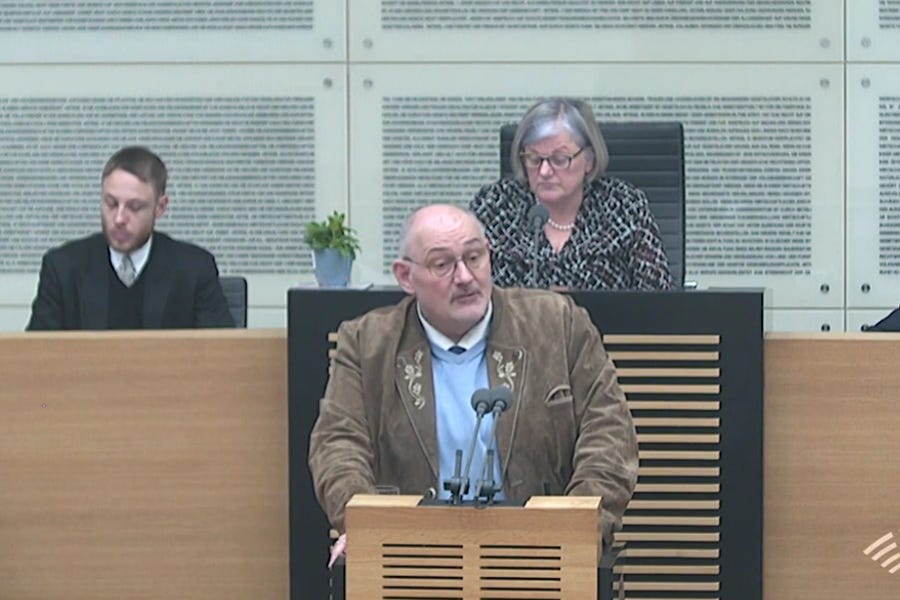
In a decree from the Dicastery for Clergy obtained by The Pillar, the Vatican dismissed the former parish employee’s appeal against his dismissal based on his political affiliation as “legally and factually unfounded.”
The case is seen as a litmus test for the German Church’s position that support for “extremist” political stances is incompatible with voluntary professional or voluntary service in the Church.
How did the case come about? What did the Vatican say? And what’s likely to happen next?
What’s the background?
On Feb. 22, 2024, Germany’s Catholic bishops unanimously approved the release of a declaration stating that “racial [völkisch] nationalism” and Christianity are incompatible.
The statement was prompted by a surge in support for the Alternative for Germany party.
The AfD was founded in 2013 by disillusioned members of the center-right Christian Democratic Union of Germany, with a platform of abolishing the euro, the currency of 20 European Union member states.
Following the arrival of a record 1.1 million asylum seekers in 2015, the coronavirus pandemic, the Ukraine war, and a cost-of-living crisis, the AfD evolved into what many commentators describe as a far-right party — though supporters dispute the label.
The bishops’ 2024 declaration argued that the AfD had undergone “several waves of radicalization” and was now “dominated by a racial-nationalist attitude.”
“We say with all clarity: racial nationalism is incompatible with the Christian image of God and man,” the bishops wrote.
“Right-wing extremist parties and those that are rampant on the fringes of this ideology therefore cannot be a place of political activity for Christians and cannot be voted for.”
“Moreover, the dissemination of right-wing extremist slogans — including racism and antisemitism in particular — is incompatible with professional or voluntary service in the Church.”
Less than two months after the declaration, Christoph Schaufert was removed from his post on the parish administrative council of St. Marien in Neunkirchen, a city in the southwestern German state of Saarland.
Schaufert, a 55-year-old father of four who was baptized in the St. Marien parish, joined the AfD in 2016, after 20 years as a member of the center-right CDU and 10 years without a party affiliation. He has represented the AfD in the Saarland state parliament since 2022.
He was the first prominent AfD politician to be dismissed from a Church office since the bishops’ statement.
St. Marien has both a parish council, responsible for pastoral care, and a parish administrative council, which oversees parish assets and personnel. Both bodies had appealed on Feb. 29, 2024, to the vicar general of the local Trier diocese to review whether Schaufert should remain in his voluntary, elected post, in the wake of the bishops’ declaration.
In a letter dated April 15, 2024, vicar general Fr. Ulrich Graf von Plettenberg informed Schaufert that he was dismissed with immediate effect from the administrative council and barred from serving on any parish council or administrative council in the Trier diocese.
Von Plettenberg made the decision public on April 17, 2024. He said that before taking the decision to remove Schaufert, he had consulted extensively within the Trier diocese, including with its Bishop Stephan Ackermann, as well as with Church officials in other dioceses.
He said he also had a face-to-face meeting with Schaufert.
“From the conversation with Mr. Schaufert, I can say that he is sticking to the high-ranking AfD offices and functions that he currently holds,” von Plettenberg said.
“Even if he does not position himself publicly in a way that is vulnerable to attack, it remains the case that as a significant representative in the public eye, as the face of a party that represents attitudes that contradict the Christian view of humanity, he damages the credibility of the Catholic Church.”
“Therefore, I no longer see any basis of trust for further collaboration with him. That’s why I decided to grant the parish’s request.”
Von Plettenberg said he took the decision in accordance with the Diocese of Trier’s Church asset management law, an ecclesiastical law issued by the bishop.
The law says that the vicar general “can dismiss a member for good cause [aus wichtigem Grund], in particular for gross dereliction of duty or conduct that causes offense … and at the same time revoke his or her eligibility for election,” following hearings.
Von Plettenberg also took into account the German bishops’ 2024 declaration and the Basic Order of Church Service, an ecclesiastical employment law document.
The employment document says: “Activities hostile to the Church which, according to the specific circumstances, are objectively likely to damage the credibility of the Church may be subject to legal sanctions.”
Schaufert had the right to appeal within 10 days of the decision, first to the bishop and then to the Vatican’s Dicastery for the Clergy. He exercised this right on April 25, 2024.
On May 21, 2024, Bishop Ackermann rejected Schaufert’s appeal.
In a letter to the politician, he said that Schaufert’s role as an AfD representative in the state parliament of Saarland was “incompatible with the exercise of an elected office on the administrative board of a parish of the Diocese of Trier.”
Ackermann added that, in his opinion, Schaufert’s dismissal had been made “for good cause,” in line with the Church asset management law.
“Added to this is the massive loss of trust in the parish council associated with your involvement in the AfD,” the bishop wrote.
Ackermann insisted that Schaufert wasn’t dismissed simply for being an AfD member, but because he was an elected representative of the party and therefore identified with its policies.
According to canon 1737 of the Code of Canon Law, Schaufert had the right to make a hierarchical appeal to the Dicastery for the Clergy within 15 days of notification, which he made on May 31, 2024.
Meanwhile, in September 2024, the German bishops’ conference issued guidance to dioceses on dismissing supporters of “extremist” parties from Church positions.
The 36-page document said decisions should be made on a case-by-case basis, weighing the intensity of a person’s “extremist tendencies” and the prominence of the post he or she holds.

What did the Vatican say?
In late January 2026, German media reported that the Vatican had rejected Schaufert’s appeal.
But it was not until Feb. 4 that the reasoning for the decision became clear. The German Church’s official news website, katholisch.de, published a report that day, based on a copy of the full three-page ruling from the Dicastery for the Clergy.
The Pillar has also obtained a copy of the full document, which is dated Dec. 15, 2025, and has the protocol number 2024 2385.
The letter — signed by the dicastery’s prefect, Cardinal Lazzaro You Heung-sik, and adjunct undersecretary, Fr. Enrico Massignani — dismissed Schaufert’s appeal as “legally and factually unfounded,” and confirmed the decrees issued by the Trier’s vicar general and bishop.
In his appeal to the dicastery, Schaufert had argued that he was targeted “solely on the basis of his ‘group affiliation.’” He said he had neither made statements nor taken actions that were racist, misanthropic, xenophobic, or incompatible with the Christian understanding of humanity.
Katholisch.de observed that the dicastery did not engage with the substance of Schaufert’s argument. Instead, it focused on whether the decision to remove him from the Church post followed the correct administrative procedure, as set out in the Trier diocese’s Church asset management law, which says a vicar general can dismiss a member of an administrative council “for good cause.”
While the dicastery referred to the German bishops’ 2024 declaration and the Basic Order of Church service, the ruling did not analyze the documents.
Summing up its interpretation of the case, the dicastery wrote: “There is a ‘good cause’ that justifies the dismissal. Furthermore, there is a fear of a division within the parish. The decision of the diocesan authorities is a discretionary one. Following the established procedure, the Ordinary applies particular canon law, which he authentically interprets in his capacity as legislator.”
Katholisch.de commented: “The reasoning behind the decision is therefore very formal: The dicastery reviews each step and checks whether the established procedure was followed — and in this case in Trier, it was. The necessary individuals and bodies were consulted, the diocesan authorities identified a valid reason and justified the dismissal. The subsequent steps, including the hierarchical appeal, were also correctly followed.”
It added: “The decree primarily establishes the considerable discretion afforded to the diocesan bishop. What constitutes a good cause within the meaning of the law can be assessed by the diocesan bishop as legislator within the scope of his own discretion.”
What’s next?
Following the Dicastery for the Clergy’s decision, Schaufert has 60 days to appeal to the Apostolic Signatura, the Church’s highest administrative court.
But katholisch.de suggested the politician would not take the case further because he has announced his departure from the Church.
Schaufert told The Pillar Feb. 6 that he had left the Church “only in a purely formal sense” — suggesting he had formally disaffiliated from the Catholic Church in Germany by making a state-recognized declaration.
He said: “I am and remain Catholic. I continue to believe in Almighty God and His Only Begotten Son, Jesus Christ... — but I am no longer willing to continue supporting the German Catholic Church organization with my tax money (and this applies not only to my case but to many things in which the German Catholic Church, in its delusion of liberalism, is moving away from Catholic tradition and the universal Church).”
Katholisch.de concluded that the Vatican ruling was a mixed blessing for German Catholics.
On the one hand, dioceses will be relieved that it is legally permissible to remove AfD members from Church posts, provided the proper process is followed.
On the other, Catholics occupying Church posts may be concerned that the ruling gives bishops considerable freedom to determine what constitutes a “good cause” to dismiss them.
Meanwhile, in a sign of rising tensions between the German Church and the AfD, Magdeburg’s Bishop Gerhard Feige said Jan. 30 that the local Catholic Church would face an “existential” threat if the party wins state elections in Saxony-Anhalt in September.
The AfD in Saxony-Anhalt, which currently has a 13% lead over the CDU in polls, released a manifesto Jan. 23 that promised to support Germany’s smaller Christian communities, while cutting financial subsidies to the two biggest communities, the Catholic Church and the Protestant Church in Germany (a federation of 20 Lutheran, Reformed, and United regional churches).
The manifesto said: “Our desire to abolish the privileges of churches that levy church taxes does not mean that we reject the Christian faith — on the contrary. It is precisely because we recognize the importance of Christianity that we are targeting churches that levy church taxes, because the large churches are damaging the faith.”
“It is not without reason that they are losing more and more members, while many small churches and religious communities are experiencing a true renaissance of Christianity. We will develop instruments to promote these small churches.”
It added: “Free churches, Baptist congregations, and Orthodox churches practice an authentic and vital faith that supports the cultural change we are striving for in many ways.”
Bishop Feige said that if the AfD won the state election and carried out its threat to end state subsidies and the state collection of church tax, the consequences would be “dramatic.”
“We don’t have large reserves,” he said. “Should this happen, we would no longer be able to operate parishes, educational centers, and social services in the same way.”
Feige’s Magdeburg diocese, located in former communist East Germany, is one of the poorest in the country. Around 20% of the diocese’s budget comes from state subsidies.
The bishop said: “Until now, something like this was considered impossible. But it isn’t anymore. We now need to discuss this in the bishops’ conference. There’s an emergency system that kicks in if a diocese becomes insolvent. But that only provides temporary assistance. I hope it doesn’t come to that.”
Legal experts have argued it would be impossible for the AfD in Saxony-Anhalt to enact the changes.
But Feige commented: “Trump is currently demonstrating how it’s done. Facts are being created, and we could litigate for years, but the money would be gone.”
The Schaufert case and the looming confrontation in Saxony-Anhalt suggest the stakes are rising ever higher in the battle between the German Church and the AfD.

I think the AfD position of challenging the official Lutheran and Catholic government (i.e. supported by Church taxes) churches provokes a necessary question for German Christians. It is hard to imagine the Church's fear of AfD is not driven by the risk of losing tax revenue if AfD forms a government. I wonder if any CDU or SPD Catholic politicians have been tossed off parish councils for promoting abortion or same-sex marriage. (They must be a dime a dozen, like in the U.S.)
"a party that represents attitudes that contradict the Christian view of humanity."
Hmmm, I wonder if this will extend to individuals who support political parties with other attitudes that contradict Christian anthropology. I'm sure it will.