
A major new study of Catholics in Australia who do not regularly attend Sunday Mass has concluded that most participants still retain a deep connection with their faith.
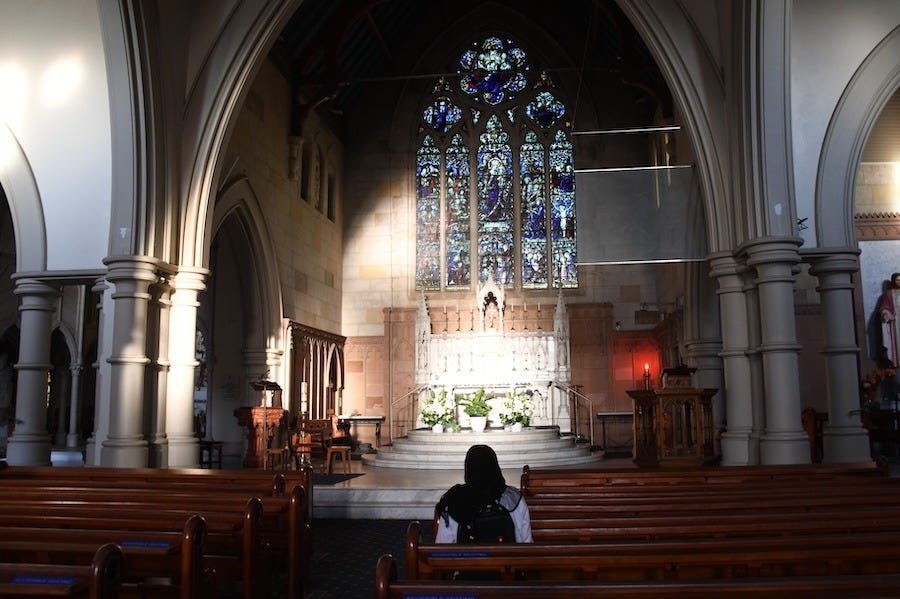
The 176-page report “Absent from the Table: Catholics in Australia Who Do Not Regularly Attend Sunday Mass,” published Oct. 7, found that 65% of study participants described faith as being very important in their lives, 64% said they prayed regularly, 55% affirmed the doctrine of the Real Presence, and 40% reported sharing their faith with others.
The findings suggest that irregular Mass attendance does not necessarily mean Catholics have left the Church behind. They also raise the question of why, if many survey participants remain attached to Catholic belief, Sunday Mass does not occupy a central place in their lives, since the Church makes it a matter of precept to attend.
Participants made a wide range of suggestions about how they could be drawn back to weekly attendance, including offering more convenient Mass times, shortening services, and improving liturgical music.
What’s the background to the report? What are its findings? And how are Australian Church figures responding to it?
What’s the background?
Australia is a country with 25.4 million people, according to the last census in 2021. Exactly 20% of the population identified as Catholics, down from 26% in 2006.
Summing up the trend, the new report said: “While the Catholic population grew in every Australian Census from 1911 to 2011 — reaching a peak of 5.4 million — the trend reversed in 2016 and then again in 2021, when the number of Catholics declined to 5,075,910.”
While Australia has seen significant immigration in recent decades, the proportion of Catholics born overseas has increased only slightly, from 23% in 2006 to 27% in 2021.
Mass attendance has declined, from 11.8% in 2016 to 8.2% in 2021. Massgoers are more likely to be older: 25.8% were over 70 and only 9.5% were aged 18 to 29 in 2021.
Given the growing disengagement from Mass, the Australian bishops’ conference commissioned the new report from the National Centre for Pastoral Research in Canberra.
The research built on the 2007 study “Catholics who have stopped attending Mass,” also commissioned by the bishops’ conference.
The new project’s initial phase consisted of an online survey of 1,963 self-selected adult Catholics, across seven Australian states and territories. The second phase comprised in-depth interviews with 67 volunteers from the first phase.
The report noted that because the sample was self-selected its findings could not necessarily be seen as representative of the wider Catholic population.
“Despite these limitations, the findings offer important insights into factors influencing Mass attendance among Catholics in Australia and their engagement with the Church,” it said.
What are the findings?
The report identified 14 “participant-centered” and “Church-centered” reasons for irregular attendance, following a classification introduced in the 2007 study.
The participant-centered reasons were: going to Mass was not a priority; a crisis of faith; family or household-related issues; traveling, weather, or temporary illness; chronic illness, infirmity or old age, transport; and attendance at another time or elsewhere.
The Church-centered reasons were: liturgical issues; challenges with the pastor and other clergy; the misuse of power and authority in the Church; structural factors; concerns related to the parish as a community; disappointment with the Church; lack of inclusivity or a sense of being excluded by Church rules; and a perception that the Church is irrelevant to life today.
The participant-centered reasons were largely consistent with those identified in the 2007 study, while the Church-centered reasons were more varied in the 2026 report, with liturgical issues taking on greater prominence.
The new study also identified several new minor themes within the broader reasons for irregular attendance, including changes in Mass attendance habits since COVID-19, challenges with priests born in other countries, and Mass not being offered weekly.
The report found that study participants continued to engage with their faith despite their irregular Mass attendance.
“Around two-thirds said faith was very important, and more than three-quarters affirmed belief in Jesus as the Son of God. Similarly, over two-thirds described God as very important,” the report said.
It added: “Nearly two-thirds (64%) prayed regularly, and many expressed Catholic identity through sending their children to a Catholic school (44%), sharing their faith with others (40%), wearing religious symbols or displaying them at home (40%), and volunteering in the wider community (39%) or parish (29%).”
Some irregular Massgoers continued to express appreciation for the Eucharist.
“Just over half (55%) affirmed the Real Presence of Christ, while 24% saw the elements as symbolic and 21% were unsure,” the report said.
The report’s authors identified six factors shaping Catholic engagement today. They were the clerical abuse crisis, a desire for community beyond Mass attendance, a shift accelerated by the pandemic in which Catholics embraced less collective expressions of spirituality such as “personal prayer, nature, online Mass, and acts of service,” competing priorities, disengagement in parish life among younger Catholics, and Indigenous issues.
While the other factors affect Catholics in many Western countries, the Indigenous issues are distinctively Australian.
The report found that some irregular Massgoers felt disappointed by a perceived lack of unified Church support for the 2023 Voice Referendum, which proposed creating a federal advisory body to represent the views of Aboriginal and Torres Strait Islander communities to the Australian Parliament.
The report identified contrasting views on the Acknowledgment of Country, which takes place before some Masses in Australia. It consists of a statement recognizing that the Aboriginal and Torres Strait Islander peoples are the traditional custodians of the land on which the gathering takes place.
“Some felt frustrated or alienated by its inclusion in liturgical settings. In contrast, others were disappointed by parish priests who actively discouraged its use, seeing this as a failure to uphold Catholic Social Teaching and a barrier to truth-telling and healing,” it said.
Reflecting on the respondents’ longing for community, the report said: “Altogether, these findings suggest that disengagement from Sunday Mass is not necessarily a rejection of faith, but rather a reflection of unmet communal needs.”
“They highlight the importance of fostering inclusive, relational and welcoming parish environments where individuals feel known, valued, and supported.”
“For many Catholics, the search for community is inseparable from their spiritual journey, and any pastoral response must attend to both dimensions.”
Respondents made a wide variety of suggestions about how to help them reconnect with the Church.
These included “making Mass more engaging, being more inclusive and progressive, building relationships, and broadening Church interaction with people.”
Study participants also mentioned “reforming Church structures, advocating on social issues, improving priestly ministry, and supporting faith and spiritual development were also seen as important pathways forward.”
The report said: “Suggestions for improving attendance regularity focused on making services more meaningful and relevant. This included explaining the ritual of the Mass to new or irregular attenders, offering better Mass times, shortening the duration of services, and enhancing the quality of some elements of the Mass, such as the music and language used.”
“Some respondents called for greater flexibility, such as approving days other than Sunday to meet weekly obligations.”
What are people saying?
The report included reactions to its findings from Australian clergy and academics.
Bishop Greg Bennet, the vice-president of the Australian bishops’ conference and the delegate for the Australian Catholic Council of Pastoral Research, wrote the foreword to the report.
He said: “The report findings do not offer a single solution but rather open a pastoral horizon. Participants call for liturgy that nourishes, preaching that speaks to real life, communities that welcome, leadership that is humble and accountable, and a Church that is inclusive, transparent, and courageous.”
“They ask to be seen not as ‘lapsed’ or ‘lost,’ but as fellow pilgrims whose faith journeys have taken different paths. Their voices challenge us to re-imagine how we accompany one another, how we form disciples, and how we embody the mercy and hospitality of Christ.”
Archbishop Anthony Ireland of Hobart noted that following COVID-19, Australian rules football stadiums were full again and crowds flocked to tennis matches.
He said: “People clearly know how to return to what they value. So, the question must be asked: why not Sunday Mass?”
“The answer is not that people no longer believe in gathering, or in ritual, or even in shared passion. It is that the Church must once again help people recognize the Sunday Eucharist as something worth having at the center of their lives.”
“This will come with meaningful catechesis and preaching, beautiful liturgies, authentic Church life and leadership, and the cultivation of a deep love for the Lord present in the Eucharist.”
Renée Köhler-Ryan, the associate deputy vice chancellor of the University of Notre Dame Australia, suggested that the 2028 International Eucharistic Congress in Sydney presented a chance for the Church to reconnect with irregular Massgoers.
“This is an opportunity to respond to some of the concerns raised in this study,” she wrote.
“One can hope that a renewed focus on beautiful and inspiring liturgy, capturing both the ancient and the new dimensions of belief in Christ’s Eucharistic presence, may form one important part of that initiative.”
It seems these Catholics have been well educated in most of their faith except for one issue: committing a mortal sin, which includes not going to Mass on a Sunday or Holy Day of Obligation (except for legitimate reasons like significant illness), sends you straight to Hell if you don't repent. Since many bishops and priests don't believe in Hell or Purgatory (and don't even encourage people to pray for the suffering Holy Souls in Purgatory) and preach that everyone goes to Heaven (except maybe Hitler) and wear white vestments at funerals to prove the point, why bother attending Mass. Though it is best to go to Mass for the love of God, it is not bad to start with the fear of God and let love take over with time. Many saints like St. Thomas Aquinas have affirmed that.
Bruh. If my liturgy came with a land acknowledgement, I'd peace out too.