Why has a Kenyan bishop imposed a curfew on clergy?
The bishop suspended a significant proportion of his presbyterate, and imposed a slate of new rules.
A Kenyan bishop issued a pastoral letter Sunday, announcing a canonical suspension for a significant proportion of his diocesan presbyterate, along with a slate of rules for his diocesan priests.
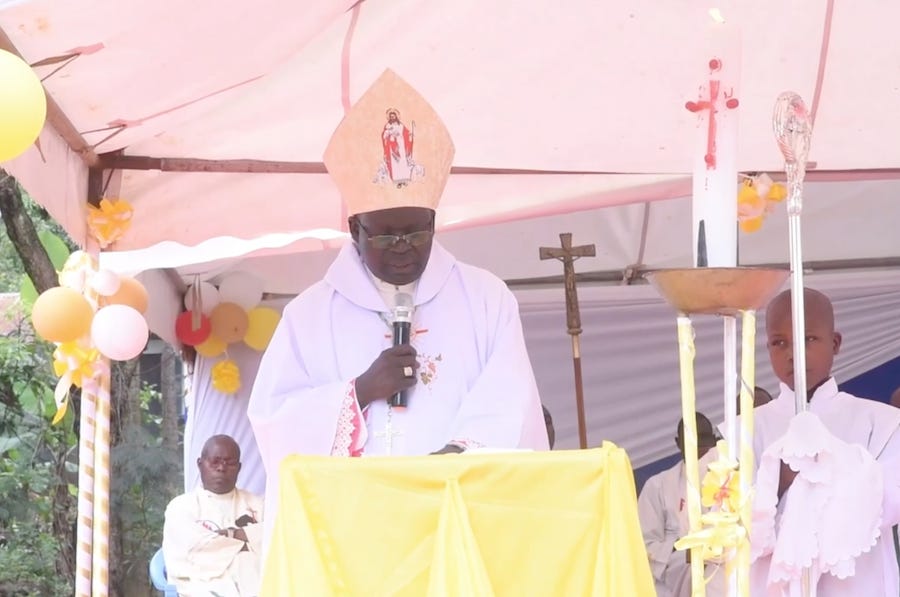
Local media reported that Bishop Hieronymus Emusugut Joya of Maralal issued a four-page pastoral letter July 12 suspending six (or by some counts, seven) priests amid allegations of abuse of ecclesiastical authority, administrative negligence, and mismanagement.
According to catholic-hierarchy.org, the Maralal diocese had a total of 37 priests in 2023, serving a Catholic population of 144,870. If that figure is still accurate, Joya has suspended roughly a sixth of his priests.
Joya also reportedly announced a string of directives for priests, including a requirement that they return to their rectories by 7 p.m. each night, along with a prohibition on drinking alcohol in bars, and a ban on owning property in relatives’ names.
What’s the background to this move? What exactly did the pastoral letter say? And what’s likely to happen next?
What’s the background?
Pope St. John Paul II established the Diocese of Maralal in north-central Kenya in 2001, from the territory of the Diocese of Marsabit.
The diocese is centered on the small hilltop market town of Maralal. While reasonably large geographically, the diocese is relatively small in terms of Catholic numbers and had only 14 parishes in 2023.
The diocese’s first leader, the motorcycle-riding Italian Consolata Missionary Bishop Virgilio Pante, led Maralal’s Catholics for more than 20 years before his retirement in 2022 at the age of 76.
His successor, Bishop Joya, was also a Consolata Missionary but Kenyan-born. Joya was not, however, from the Maralal region. He was born in western Kenya and grew up in the Archdiocese of Kisumu.
The official website of the Consolata Missionaries in Africa recently described a process of transition within the “vast and rugged” Maralal diocese.
It explained that when Pante began his episcopal ministry, local communities were beleaguered by cattle rustling, land conflicts, drought, and poverty. With few resources, the bishop crisscrossed the diocese, trying to strengthen fragile pastoral structures. He also tried to put local Church institutions, such as the Wamba Hospital, on a more secure financial footing.
The article portrayed the 61-year-old Joya as building on Pante’s legacy. It noted that he had served previously as a pastoral coordinator in the diocese and was already familiar with it when he took over as bishop. The article stressed Joya’s international experiences of study and ministry, saying he possessed “a rare combination of pastoral experience, intellectual formation, administrative competence, and global perspective.”
“His vision is not merely to maintain the Church but to strengthen its capacity to become self-propagating, self-sustaining, and deeply evangelizing,” the article said.
“Across the diocese, signs of renewal are increasingly visible. Areas once affected by persistent conflict are experiencing greater stability. Parish structures are growing stronger. Lay participation is expanding. Youth and women are becoming more actively engaged in Church life.”
Other coverage of the diocese suggests a less harmonious picture. In 2025, local media reported that Joya faced a backlash after appointing a new administrator to an educational institution previously led by a popular priest. Students were said to have held a strike, protested in the streets of Maralal, and accused the bishop of bullying behavior.
A report described the incident as revealing “longstanding tensions, contested leadership decisions, and fears of a culture slipping from the Church’s core values.”
What did the pastoral letter say?
The full text of Bishop Joya’s four-page pastoral letter does not seem to be currently available.
According to Radio Mchungaji, a Catholic community radio station serving northern Kenya, Joya unveiled “a comprehensive pastoral and administrative directive” at a July 12 Mass at the Cathedral of Sts. Peter and Paul in Maralal.
The bishop recalled that when he arrived in the diocese almost four years ago, he faced immediate economic and administrative challenges. He adopted a strategy of seeking donations and grants to try to restore the diocese’s financial equilibrium.
In December 2022, he brought diocesan priests together to discuss how parishes and local Church institutions could help the diocese to resolve its financial problems. But he suggested this month that while all priests agreed to cooperate at the time, some did not follow through on the commitment.
“Some of the priests and lay Christians started accusing me of always asking for money, taking schools and parish equipment that belonged to their parish,” the bishop said in remarks reported by Kenya’s People Daily newspaper.
Joya argued this perception was unfair because his fundraising had paid off diocesan debts, helped to support development projects, and strengthened the administrative apparatus.
He said: “I have mobilized hundreds of millions of shillings in the time I have been here, more than all the money all Christians of this diocese have done for their Church… Who should be accused of not supporting the Church and who made the diocese bankrupt?”
The bishop said he had received credible evidence that diocesan priests had engaged in misconduct and decided to take action according to the Code of Canon Law. This led to the suspension of six (or seven) priests.
The Kenyan media coverage was unclear about whether the priests were suspended from ministry generally or only from exercising certain faculties.
Joya also issued a series of directives that priests would immediately be required to follow. These appear to be particular disciplinary norms issued by the bishop for his diocese.
Priests will be expected to be in their presbyteries by 7 p.m. for evening prayer. They will require the bishop’s permission to spend the night at another location. They will also need the bishop’s approval for a lay person to stay overnight at their residence.
According to the bishop’s order, priests in the diocese are forbidden to drink alcohol in bars or Church residences. They are also expressly prohibited from attending liturgical celebrations while intoxicated.
The directives also stipulate that priests are not allowed to engage in private business activities unconnected to the Church, and they also cannot acquire or own property in relatives’ names without a reasonable explanation.
They also reminded priests that they should not cohabit or engage in intimate relations.
Further, diocesan vehicles must only be used for official purposes, with maintenance costs funded by a parish, Catholic institution, or Church group, the directives added. All Church bodies are expected to manage their finances with transparency and accountability. Financial councils must be allowed to work unhindered, while parish councils are responsible for annual budgets and audits.
Finally, all Church personnel are expected to comply with Church and civil laws, the directives stated.
Some of the rules are either repetitions of basic moral expectations — such as the rules around priestly sexual continence. Others, including the prohibition on priests engaging in trade and commerce and necessity of proper financial administration are included in the universal Code of Canon Law.
However, some of the measures — for example imposing a curfew on diocesan clergy, or the the requirement that all priests receive prior permission before spending a night outside of their parish residence — raise questions about the limits by which a bishop can generally restrict the behavior of his priests, as opposed to legitimately imposing limits on individuals for specific reasons.
What happens next?
The priests will remain suspended until their cases are resolved, according to Bishop Joya, who said they will be expected to reflect deeply in this period on their priestly vocations and responsibilities toward the Church. The bishop called for prayers for the men and for the strengthening of the diocese. He also named priests to take up their vacated roles.
It’s possible that, in the coming months, some of Joya’s directives may be challenged canonically by clergy of the Maralal diocese. Some canon lawyers have questioned, for example, whether the bishop has the right to impose the 7 p.m. restriction on priests, or if this is outside his powers.
Canonical appeals by the suspended priests could potentially extend their cases, turning the suspensions into complicated, time-consuming disputes. While the number of suspended priests seems small, it is proportionately large. The suspensions are likely to increase pastoral burdens on remaining clergy, possibly for a considerable time.
More broadly, other clergy in ministry in the diocese could appeal the rules to Rome where, if the case was accepted, Vatican consideration would have suspensive effect on the policies.
Given recent diocesan history, the bishop could face pushback in some quarters in response to this major shakeup. Part of his flock may dispute his framing of the suspensions as a necessary step to restore priestly integrity and good governance in the diocese, possibly arguing that the bishop is seeking to unduly centralize control over parish finances and assets.
The young diocese seems destined to experience growing pains for some time yet.

