Why is an Ivorian diocesan bishop now an auxiliary?
Bishop Gaspard Béby Gnéba previously issued a letter urging Catholics to denounce priestly misconduct.
Leo XIV made an appointment in West Africa last week that has left Vatican watchers scratching their heads.
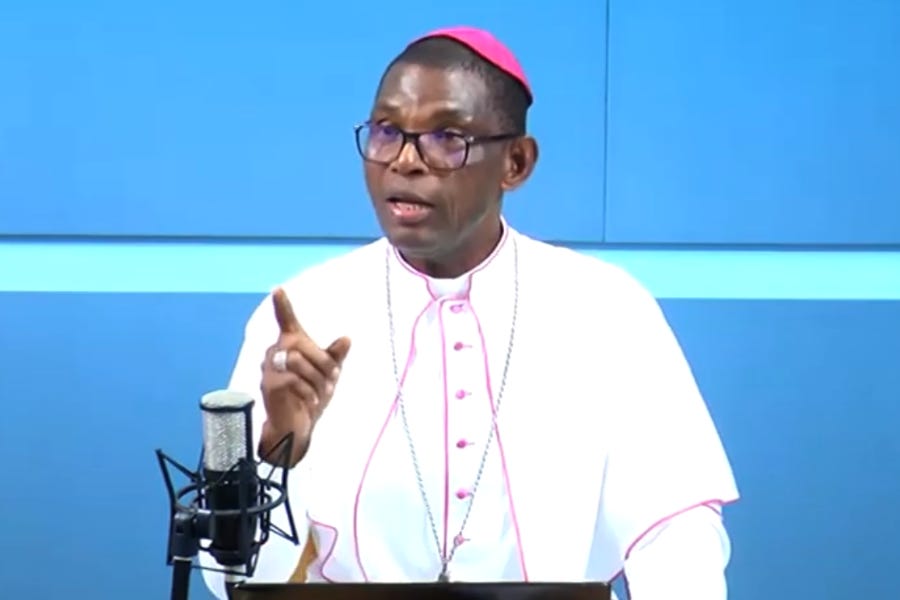
On Feb. 19, the pope named Bishop Gaspard Béby Gnéba as an auxiliary bishop of the Archdiocese of Abidjan. Gnéba had led the Ivory Coast’s Man diocese since 2008, so why was he now being appointed as an auxiliary bishop?
Typically, episcopal appointments work the other way around: auxiliaries are promoted to diocesan bishops. The transfer of a diocesan bishop to the post of an auxiliary bishop therefore raises questions.
In keeping with its usual practice, the Holy See press office did not indicate why Gnéba had been reassigned as an auxiliary in the nation’s capital. The bishop is 63 years old, meaning he could have led the Man diocese for another 12 years before submitting his resignation to the pope for age reasons.
Many observers would interpret the move reflexively as a demotion. But, as we will see, that is not always the correct conclusion.
Let’s take a look at recent similar appointments, and then consider the specific situation of Bishop Gnéba.
When diocesan bishops become auxiliaries
The past few years have seen a handful of cases in which diocesan bishops have been appointed as auxiliaries.
2023: The 49-year-old Bishop Milan Lach, S.J., had led the Ruthenian Catholic Eparchy of Parma in Ohio for nearly five years when Pope Francis named him the auxiliary bishop of the Slovak Catholic Eparchy of Bratislava.
2023: The 64-year-old Bishop Thierry Brac de la Perrière had led the French Diocese of Nevers for almost 12 years when Pope Francis appointed him as an auxiliary bishop in the Lyon archdiocese.
2023: The 68-year-old Bishop Jean-Pierre Batut had overseen France’s Blois diocese for eight years when Pope Francis named him as an auxiliary in the Toulouse archdiocese.
2024: Bishop Paul Dempsey had led Ireland’s Diocese of Achonry for almost four years when Pope Francis named him an auxiliary bishop of the Archdiocese of Dublin, Ireland.
What were the reasons for these unusual moves?
In Bishop Lach’s case, the transfer from the U.S. to Slovakia was not particularly surprising. He had previously served as an auxiliary in Prešov, Slovakia, and now returned to his homeland to serve again as an auxiliary, but this time in the capital. Aged just 49, Lach would likely be able to pour a lot of energy into his new role, with the benefit of five years of leadership experience in the U.S. It’s possible Lach was being lined up to succeed the current head of the Eparchy of Bratislava, who is now 75.
The French Bishop Brac de la Perrière explained that after 20 years as a bishop, he now aspired “to a less onerous and less exposed ministry.” He had previously served as an auxiliary bishop of the Lyon archdiocese from 2003 to 2011, so he was returning to a familiar place and role.
His compatriot Bishop Batut had suffered from eyesight problems. In an interview, he spoke about the importance of having the humility to recognize “when the burden becomes too great.”
French media suggested that Brac de la Perrière and Batut moved to low-key auxiliary roles because of a combination of struggling with the demands of episcopal ministry, fatigue, and other health problems.
The transfer of Ireland’s Bishop Dempsey, meanwhile, seemed to be part of a shift of ecclesiastical resources toward the country’s capital, Dublin. In the rural Achonry diocese, Dempsey oversaw just 23 parishes. The Dublin archdiocese has more than a million Catholics and almost 200 parishes.
In 2025, the Achonry diocese was united in persona episcopi (in the person of the bishop) with the Diocese of Elphin, suggesting Dempsey’s move was part of a planned consolidation of the Church in western Ireland.
Each of the four cases of diocesan bishops becoming auxiliaries had its own specific logic. None of them appeared to be a Vatican-imposed demotion, based on the publicly available evidence.
The case of Bishop Gnéba
Gaspard Béby Gnéba was born in Tehiri Guitry, southwestern Ivory Coast, in 1963. He was ordained a priest of the local Diocese of Gagnoa in 1992 and served as a professor at the local seminary.
Pope Benedict XVI chose Gnéba to lead the nearby Diocese of Man in 2007, when the churchman was only 44 years of age. At that time, the diocese served around 100,000 Catholics out of a total population of 1.5 million. It had a relatively small number of priests and parishes serving a rapidly growing community.
Gnéba made international headlines in January 2024, when he issued a letter urging lay Catholics to denounce priestly misconduct.
With uncommon directness, he wrote: “Any lay faithful who knows that a priest is not faithful to his celibacy, has a wife or child, has committed sexual abuse or economic crimes, must have the courage to denounce him to the bishop, otherwise he commits a sin of complicity before God, the pope, and the Church,”
Gnéba challenged priests with secret wives and children to “come to see me as soon as possible to present their resignation.”
The letter was not well received by local clergy, to put it mildly. Infighting between Gnéba and his priests prompted the Vatican to launch an apostolic visitation — a kind of ecclesiastical audit — of the diocese. Benin’s Archbishop Roger Houngbédji led the apostolic visitation in August 2024.
In December 2024, Pope Francis named Ivorian Cardinal Jean-Pierre Kutwa as apostolic administrator sede plena (“while the see is occupied”) of the Man diocese. This meant that Gnéba remained the Bishop of Man, perhaps in the hopes that Kutwa could engineer a reconciliation between Gnéba and his priests.
As Gnéba began what was described as a period of “spiritual rest,” without administrative responsibilities, the apostolic nuncio Archbishop Mauricio Rueda Beltz likened Kutwa to a “doctor,” sent to heal the wounds of the Man diocese.
Kutwa’s intervention began promisingly, when the Man diocese’s priests issued a statement shortly after his appointment expressing regret at the “unfortunate situation.”
“To our dear brothers and sisters, both consecrated and lay members of the Diocese of Man, we ask for your forgiveness for the scandal we have caused over the past year,” they said.
“We are deeply sorry for the hardship this situation has inflicted on our diocesan family, and we entrust ourselves to your prayers. Thank you for your patience and support.”
The priests added: “We believe this crisis is now behind us. This message marks the beginning of a process that will lead to lasting reconciliation and enduring peace in our region.”
Gnéba’s transfer from Man to Abidjan suggests that “lasting reconciliation” between the bishop and his priests proved elusive. Or perhaps Kutwa and the Holy See concluded that reconciliation was best served by offering Catholics in the Man diocese a fresh start with a new bishop, who could be appointed in the coming months.
Meanwhile, Gnéba will assist Cardinal Ignace Bessi Dogbo, Kutwa’s successor as Archbishop of Abidjan. Gnéba is scheduled to be installed in his new post at an April 25 Mass at St. Paul’s Cathedral in Abidjan.
As the sole auxiliary bishop in an archdiocese serving around 2.6 million Catholics, Gnéba is not likely to have much time to dwell on the painful events that led to his departure from the Man diocese. For both him and his former diocese, it is a new beginning.

