Why Trump would want Pope Leo to be political
Donald Trump doesn't play in a vacuum, only in opposition to someone.
Bishops, cardinals, and secular leaders from around the world have lined up to condemn a statement and social media post by President Donald Trump attacking Pope Leo XIV.
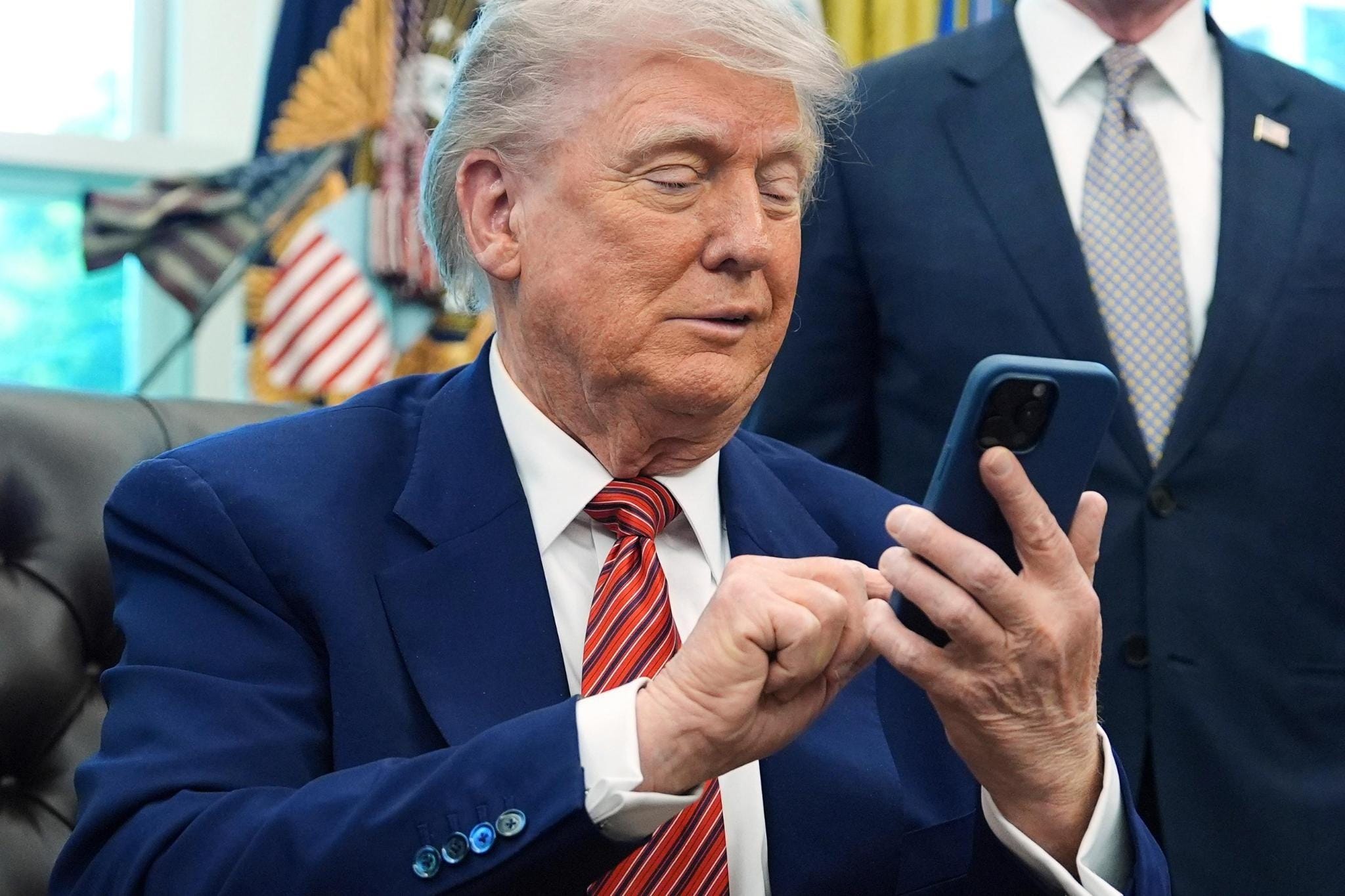
President Donald Trump in the Oval Office, May 23, 2025. Credit: Evan Vucci/AP
In response to a question from a reporter on Sunday, then amplified in a post on social media, Trump described the pope as “WEAK”, and “terrible at Foreign Policy” [sic] while insisting that Leo was elected “only” as a consequence of the Trump presidency.
Trump had been asked about increasingly direct appeals for peace by the pope over the military strikes carried out by the United States and Israel against Iran and Lebanon. In response, the president called Leo “a very liberal person, and he’s a man that doesn’t believe in stopping crime,” declaring that “I’m not a fan of Pope Leo.”
Trump also claimed Leo “thinks it’s OK for Iran to have nuclear weapons” and “thinks it’s terrible that America attacked Venezuela.”
In response, both Church and government leaders from around the world have issued statements condemning the rhetorical attack on the pope by the American president.
Donald Trump has a lengthy record of provocative public statements and personal attacks on world leaders, and with the Vatican under Leo emerging as a consistent and increasingly strident critic of the war in Iran, there was, at least for some observers, a sense of inevitably to the president’s denunciation of the first American pope.
For his part, Leo has appeared unfazed, chuckling when asked about Trump’s comments and saying simply that he thought “very little” of the affair. “I think people who read will be able to draw their own conclusions.”
“I’m not a politician,” said Leo. “I’m not going to enter into a debate with him, my message has always been the same: to promote peace. And I say this for all the leaders of the world, not just him. Let us try to end wars and promote peace and reconciliation.”
If a vituperative outburst from the president was always a likely possibility, so too was the pope’s unwillingness to be drawn into an explicit war of words.
More curious, though, might be the president’s chosen lines of criticism aimed at Leo, and what they might suggest about Trump’s understanding of American Catholicism in the current American political context, and what he hopes to achieve by attacking Leo.
—
The immediate context of Trump’s comments of Leo was, of course, the pope’s repeated criticisms of the war in Iran, with Leo having called on Catholics and people of good will on Saturday during a prayer vigil to help “break the demonic cycle of evil” and place themselves “at the service of the Kingdom of God. A Kingdom in which there is no sword, no drone, no vengeance, no trivialization of evil, no unjust profit, but only dignity, understanding and forgiveness.”
Condemning the “delusion of omnipotence that surrounds us and is becoming increasingly unpredictable and aggressive,” Leo lamented that “even the holy Name of God, the God of life, is being dragged into discourses of death,” with the pope having previously pushed back on claims by Trump administration officials that God was supposedly on the American side of the conflict, and directly challenged as “unacceptable” threats by the president of civilizational death in Iran.
In response, Trump said on Sunday that Leo supposedly thought it was “OK” for Iran to possess nuclear weapons, and linked previous papal concern over military action to abduct and detain Venezuelan dictator Nicholas Maduro as proof the pope is “weak” on crime because of the Maduro regime’s role in narcotics trafficking.
Interestingly, and unexpectedly, Trump also made repeated references to COVID-19 lockdown restrictions on religious worship, and suggested they were a more pressing concern for American Catholics, and a better issue for the pope to focus on, while also touting his alleged handling of the economy.
At first glance, Trump’s choice of topics might seem a somewhat bizarre grab bag of issues, only loosely connected among themselves and even less so in direct response to the pope’s various remarks in favor of peace and military de-escalation.
But another reading of the president’s salvo against Leo is that it is a calculated political move aimed at shoring up domestic support for the administration across a variety of policy issues, in the face of an overseas military conflict widely seen as at odds with the isolationist tendencies of his own supporters.
Across all three of his presidential election campaigns, Trump has defined himself and his political appeal as adversarial — engaging in personal attacks on political opponents like Hillary Clinton and Joe Biden as a means of crystalizing a range of policy issues into a personal binary.
Ahead of a mid-term election later this year, and in the absence of a clear national political opponent to campaign against, it is possible Trump has determined that the first American pope is the only figure of sufficient stature to define himself against.
And although Pope Leo has made it clear he is not a politician, it could be that Donald Trump has decided that is what he needs the pope to be.
While offensive to many, and baffling to others, it may prove an effective strategy, at least among some American Catholics and voters.
—
It is worth recalling that since the beginning of Trump’s second term in office, the Catholic hierarchy in the United States has been unusually unified and robust in its engagement with the White House.
In the early months of last year, the U.S. bishops’ conference was forced to sue the administration over the cancellation of refugee resettlement contracts administered by Catholic agencies, leaving the USCCB millions of dollars out of pocket. The White House, including through the Catholic vice president, JD Vance, accused the USCCB of using the resettlement of “illegal immigrants” to pad its “bottom line.”
At their November plenary meeting, the bishops passed unanimously a joint statement denouncing the administration’s campaign of immigration enforcement actions in cities across the country, with Pope Leo weighing in to support them and — while stressing that the Church affirms the right of nations to control and police their borders — decrying violations of human rights and due process.
Along the way, the Trump administration’s support for IVF treatments and mail-order abortion drugs, coupled with the removal of a Republican Party commitment to ending abortion, has seen institutional pro-life support bleed away from the administration.
Since the new year, the administration has also faced both the unpopularity of foreign military interventions — again opposed by Church authorities including Pope Leo — resulting in a now-famous and famously contentious meeting between the apostolic nuncio and the Pentagon.
At the same time, Democratic leadership has — as is expected of the opposition party — opposed the Trump administration, but without producing a single figure around whom opposition can rally, or with whom they can identify, and remained internally divided over controversial and unpopular social issues like transgenderism.
From a certain perspective, then, the American Catholic hierarchy united behind Pope Leo has emerged, in the eyes of some at least, as a kind of credible political opposition voice almost by default — with a special significance given to the words of the pope since senior administration figures like Vance and Secretary of State Marco Rubio are public Catholics.
If this perspective is shared by Trump, and the directness with which he attacked Pope Leo on Sunday suggests at least that it might be, the terms of Trump’s outburst appear less spontaneous and perhaps more calculated at trying to force a crack between populist Catholic voters and the Church’s hierarchy, while placing Trump in his preferred position of a battle of public personalities.
Shortly after posting his denunciation of the pope on social media, and with condemnations already pouring in, Trump appeared to deploy another of his preferred tactics in upping the stakes, posting an AI image of himself as Jesus — since deleted.
For many — most especially for many Catholics — the response online was outrage and offense, by no means unfamiliar reactions to Trump political messaging. There was, too, predictably, a move to rally around Trump from among his most committed supporters, including a section of Evangelical Christianity which is itself reflexively hostile to both the Catholic Church and the figure of the pope.
But, at the same time, conciliatory efforts by some Catholics may also help along a bid by the White House to refocus MAGA-minded Catholics. Few would have predicted that among the first major figures to qualify their criticism of Trump’s anti-Leo salvo would be a prominent American bishop.
Writing on twitter.com on Monday morning, Bishop Robert Barron of Winona-Rochester called Trump’s statements about the pope “entirely inappropriate and disrespectful.”
“It is the Pope’s prerogative to articulate Catholic doctrine and the principles that govern the moral life,” said Barron, while allowing that “in regard to the concrete application of those principles, people of good will can and do disagree,” and expressing his hope that Catholics in the administration like Vance and Rubio press for real dialogue with the Vatican.
From there, though, Barron’s statement appeared to pivot sharply to praising Trump’s record, saying “I am very grateful for the many ways that the Trump administration has reached out to Catholics and other people of faith. It has been a high honor to serve on the Religious Liberty Commission. No President in my lifetime has shown a greater dedication to defending our first liberty.”
“All that said,” Barron concluded, “I think the President owes the Pope an apology.”
It is worth noting that no other U.S. bishop made any similar qualification in decrying Trump’s attack on Pope Leo, including the USCCB president Archbishop Paul Coakley. But Barron’s formulation did appear to engage most closely with some of Trump’s claims in his attack on the pope — for example appearing to affirm the president’s claim to being a champion of religious freedom in the context of pandemic restrictions.
That avenue of response is likely to be taken up, albeit with different cadences, by prominent Catholics within and around the administration in the coming days, as they seek to create a distinction between the president’s “regrettable” rhetoric and while claiming Catholic bona fides for his policies.
In doing so, it seems highly likely that they would also seek to contextualize serious and substantive concerns and criticisms by the pope of administrative action — like the conflict in Iran — as part of a mutual exchange between Leo and Trump, as though they were equal participants in a performative public clash of personalities, rather than a one-sided salvo from Trump.
If that narrative could be successfully advanced, it could serve to blunt the force of the Church’s urgent moral concerns, expressed either by the Vatican or the American bishops’ conference, and turn the pope into a usual political strawman for the midterm elections.
Such a Trump political strategy could, in turn, could be further helped along if some senior U.S. clerics, like the three cardinals who recently granted an interview to 60 Minutes, allow themselves to become presented as overtly partisan voices in American politics, rather than apolitical champions of the Gospel.
How equipped the hierarchy is to anticipate all of this, and avoid being turned into a political foil to the White House, remains to be seen.


Let's remember to pray for our Pope. 18 flights, 25 planned speeches all in 10 days for this current tour of Africa. We are blessed to have him, and more important than getting bogged down in political shenanigans, let's support him with our prayers.
Interesting analysis! But honestly I don't think his attack on the pope had any strategy at all, he just has the emotional regulation of a toddler and lashed out ¯\_(ツ)_/¯
"The White House, including through the Catholic vice president, JD Vance, accused the USCCB of using the resettlement of “illegal immigrants” to pad its “bottom line.”"
This made me think, would The Pillar do an investigate piece looking into the history of the American church in supporting immigrants and migrants? I've been seeing this conspiracy pop up all over the place and it's horrible for Catholics to genuinely suggest our bishops engaged in migrant and refugee resettlement for financial gain or political power.