Will Bätzing be re-elected as German bishops’ chairman?
The current conference chair is the front runner for a second term - if he stands for re election.
When the German bishops gather for a plenary assembly in February, they will decide who will lead the country’s powerful episcopal conference for the next six years.
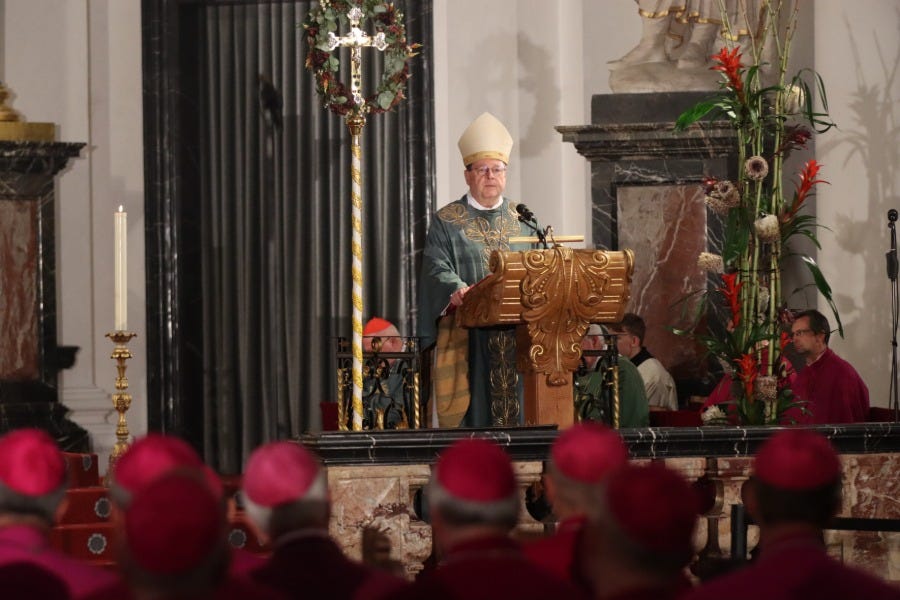
There is an obvious candidate: the incumbent bishops’ conference chairman, Bishop Georg Bätzing. But just weeks before the vote, his re-election is shrouded in uncertainty.
Why is there an element of doubt? Who are the other possible candidates? And what challenges are likely to await whoever leads the German bishops’ conference next?
Let’s take a look.
Why the uncertainty?
There is no obvious impediment to Bishop Bätzing standing for another six-year term.
The Vatican has asked bishops’ conferences not to elect leaders who will turn 75 during their presidential terms, as this infringes on the pope’s freedom to accept their resignations as diocesan bishops when they reach the standard retirement age.
But Bätzing is only 64, which means he would be 70 when his second term came to an end. So, no problem there.
There is also no barrier to his running for a second term. The German bishops’ conference’s statutes permit chairmen to serve for a maximum of two consecutive terms.
In the decades following Vatican Council II, chairmen tended to serve for extended periods. Cardinal Karl Lehmann, for example, led the bishops’ conference from 1987 to 2008.
But following that 21-year stint, German bishops’ leaders have tended to be short-lived. Lehmann’s successor, Archbishop Robert Zollitsch, served one term, from 2008 to 2014.
Zollitsch’s successor, Cardinal Reinhard Marx, was expected to serve two terms. But he unexpectedly announced in 2020, weeks before the ballot, that he would not be standing again. The cardinal, then 66 years of age, said it was “time for the younger generation to take over,” noting that he would have been 72 at the conclusion of his second term, “and the end of my tenure as Archbishop of Munich and Freising would also be near.”
Not everyone was convinced of Marx’s rationale for the decision. Some suggested it was a tactical withdrawal to allow a less prominent figure to be elected, who could concentrate on steering the “synodal way” to its conclusion, while the well-connected Marx sought to smooth ruffled feathers at the Vatican.
Marx’s decision opened the way for the election of Bätzing, the Bishop of Limburg since 2016. Bätzing was largely unknown in the wider Catholic world, but was strongly associated with Marx, having served in the Diocese of Trier when Marx was bishop of the ancient German see.
Under Bätzing’s leadership, deep fissures opened up in the bishops’ conference, arguably created by his commitment to advancing the synodal way regardless of fellow bishops’ reservations.
In Bätzing’s conception, the role of chairman is to blaze a reforming trail, rather than build a careful consensus. But he is nevertheless aware of the divisions among his brother bishops, describing them in a December 2025 interview as a burden. In the same interview, he said he was keeping an open mind about whether to stand for a second term.
Who else might be a candidate?
The German bishops’ conference’s statutes say the body’s chairman must be elected from among the country’s diocesan bishops. That narrows the field to 27.
The Vatican’s stipulation that bishops’ conference presidents must be under 75 at the end of their term further restricts the candidates. To be under 75 at the end of the next six-year term, in February 2032, a diocesan bishop must currently be under 69 years of age.
That rules out, for example, the 71-year-old Archbishop Heiner Koch of Berlin.
Cardinal Rainer Maria Woelki of Cologne could theoretically stand, because he is on the cusp of the age limit. But as the 69-year-old belongs to the bishops’ small conservative minority, he would be unlikely to gain the necessary two-thirds majority of votes in the initial ballots, or the simple majority required from the third ballot onward.
Given that the top item on the next leader’s agenda is likely to be the creation of a new permanent body in the German Church known as the synodal conference, the bishops might be drawn to candidates who have been involved in the negotiating process with the Vatican.
That would include Bishop Stephan Ackermann, 62, of Trier. If he were elected, he would be the third bishops’ conference chairman in a row linked to Trier, after Bätzing and Marx.
Also involved in the Vatican negotiations are Bishop Franz-Josef Overbeck, 61, of Essen, and Bishop Bertram Meier, 65, of Augsburg.
Of the three, Meier arguably has the deepest knowledge of Rome’s inner workings, as he previously served as head of the German-language department in the Vatican Secretariat of State. When tensions flared over the synodal way, Meier played a role as an intermediary between the German bishops and curial officials.
If Meier were elected chairman, it would signal that the German bishops wanted to invest significantly in improving Vatican ties.
Another figure who has acted as a go-between is Bishop Heiner Wilmer, 64, of Hildesheim. Wilmer, a member of the Dehonians, was one rumored to be in the running to lead the Vatican’s Dicastery for the Doctrine of the Faith. He has had regular private papal audiences in recent years, most recently in November 2025 with Pope Leo XIV.
In the German bishops’ conference, the vice-chairman isn’t necessarily expected to succeed the chairman. But it’s worth mentioning the current vice-chairman, Bishop Michael Gerber, who was named Bishop of Fulda at the age of 48. Still only 55, he was diagnosed with cancer in the summer of 2025, but returned to the pulpit on Christmas Eve following surgery. As vice-chairman, he has been committed to building bridges within the fractured episcopate and seems well-respected.
What challenges await?
The German bishops will face another weighty issue besides the election at their Feb. 23-26 plenary assembly in Würzburg. They must decide whether to approve the statutes of the synodal conference, the new body intended to permanently institutionalize the synodal way.
The bishops’ vote is the last hurdle before the statutes are submitted to Rome, which must give its approval before the synodal conference can be established.
The bishops’ debate over the statutes may deepen the chasm between the majority of bishops who favor the synodal way and the minority who oppose it. There could be further antagonism if the bishops override the minority’s objections to adopt the statutes by, say, a two-thirds majority.
The new chairman would then have the nerve-wracking task of seeking Rome’s approval to create a permanent body that some of his fellow German bishops deem illegitimate.
Beyond the synodal way and its legacy, there is another pressing problem: the German Church, once a byword for wealth, has money problems. The bishops’ conference announced in July 2025 that it would need to make “hard cuts” to expenditure from a common fund known as the Association of the Dioceses of Germany, citing a declining number of Catholics and an anticipated fall in church tax income.
The cuts have begun. They are unpopular. And the next chairman will have to oversee more over the next six years.
While the mass exodus of German Catholics may be slowing, it is likely to continue for the foreseeable future. A poll published this week concluded that almost one in four German Catholics intend to formally leave the Church in the next two years.
The leadership of the German bishops’ conference is therefore arguably a poisoned chalice. Whoever the next chairman is, he will preside over a fragmented body of bishops, serve as the de facto leader of a demoralized and dwindling flock, and need to make financial decisions that will alienate parts of the German Church.
Given this reality, it’s not surprising that Bätzing is hesitating before standing again.

So basically the goal for the German episcopate is to determine which heretical German bishop would be best in fooling the Pope about their synodal way. Unfortunately, except for the four good German bishops, none of them will be able to fool God at their particular judgment.
I'll take whichever realistic prospect is least depressing, thanks.