Will bishops reshape ‘Faithful Citizenship’ around Trump II?
After decades of being broadly perceived as aligned with Republicans, a shift seems to be underway.
Three U.S. cardinals gained attention this week when they issued a statement highly critical of the Trump administration’s foreign policy, especially the president’s overtures toward an American acquisition of Greenland.
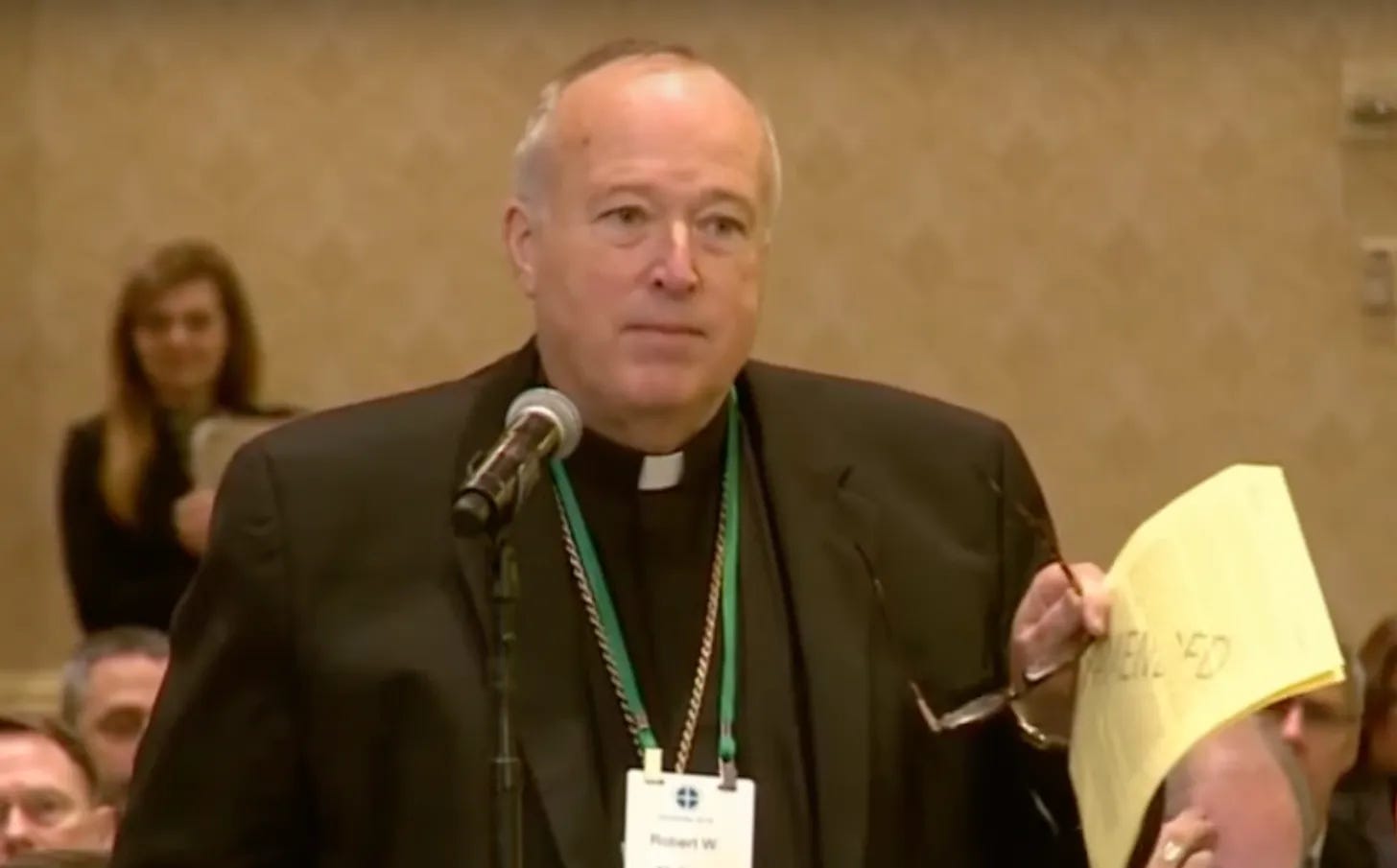
Cardinal Robert McElroy of Washington. Pillar file photo.
Their statement came as a former president of the USCCB, who oversees the American military ordinariate, has said that soldiers sent to a military takeover of Greenland might in good conscience refuse direct orders that put them into an unjust war.
Both statements have made headlines around the world. And while they came shortly after the USCCB’s current president praised a congenial meeting with President Donald Trump last week, they signify growing impatience among the American episcopate with the presidential administration, and — by extension — the Republican party.
After several decades in which the U.S. bishops’ conference has been perceived to be broadly aligned with the Republican party, a growing consensus about a shift seems to be underway.
That all comes as the U.S. bishops are, in principle, committed to a revision to their guide for Catholics in the voting booth. And a growing impatience with the Republican party could lead a very different iteration of their customary guidance on public life.
—
While a Jan. 19 statement from Cardinals Joseph Tobin, Robert McElroy, and Blase Cupich has been widely seen as a broadside against President Donald Trump’s overtures toward Greenland, the statement was more comprehensive than that.
It lamented American foreign policy unilateralism and dramatic cuts to American foreign aid and relief programs. But it also addressed the “protection of the right to life,” mentioning explicitly that “abortion and euthanasia are destructive of that right.”
In previous administrations, that remark might have been taken as a kind of nod to the episcopal commitment to non-partisanship, a recognition that while the statement is talking about Trump, the other guys have serious moral issues to work on, too.
But the second Trump administration is itself coming under increasing scrutiny from pro-lifers.
While the first Trump term saw the president appoint the judges which led to the reversal of Roe v. Wade, the second has seen Trump urge lawmakers to show “flexibility” on the question of federal funding for abortions, praise and promote in vitro fertilization, and defend a liberalization of mail-order abortifacients which are responsible for the majority of terminated pregnancies each year.
That puts the bishops in new territory. In years past, their commitment to the defense of human life as a “preeminent priority” in the voting booth has mostly been taken as coded support for the election of Republicans, who are seen to avoid at least the abortion maximalism of their Democratic counterparts.
But if the two major parties, at the national level at least, are each becoming tolerant of legal protection for abortion, the bishops’ guidance itself might have to shift, or find new ways to talk about making hard choices in the voting booth.
And while that’s happening, it’s not unremarkable that Archbishop Timothy Broglio has emerged as a visible Trump critic, given that the diplomat-prelate has been widely taken to be among the bishops most inclined toward a conciliatory relationship toward the Trump administration when possible.
At the same time, the administration’s domestic policies on immigration enforcement and foreign policy have triggered robust and near-unanimous opposition from the bishops.
The result is a seemingly newfound appreciation for how truly politically homeless American Catholics are — or should understand themselves to be.
But while some might lament the loss of a pro-life party, even in name, others might ask if the new partisan normal could serve as a moment of and for clarity by the bishops.
Presented with two parties, both of whom now run afoul of the Church’s preeminent social priority, as well as a gamut of other grave moral issues, there may be a chance for the bishops to find new unanimity of purpose and priority in their advice to Catholic voters.
So what might that mean for “Faithful Citizenship,” the bishops’ voting and civic life document, which has been, at least in theory, under review for amendment for about two years?
Most practically, it could mean an end to sometimes fractious debate about the language with which the document lists and explains the Church’s moral priorities in the public square.
Specifically, previous meetings of the bishops have at times resulted in pointed — sometimes acrimonious — exchanges over the language of “preeminence” as used to describe the issue of abortion.
Past criticisms of the term “preeminent” have come from bishops like Cardinal McElroy, one of the three signatories to the cardinals’ statement earlier this week, who in a past meeting suggested such language was somehow “anti-Francis,” despite the former pope’s own repeated statements on the unique evil of abortion.
But some observers of the bishops’ conference suggested that McElroy’s opposition to the language of preeminence was less about abortion itself and more about a concern that it could be interpreted by some as coded endorsement for the Republican party.
With the GOP increasingly under criticism from pro-life groups, and with Churchmen like McElroy and Cupich finding new space to emphasise the importance of life issues in addressing the political sphere, the language of “Faithful Citizenship” could become suddenly less controversial among the conference body.
Similarly, many of the bishops who have been among the most outspoken defenders of the Church’s preeminent concern for ending abortion might find themselves more open to giving more space and stronger language to other important moral teachings — including the care of the poor and the treatment of immigrant detainees — if there is no longer a concern doing so might seem to draw a false moral equivalency between issues and parties.
More broadly, though, the shifting partisan landscape could create an opportunity for the bishops to rethink entirely the tone and tenor of their advice to Catholic voters.
For decades, if not generations, the bishops’ joint text has been criticized by some as a careful act of not explicitly endorsing either party, while often appearing to balance the lesser of two evils.
Now, with both parties seemingly committed in policy and practice to what the Church considers to be immoral means and ends, including on abortion, the bishops could decide that helping Catholics equivocate between them is itself morally untenable.
If they do, it could clear the way for “Faithful Citizenship” to articulate a much more robust vision of the limits of Catholic conscience in political life, and focus more directly on calling on the faithful to reform a partisan process in which it is no longer possible for a Catholic to cooperate with either party’s agenda.
That kind of shift, from pragmatic assessment to prophetic witness, would require a real shift in how the bishops think and teach about politics as a body. It would also involve demanding more of lay Catholics’ exercise of civil responsibility than simple voting.
Whether the bishops would be comfortable making such a witness, or whether lay Catholics would be disposed to assume such responsibility, are open questions.
—
In the 1980s, the U.S. bishops’ conference was so frequently seen to align with the Democratic party social values that the conference was nicknamed among Catholics the “Democrats at Prayer.”
That shifted over time, with periods of ambiguity and division, but in the early 2000s a shift began as the George W. Bush administration aimed to partner with religious groups on abortion, and also on faith-based social service provision.
By the early 2010s, a rather complete change was evident — by the time of the 2012 “Fortnight for Freedom,” most USCCB-watchers perceived that the conference had become rather more frequently associated with the Republican party, especially with an increasingly strong emphasis on religious liberty.
As the Democratic party adopted a more “progressive” social agenda on matters of sexuality and gender identity, the conference alignment with the GOP continued to seem strong, and likely to continue.
There are exceptions — Tobin, McElroy, and Cupich among them — whose social and political priorities have led them to considerably more conciliation with the Democratic party than most of their confreres would desire. But those bishops have been mostly in the minority.
In the second Trump era, the grounds seem to be shifting again.
There will be bishops who aim to build alliances with the Trump GOP, emphasizing their view that is “less bad” than the gnostic social agenda of the Democratic party. And there will remain bishops who seem generally more inclined toward collaboration with the Democratic party, with many of them lionizing the blue collar immigrant Democratic Catholic culture of their childhoods, or of their parents.
But on the whole, it’s worth wondering whether the second Trump era might lead to a period in which the bishops are far more critical of both American parties, and far more insistent on the degree to which Catholics find serious inconsistencies in the approaches and platforms of both political parties.
Pendula swing, of course. The pendulum has swung for the USCCB in the past. But the second Trump era seems to represent a more significant and radical reshaping of the American political landscape than anything in recent American history.
As a new normal emerges, it could see bishops standing further from the day-to-days of process and the issue du jour, emphasizing a broader and more aspirational vision of what it looks like when Catholics aim to order and animate their society with the spirit of the Gospel.


This feels like a post where JD's oft-repeated admonition to be charitable in the comments will be needed sooner rather than later.
The main thing I want from bishops, priests, and laity is a sense that our religion influences our politics, not the other way around. When do we boldly repeat church teaching like a biblical prophet, and when do we hem and haw about prudential judgment and complex realities--does it neatly align with a partisan political perspective? Does it feel like less of a betrayal to attack a bishop who calls out your side than to attack a politician on your side who runs afoul of Church teaching? Politics has always been totalizing and existential, but it feels like it's gotten worse with social media.
To repeat a phrase I have written in these comments before, we have rendered unto Caesar the things that are God's. I want to know that when a churchman preaches about politics, what I hear is a reflection of who he worships, not who he voted for.