Will Pope Leo approve Germany’s synodal conference?
The new national synodal body currently exists only on paper and can’t be established without Vatican approval.
One of the most pressing issues that Pope Leo XIV will face in 2026 is whether to approve a new national body for the Catholic Church in Germany.
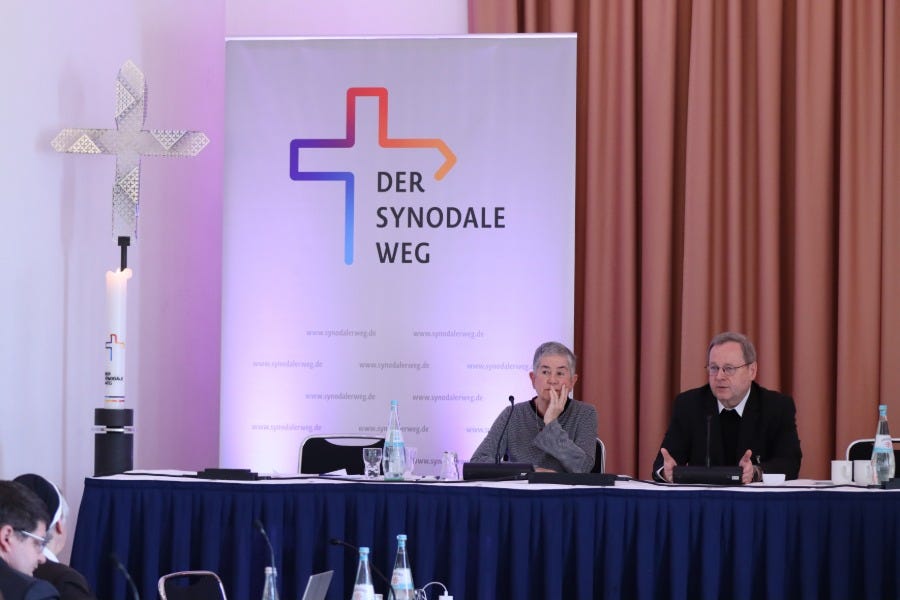
The first meeting of the new body, known as the “synodal conference,” is already pencilled in for Nov. 6-7, 2026, in Stuttgart. There are even dates for a second meeting, on April 16-17, 2027, in Würzburg.
But the new national synodal body currently exists only on paper and can’t be established without Vatican approval.
What is the synodal conference? What has Pope Leo said so far about the project? And what’s likely to happen next?
What’s the synodal conference?
The synodal conference is an attempt to give permanent institutional form to Germany’s controversial “synodal way,” an initiative co-sponsored by the country’s bishops and the lay Central Committee of German Catholics (known by its German acronym, ZdK).
The synodal way brought together the bishops and a select group of lay people at five assemblies from 2020 to 2023 to discuss sweeping changes to Catholic teaching and practice.
The assemblies produced 150 pages of resolutions calling, among other things, for women deacons, a re-examination of priestly celibacy, lay preaching at Masses, greater lay involvement in selecting bishops, and a revision of the Catechism of the Catholic Church on homosexuality.
But arguably the most far-reaching resolution, passed in September 2022, called for the creation of a permanent “advisory and decision-making body” composed of bishops and lay people.
This new organ, known as the “synodal council,” would “take fundamental decisions of supradiocesan significance on pastoral planning, future perspectives of the Church, and financial and budgetary matters of the Church that are not decided at diocesan level.”
It would replace a body known as the Joint Conference, which has brought together representatives of the bishops’ conference and the ZdK roughly twice a year since 1976. The Joint Conference is merely a consultative and coordinating body with limited authority.
The synodal way resolution entrusted the synodal council’s creation to an interim body known as the “synodal committee” and said the new permanent body should be established “by March 2026 at the latest.”
That timetable is still possible, despite a series of Vatican interventions intended to discourage the German bishops from establishing the body. Vatican cardinals argued that the synodal council would usurp the authority of the German bishops’ conference and undermine the episcopal office as expressed in the documents of Vatican Council II.
The Vatican’s repeated interventions led to face-to-face meetings between curial officials and German bishops. The German side ultimately agreed to drop the name “synodal council” and not to establish the new body without Roman approval (recognitio).
The interim synodal committee finalized the statutes of the permanent body, now known as the synodal conference, in November 2025. ZdK members approved them days later at a plenary assembly in Berlin.
Following their approval by the ZdK, they must be endorsed at a plenary assembly of the bishops’ conference. The German bishops will hold their next plenary assembly on Feb. 23-26, 2026, in Würzburg.
Although four German diocesan bishops refused to take part in the post-synodal way project, the other 23 diocesan bishops are more or less firmly committed to synodal conference. If the statutes require unanimity among the bishops, they will not pass. But if they only need a two-thirds majority, they will be adopted comfortably.
Once all the hurdles in Germany are cleared, the statutes will be submitted to the Vatican for recognitio ad experimentum, or approval on an experimental basis, typically for three to five years.
What’s Pope Leo said?
In his first seven months as pope, Leo XIV has said relatively little about the Catholic Church in Germany.
His first reference came in his first major interview, with Crux’s Elise Ann Allen. In comments published in September 2025, he criticized ritual blessings of same-sex couples “in Northern Europe,” arguing that they violated the norms of the 2023 Vatican declaration Fiducia supplicans. His remarks were widely interpreted as a rebuke of practices in Germany, where parishes have held blessing ceremonies for same-sex couples for decades.
The next reference came at the start of his trip to Turkey and Lebanon in November 2025, when he was asked whether he intended to approve the synodal conference. According to German media, he replied: “We shall see.”
On the plane back from Lebanon, Pope Leo offered his most substantive remarks to date on the Church in Germany.
Speaking in English, he said: “The synodal way is not unique to Germany; the whole Church has celebrated a synod and synodality over the past several years.”
“There are some great similarities, but there are also some marked differences between how the synodal way in Germany has been carried forward and how it may well continue in the universal Church. On the one hand, I would say there is room certainly for respect for inculturation. The fact that in one place synodality is lived in a certain way, and in another place it is lived differently, does not mean that there will be rupture or a fracture. I think that is very important to remember.”
“At the same time,” he continued. “I am aware that many Catholics in Germany believe that certain aspects of the synodal way that has been celebrated in Germany up until now, do not represent their own hope for the Church or their own way of living the Church.”
“So, there is need for further dialogue and listening within Germany itself, so that no one’s voice is excluded, so that the voice of those who are more powerful does not silence or stifle the voice of those who might also be very numerous but don’t have a place to speak up and to allow their own voices and own expressions of Church participation to be listened to.”
“At the same time, as you know I am sure, the group of German bishops has been meeting, for the last couple of years, with a group of the cardinals from the Roman curia. There is an ongoing process there as well, to try and make sure the German synodal way does not, if you will, break away from what needs to be considered as a pathway of the universal Church.”
The pope added: “I’m sure that will continue. I suspect there will be some adjustments made on both sides in Germany, but I’m certainly hopeful that things will work out positively.”
What does it all mean?
Pope Leo’s response to a direct question about whether he will approve the synodal conference was sphinx-like. Does “we shall see” mean “more than likely” or “probably not”?
Observers in Germany are divided over whether the Vatican will give the green light. Bishop Klaus Krämer of Rottenburg-Stuttgart, for example, has said he assumes Rome will approve the body. But canon lawyer Heribert Hallermann has argued that the statutes are too riddled with ambiguities to satisfy Rome.
Leo XIV’s brief response did seem to suggest that the Vatican will not simply rubber-stamp the synodal conference. And in his longer comments on the synodal way, he appeared to be setting out criteria for approval.
The first point he made was that some local expressions of synodality may legitimately differ from others due to a need to “inculturate” the norms established by the global synodal process. At the same time, he recognized the danger that these expressions might be so different that they constitute a break with the “pathway of the universal Church.”
After this general observation, he homed in on a specific weakness of the German synodal way: that it did not begin with a broad-based consultation of the country’s Catholics, but rather with a project driven by an ecclesiastical elite using tactics drawn from the political world.
Pope Leo suggested the project needed “further dialogue and listening within Germany itself,” so the voice of the country’s most influential ecclesial group doesn’t drown out others’.
So perhaps Leo XIV won’t approve the synodal conference unless it includes some mechanism for listening to the voices of those suppressed during the synodal way.
But it would be difficult, at this late stage, to make the project more inclusive, because the synodal way has arguably become more exclusive at each stage in its evolution.
At the last count, there were 19.8 million Catholics in Germany. But the five synodal way assemblies had just 230 voting participants, comprising bishops, ZdK members, and representatives of religious orders, youth organizations, priest councils, and other groups.
The interim synodal committee had a nominal membership of only 74, consisting of 27 diocesan bishops, 27 ZdK members, and 20 additional members elected at the fifth synodal way assembly in 2023.
The permanent synodal conference, which is due to have considerable influence in Germany, is expected have 81 members, comprising 27 diocesan bishops, 27 ZdK members, and 27 further members to be elected at a final synodal way assembly in Stuttgart on Jan. 29-31, 2026.
While the synodal way assemblies began with a small conservative minority opposed to the initiative’s general direction, the group was eroded by resignations. Members of the minority complained that the assemblies had an intimidating parliamentary atmosphere and procedures were hastily rewritten to ensure a predetermined outcome.
Following the four bishops’ boycott, the interim synodal committee contained few dissenting voices, as seen in its unanimous vote to approve the synodal conference’s statutes.
Given its similar composition, the synodal conference would also likely be an almost uniformly progressive institution.
If Pope Leo were to insist on a more ideologically inclusive body, it would be difficult to achieve it due to the steady narrowing of the project’s ideological spectrum.
Perhaps he could insist that the body consults periodically with the minority of German bishops who oppose the synodal way’s general drift. Interestingly, this happened at the most recent meeting of the German bishops and curial officials in Rome, when the conservative Bishop Stefan Oster attended as a “guest.”
But this would only address the issue superficially. Arguably, the only way to ensure that the German synodal path truly reflects the composition of the Catholic Church in Germany would be to start the whole process from scratch, with a consultation aimed at all 20 million members.
This would mean breaking the ZdK’s iron grip on the current synodal project, which would likely provoke a crisis in the German Church, at least at the elite level.
Given his apparent desire to bring a measure of peace to the Church, Pope Leo is unlikely to pursue this radical option. He is more likely to pursue a path of less resistance, approving the statutes of the synodal conference, but after insisting on small “adjustments” and perhaps not as quickly as its architects would hope.
