Zuppi toughens tone in euthanasia law debate
'The answer to suffering is not death,' said the president of the Italian bishops' conference.
Cardinal Matteo Zuppi said this week that legislation legalizing assisted suicide and euthanasia risks “weakening public commitment to the most fragile and vulnerable,” marking a notable shift in tone as Italy prepares to debate legislation on the topic.
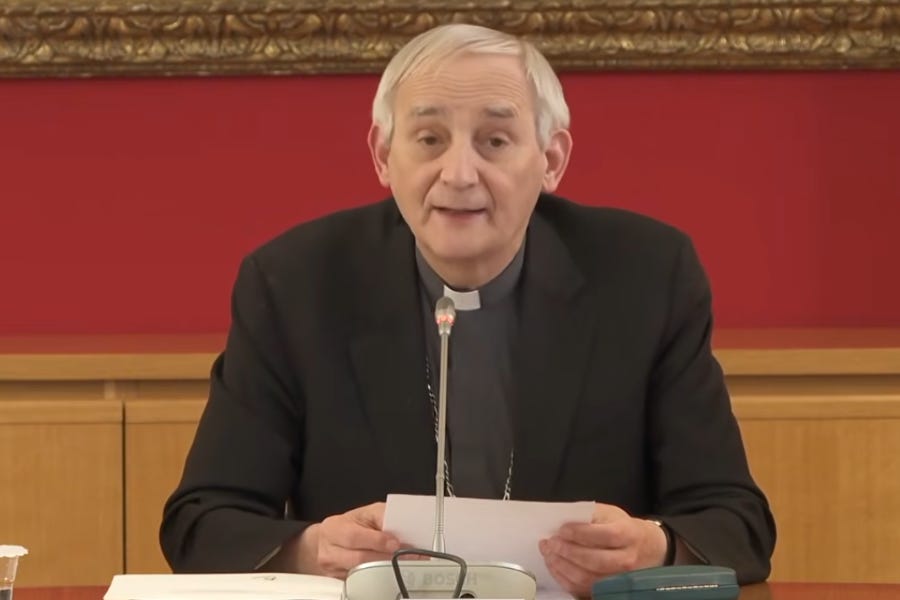
Zuppi, the president of the Italian bishops’ conference, made the remarks Jan. 26 during an address to the conference’s permanent council, with the Italian Senate is expected to take up a euthanasia bill in February.
“The most fragile and vulnerable, often invisible, could become convinced that they have become a burden to their families and to society as a whole, deciding to step aside prematurely and leave the scene,” the cardinal told his brother bishops.
“Human dignity is not measured by its efficiency or usefulness. Life always has value, despite illness, frailty, and limitations. The answer to suffering is not to offer death, but to guarantee forms of social support, continuous health care, and home health care, so that the patient does not feel alone and families can be supported and accompanied,” he said.
Zuppi’s remarks came after the justice and social affairs committees of the Italian Senate approved, in a joint session on July 2, 2025, the text of a euthanasia bill proposed by members of the conservative governing coalition.
Debate over euthanasia in Italy dates back to a 2019 ruling by the constitutional court calling on parliament to legislate on assisted suicide.
The bill’s supporters argue that it narrowly circumscribes the practice, allowing only patients receiving palliative care and kept alive by life-sustaining treatments to request assisted suicide in extreme cases. Several Italian regions, including Sardinia and Tuscany, passed regional laws legalizing euthanasia in 2025.
The Italian bishops and the country’s prime minister Giorgia Meloni have criticized the bill, though she has not ruled out eventual support depending on the final content.
At her end-of-the-year press conference in December 2025, Meloni said she believed that “the state’s role isn’t to encourage suicide, but rather to minimize the loneliness and hardship experienced by those with serious illnesses and their families … that make assisted suicide appear as an option.”
“Whether I favor it or not depends on the content. The Senate is dealing with it, where there are proposals; there are no government initiatives,” she added.
Zuppi also emphasized palliative care as an alternative to euthanasia.
He said: “We must choose and strengthen, at the national level, interventions that best protect life, promote support and care during illness, and support families in times of suffering.”
“We also feel a strong duty to remind everyone that choosing an early death … is not an individual act, but profoundly impacts the fabric of relationships that constitute the community.”
He added: “It is precisely when a person becomes weak that they need a network to support them… The presence or absence of this support can be the dividing line between choosing to live and requesting death.”
Studies point out that only 25% of patients needing palliative care can access it, even though Italian law recognizes it as a legal right.
“Palliative care — which must be guaranteed to all, regardless of social or geographic distinctions, yet is not implemented — represents a true antidote to the logic that considers assisted suicide or euthanasia as viable options,” Zuppi said.
“This logic of death can also be subverted with a strong commitment from Christian communities, called to reach out to those approaching the final stage of life with responsibility, charity, and an evangelical spirit,” Zuppi concluded.
The address marks a significant departure from Zuppi’s more cautious public statements on euthanasia in recent months.
In November, Zuppi had expressed himself in much more ambiguous terms during a press conference.
“We are especially concerned about the differentiated autonomy on assisted suicide. The ongoing debate is not about a right, but about decriminalization; these are very different things,” Zuppi said at the time.
“Palliative care must be guaranteed to all, effectively and uniformly, in all regions: it is a concrete way to alleviate suffering and ensure dignity until the end… It’s not about persecution, but about not losing our humanity,” he commented.
Meanwhile, Avvenire, the newspaper of the Italian bishops’ conference, published an article in 2025 against “totally negative” proposals on the decriminalization of euthanasia.
The shift in tone follows a series of unequivocal statements by Pope Leo XIV against euthanasia.
In December, in comments to journalists after leaving Castel Gandolfo, the pope said he had spoken “very explicitly” with Illinois governor JB Pritzker about assisted suicide legislation signed into law in that state.
“We were very clear about the necessity to respect the sacredness of life from the very beginning to the very end. And unfortunately, for different reasons, he decided to sign that bill. [I’m] very disappointed about that.”
In his January address to the diplomatic corps in the Vatican, the pope said that “civil society and states also have a responsibility to respond concretely to situations of vulnerability, offering solutions to human suffering, such as palliative care, and promoting policies of authentic solidarity, rather than encouraging deceptive forms of compassion such as euthanasia.”

Only 25% of people can access palliative care? That's absolutely disgraceful. That right there is a great example of a fight that is tailor-made for lay people. I'm glad his Eminence is speaking clearly, but this seems to me like a no-brainer: the brightest and best lay people competent in that field could have an enormous impact. I'm sure the Italian faithful are engaged in it, and I'd be interested to know how it goes.