Ahead of Leo visit to Spain, monument remains controversial
Leaked correspondence suggests the Spanish bishops have played a larger role than they have publicly admitted.
When Pope Leo travels to Spain in June, he’ll find himself in the middle of a complex situation involving the Spanish bishops and the country’s socialist government.
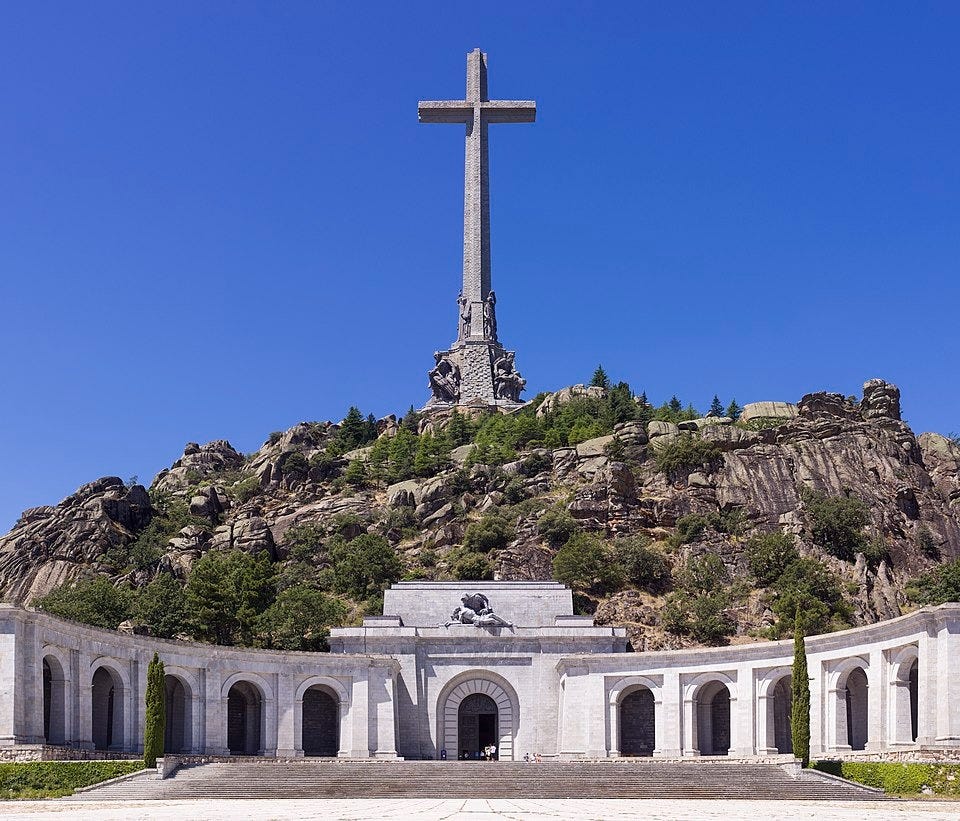
While the focuses of tension are varied, perhaps the largest one is the government’s attempt to “resignify” the Valley of the Fallen, a Franco-era monument to the deceased in the Spanish Civil War. The monument, which is owned by a public foundation, contains the world’s largest cross, a basilica, and a Benedictine abbey.
While the Spanish bishops have claimed they did not approve planned changes to the monument, recently leaked correspondence between the Archbishop of Madrid and the Spanish Minister of Justice suggest that the bishops have played a larger role than they have publicly admitted.
Meanwhile, the monks at the abbey have filed a civil complaint over the project, arguing that the Madrid archdiocese does not have legal standing to represent them in negotiations regarding the monument, because they belong to a sui iuris abbey, directly subject to the Holy See.
The monument of the Valley of the Fallen – or Valley of Cuelgamuros, as it was officially renamed a few years ago – was meant to be a symbol of reconciliation after a bloody civil war that tore Spain apart in the 1930s.
Instead, it has become a frequent source of controversy between the political left and right in Spain, and more recently the subject of tense negotiations between the government, which intends to “resignify” the site, and Church authorities.
The monument was commissioned by Spanish dictator Francisco Franco in 1940, a year after his victory in the Spanish Civil War.
The monument uses Catholic symbols and imagery, and includes a 152-meter (500-foot) vertical cross, a cross-shaped basilica, and a Benedictine monastery.
More than 30,000 people are buried there, one-third of whom fought for the Republicans, who fought against Franco’s Nationalist forces.
The principal architects of the monument were Francoist supporters, while the sculptor in charge of the statues in the monument was a socialist.
The monument’s supporters laud it as a campus dedicated to reconciliation, where combatants and victims from both factions are buried side-by-side and where Benedictines are tasked with praying for atonement, reconciliation and peace.
But some contemporary Spaniards say the complex is a tribute to fascism, and stands as a testimony to a period and an event they wish had never happened.
Critics do not see the basilica as a gesture of reconciliation, but instead as a celebration of the regime, and the victory of Catholic nationalism over anti-clerical republicanism.
They also charge that the basilica was built by forced inmate labor, while supporters argue that only volunteer prisoners were used, and they had two days struck off their sentence for each day they worked, besides being paid a proper wage.
Adding to controversy over the site is that Franco was buried at the monument — against his own wishes — and his body remained there until 2019, when the government won a legal battle to exhume his remains, arguing that the site had become a pilgrimage destination for the far right.
After more than a decade of discussion, the Catholic Church and the socialist-led government in Spain announced earlier this year that they had reached an agreement which would keep the basilica, its massive cross, and the Benedictines in place, with the government moving forward with plans to “re-signify” the parts of the monument “not reserved for worship” — although this would include parts of the basilica itself.
Cardinal José Cobo of Madrid downplayed the role he played in the negotiations, saying he didn’t have jurisdiction over the abbey. The Spanish bishops’ conference has also said that the Vatican did not sign any deal with the Spanish government.
This had led to confusion as to who was responsible for the negotiations, as well as criticism for the lack of transparency in such a thorny issue for the Spanish Church.
When the Spanish government announced an international contest for proposals to resignify the monument in April 2025, the Spanish bishops’ conference was quick to distance itself from the initiative, publishing a statement saying that “the Catholic Church has never been the promoter or driving force behind the re-signification activities that the Spanish government wishes to carry out in the Valley.”
“The government is taking the initiative by launching a tender for proposals without consulting the Church about the details or questions that should be clarified beforehand, in case the spaces and religious sensibilities are not respected.”
However, Religión Confidencial published leaked letters between Cardinal Cobo and the Spanish Minister of Justice Félix Bolaños regarding the agreements.
The correspondence between Bolaños and Cobo is dated March 4- 5, 2025, a month before the resignification was publicly announced. The letters indicate that the decision had been made in coordination with Cobo, even as the bishops’ conference statement suggested otherwise. They also suggest that the Vatican had given at least tacit consent.
The letters also include an annex outlining which parts of the monument would be included in the “resignification” plan. In it, Bolaños and Cobo agreed that the space reserved for worship would be reduced to the altar and the nearby seating area, while the rest of the interior of the basilica - narthex, atrium, nave, and dome - would be considered as “not destined for worship.”
Therefore, all these areas of the basilica are open to interventions, so long as these interventions are “compatible with the celebration of the liturgy,” and guarantee an independent space of access to the space reserved for worship.
In one letter, dated March 4, 2025, Cobo accepts the transformation of parts of the basilica as long that the “sacred spaces and the presented artistic expressions are harmonized in such a way that they respect the religious and cultural end of these spaces according to the characteristics of a Catholic church,” after Bolaños had told him that the Spanish government had launched an international contest of ideas to resignify the monument.
Bishop César García Magán, auxiliary bishop of Toledo and spokesman of the Spanish bishops’ conference, said in an April 2025 press conference that the government originally wanted to decommission the basilica, expel the Benedictine community from the basilica, and take down the cross in the monument, but the negotiations thwarted such proposals.
In the correspondence, Bolaños speaks of conversations held with the Vatican secretary of state, Cardinal Pietro Parolin, while Cobo said he had conversations with the Benedictine community in the basilica, the Spanish nuncio, and the president of the bishops’ conference under the coordination of the Holy See, “in which it was agreed that the Archbishop of Madrid should start the dialogue.”
In an April interview, Minister Félix Bolaños said that “regarding the Cuelgamuros there was an agreement, but not an agreement with Cardinal Cobo that I also signed. There was an agreement with the Vatican. Therefore, the Vatican is absolutely committed to the Valley being a place of memory and democracy and not a mausoleum of the dictatorship.”
The Spanish bishops’ conference, however, has repeatedly said that the Vatican did not sign the agreements and merely took part in some of the conversations.
While no Vatican official signed any documents on the resignification, the correspondence between Bolaños and Cobo seems to reveal a much more active role by the secretariat of state than the Spanish bishops’ conference and the Archdiocese of Madrid have publicly admitted.
In one of his letters, Cobo claims to be working in “coordination with the Holy See,” and of having informed Rome of his reply to Bolaños before writing the letter.
In a March 26, 2025 statement, the Archdiocese of Madrid said that the only things that had been agreed upon were the “the continued presence of the Benedictine community and the preservation of the Basilica’s status as a place for worship, as well as respect for all religious elements located outside the Basilica,” despite the fact that Cobo had already agreed to interventions within the basilica as part of the resignification.
Moreover, while more recently the archdiocese and the Spanish bishops’ conference said that the Holy See was not a signatory of any agreements, the March 2025 statement claimed that there was an agreement between the Holy See and the Spanish government that “guaranteed the continuity of the Benedictine community.”
The statement also added that “any other aspect related to the resignification is of the exclusive competence of the Holy See and the government, which are the parties that have taken part in the negotiations.”
That claim again appears to contradict the bishops’ conference’s statement about the Holy See’s role in the negotiations, as well as Cobo’s own signing of the agreement on the resignification with Spain’s justice minister.
An April 16, 2025 statement from the Archdiocese of Madrid said that the “the terms of the agreement reached between the government and the Holy See are general and have never gone into the details or specifics of the agreement,” despite the fact that the correspondence between Cobo and Bolaños discussed specifically which parts of the basilica would be resignified.
Some commentators in Spain have defended the Church’s negotiations on the grounds that the monument is owned by a public foundation, meaning the Church has no legal authority to block changes the Spanish government wishes to make. From that perspective, the continued presence of the basilica and the Benedictine community should be considered a victory.
But a December 2020 report from the council of legal affairs of the Spanish bishops’ conference published by Religión Confidencial mentions several legal arguments that could be used to defend the monument from resignification.
The report says that according to article I.1 of the Agreement on Legal Affairs between the Holy See and the Spanish state of 1979, the Basilica of the Holy Cross of the Valley of the Fallen is a “sacred place of the Catholic Church and, therefore, inviolable.”
The Decree-Law establishing the Fundación del Valle de los Caídos (Foundation of the Valley of the Fallen) in 1957 says that the basilica, abbacy, guesthouse, choir school, and adjacent premises are owned by the foundation, which is a public foundation established for religious purposes.
The Decree-Law includes the Spanish state’s commitment that the Benedictine community’s presence be perpetual, unless the monks fail to comply, “which is not the case,” according to the report.
Furthermore, Pope Pius XII established the abbacy “in perpetuity” through the Apostolic Letter Stat Crux of May 27, 1958, such that, “having been established by a pope, only another pope could abolish it.”
Moreover, the report itself claims that the abbey of the Holy Cross is a sui iuris abbey incorporated to the Congregation of Solesmes of the Order of Saint Benedict, and therefore, is a “canonical entity not under the jurisdiction of any bishop… or the Secretariat of State of the Holy See.”
The report adds that the legal representation of the abbey corresponds exclusively to the prior, and that “Any other ecclesiastical body or authority, such as an archbishop, is not authorized to sign an agreement that directly affects the abbey, and consequently that legal act is null and void,” while the third clause of the agreement between the foundation and the Abbey of Silos - the abbey from which the first monks came to the Valley of the Fallen - in 1958 expressly states that the administration of the goods of the foundation is specifically entrusted to the prior, and “not to any other authority.”
In fact, in an April 16, 2025 statement, the Archdiocese of Madrid, said that its role is of “support, but without having jurisdiction over the basilica or the religious community residing there,” and that the Church “has never been a promoter or driving force” behind the resignification activities.
The bishops’ conference report also says that using the monument for civil purposes, even when compatible with worship, violates the 1979 agreement between Spain and the Holy See on legal affairs — which is an international treaty.
Articles 1.1 and 1.5 of the agreement guarantee the free exercise of the Church’s activities and the inviolability of its places of worship. The report notes that “these precepts do not make a distinction depending on the ownership of the property,” meaning that the inviolability of places of worship also extends to places of worship in publicly owned buildings, as is the case with the basilica.
Therefore, the report concludes that any modification to make a civil use of the basilica should be conducted “according to the general rules of international law, and not of internal law.”
In November 2025, the monks of the Valley of the Fallen filed a civil complaint against the resignification project, which temporarily halted the contest and the negotiations between the Church and the Spanish government. If effective, the complaint would mean that no agreements can be made without the consent of the prior of the Benedictine community.
The complaint led Bolaños to ask Cardinal Parolin to expel the Benedictine community from the monument and replace it with a different religious community in October 2025, according to media reports.
In November, the Spanish government announced the project that was chosen for the resignification of the monument would cost 31 million euros. According to the project, most of the interventions would be done on the exterior of the monument, while the changes to the basilica would be minimal.
“It is a project that boldly confronts the monumental scale of the existing complex. It proposes a new vision of this monumental complex in which boundaries are redefined, nature is given greater prominence, and the axiality that had so characterized this monument is broken to create a large shadow—a great fissure—that facilitates encounters, invites dialogue, and encourages a more pluralistic, more democratic one that includes many perspectives,” Iñaqui Carnicero, one of the leaders of the project, said.
The project intends to eliminate the grand staircase that leads to the basilica and the construction in its place of a portico at the foot of the church, resembling a large horizontal fissure that will stretch from side to side of the monument’s esplanade.
Visitors will be able to enter through this portico into a circular, open-roofed vestibule that will provide shared access to both the basilica and the new visitor center, which seemingly violates the agreement between the Church and the Spanish government that said that the basilica should have an independent entrance.
While the project said the interventions in the interior would be “minimal,” much has been left to say beyond that. The only specific change the project mentioned was the installation of panels to “resignify” some of the basilica’s side chapels.
The project organizers say that the preparatory phase will take eight months, followed by 40 months of construction. The process, however, has been halted while the legal complaint filed by the monks is resolved.

