
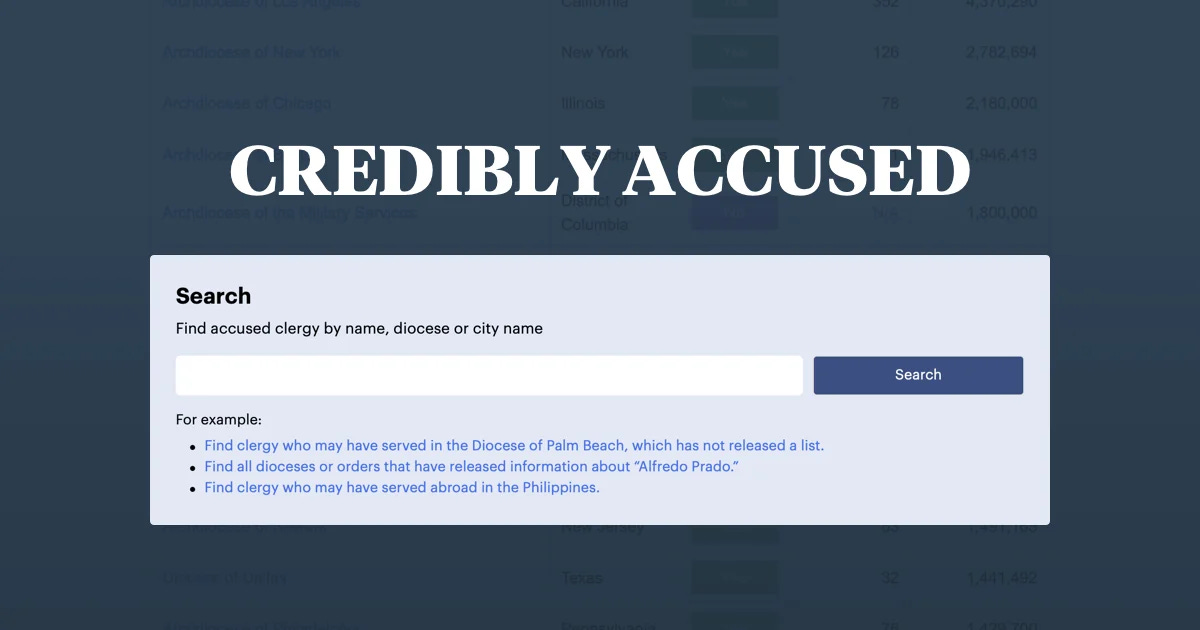
The highest appellate court in the Catholic Church, the Tribunal of the Roman Rota, published last month an English translation of a ruling that criticized Catholic dioceses and religious orders for publishing online lists of priests “credibly accused” of abusing minors.
The court issued this decision on June 26, 2025, in a canonical defamation lawsuit brought by man against his former religious order.
The court noted that: “the Catechism of the Catholic Church teaches under No. 2477: ‘Respect for the reputation of persons forbids every attitude and every word which may cause unjust harm to them,’”, along with the canonical norm that no one may be deprived of his good reputation unjustly.
The court’s main objection was that the man, referred to as Mr. X, was never charged or convicted of a crime by the Church or law enforcement.
That is true, but that’s also the core problem. The sexual abuse crisis in the U.S. grew because the Church so rarely put accused priests through formal canonical trial processes and failed to report allegations to police for investigation.
What would have happened if dioceses and religious orders had acted to uphold justice and protected victims as these abuse cases occurred throughout the mid-20th century? They would have announced allegations publicly, invited potential victims to step forward, and partnered with law enforcement to conduct thorough investigations. Once concluded, they would have announced the findings to either incriminate or exonerate the priest. All of that would have been public.
For 13 years I was privileged to serve three Catholic dioceses and multiple bishops as a communications and executive advisor. I have also advised diocesan communications directors going through complicated media outreach regarding child sexual abuse allegations and the publishing of lists of credibly accused priests. That experience gave me helpful insight into the credibility and seriousness of findings that have been, and still are, published by dioceses and religious orders in those lists condemned by the rota.
For one, it should be acknowledged that public reports often use but rarely define the term “credibly accused.” However, it is essential to realize that while the Church mistreated victims decades ago, the lists of credibly accused priests published today are subject to intense, rigorous review.
While no two dioceses are the same, in my experience, a finding of credibility typically came in at least one of three ways.
One, the priest admits the allegation was true.
Two, the priest was found guilty by a Church or criminal court.
Three, the diocesan review board assessed all available information and evidence, made a recommendation to the bishop to permanently remove the priest from ministry, and the bishop accepted the recommendation.
The institution of diocesan review boards was created under the 2002 “Charter for the Protection of Children and Young People,” promulgated by the U.S. Conference of Catholic Bishops. Establishing these boards was perhaps the most consequential decision the bishops ever made.
In addition to the sincere and honest efforts by contemporary bishops, the charter is a major reason why the Catholic Church in the U.S. is perhaps the safest place for children outside of the care of their own parents.
The members of diocesan review boards are often a mixture of former law enforcement, attorneys, medical experts, human resource professionals, psychologists, parents, and priests with experience in both Church governance and canon law.
Each member is selected to ensure facts are evaluated from multiple professional angles. In many cases, review boards use the civil standard of a “preponderance of the evidence”—meaning they must advise their bishop whether, based on available evidence, it is more likely than not that the abuse occurred, with a view to proceeding with a canonical process.
These review board determinations are most often the locus of complaints about the due process rights of accused priests.
In its recently published decision, the Roman Rota quoted canon 220 of the Code of Canon Law: “No one is permitted to harm illegitimately the good reputation which a person possesses nor to injure the right of any person to protect his or her own privacy.”
And there are cases, in fact, where a review board either discerned poorly the recommendation made to their bishop, or were denied critical evidence by ecclesial bodies or law enforcement, and therefore made a poor recommendation on incomplete information. I was floored how often local law enforcement would not give the diocesan review board evidence that could have justified permanently pulling the priest from ministry or could substantiate his innocence, simply as a matter of policy.
In some cases, a priest’s actions may not have violated criminal law, yet remained deeply immoral and contrary to Church law. Bishops need to know the truth in either situation, but law enforcement agencies rarely share internal case documents or evidence.
On rare occasions, review boards have deemed allegations credible against priests who were later proven innocent. In those cases, a priest’s reputation may suffer long-term damage before exculpatory evidence comes to light. When this occurs, dioceses have a strict obligation to correct the public record and do everything reasonably possible to restore the priest’s good name and make amends.
The Rota, however, uses concerns over these instances as reason to deny victims and the faithful a full accounting of which priests abandoned their most fundamental duty to protect God’s children. They did the opposite – they preyed on them.
Claiming these public lists are illegitimate entirely, rather than in need of constant vigilance and improvement, dismisses the exhaustive work review boards undertake when examining evidence, hearing witness testimony, speaking with the victim, interviewing the priest (if he so chooses), and reviewing other claims. For decades, the Church failed children, while law enforcement often could not act or chose not to. Public accounting remains one of the few avenues left for victim justice.
In my opinion, the strongest criteria for a finding of credibility, of the three mentioned above, is one and three. An admission of guilt to a gut-wrenching crime is compelling. And the persistent and fair assessment of all facts by both priests and laity gives the faithful greater confidence that the case was reviewed seriously. Especially compared to any canonical process which might follow, which strikes many of the faithful as mysterious and closed-door, carried out exclusively by priests and not likely to inspire confidence.
Law enforcement may choose not to investigate the abuse claim at all, for various reasons, and should not be seen as an inherently more credible body to produce justice than a review board.
And to be clear, not every allegation before a review board is found credible. I wrote statements several times announcing that a particular allegation was not substantiated by the evidence. We would spend as much effort as needed to reasonably clarify that the priest is presumed innocent.
There were circumstances at times, though, where the priest was clearly guilty of wrongdoing, boundary violations, or lesser infractions than sexual child abuse. We could not be as effusive about his overall innocence in those circumstances and sometimes, due to those or other moral issues, they were still not fit for public ministry.
A police officer once told a diocesan general counsel I worked with that the priest under investigation repeatedly kissed a minor on the mouth, but that it doesn’t constitute sexual assault. By the letter of criminal law in that state, I suppose he was correct. But I, nor any bishop I have ever worked with, want that priest anywhere near children.
To suggest that credible findings can only originate from internal Church trials ignores how often closed-door processes historically subverted justice for victims.
Mr. X allegedly abused two children in the 1980s. In 2002, he requested and received permission from the Holy See to return to the lay state and be dispensed from religious life. In 2002. Are we asked to believe that it is coincidental that his request to leave his religious community was the same year the U.S. bishops committed to sweeping new policies, transparency, restrictions on abusive priests, and protections for children?
The good news is that most of today’s bishops were in diapers when the mid-20th century allegations took place. They came through seminary in a very different time, with very different expectations of the Church. New bishops are ordained to ministry in which the strongest organizational child protections on the planet are the playbook and reasonable transparency is the expectation.
The bad news is that no mechanism can fully remedy decades of past misconduct and institutional cover-ups. Nevertheless, review boards perform vital work to ensure that when allegations are credible, the truth is acknowledged, and victims are believed.
This structure and process could also be used to investigate allegations of priests who sexually abuse and manipulate adults, especially those under the priests supervision as a spiritual director. There is no universal guideline or mechanism for investigating those canonical crimes and the Church essentially functions with adults the way it did with children 70 years ago. No two dioceses handle them the same. But perhaps that will come later. I pray it does.
Justice is good for victims – they need to know the Church cares for and believes them. Pastoral care can’t be received if the victim feels like the Church is continuing to harm them.
Justice also benefits priests by clearing the innocent and holding the guilty accountable.
The Church is better for it.
Billy Atwell is Founder and Principal of Atwell Consulting, where he focuses on executive communications, reputation strategy, and leadership development. He spent 13 years as an executive and communications advisor and spokesperson for dioceses and bishops.
"On rare occasions, review boards have deemed allegations credible against priests who were later proven innocent. In those cases, a priest’s reputation may suffer long-term damage before exculpatory evidence comes to light. When this occurs, dioceses have a strict obligation to correct the public record and do everything reasonably possible to restore the priest’s good name and make amends."
The internet has created permanence of information that has never existed before and this is an issue that needs to be considered as well.
"In 2002 he received permission to return to the lay state..." The bishops' conference published the Charter for the Protection of Children and Young People in 2002. The implication is that the charter caused him to ask to return to the lay state. Perfect example of the Post hoc ergo propter hoc fallacy.
The historical method of hiding/concealing abuse was an evil perpetuated by ecclesial authorities; however, it is also evil to publicly slander an individual's reputation when they cannot defend themselves (i.e. they are dead), or to answer the allegations prior to their publishing. One cannot commit evil in an attempt to correct a prior evil.