
More than three months after the Dicastery for the Doctrine of the Faith issued its decree declaring the excommunication of the leadership of the Society of St. Pius X, questions remain about the full effects of the society’s schism.
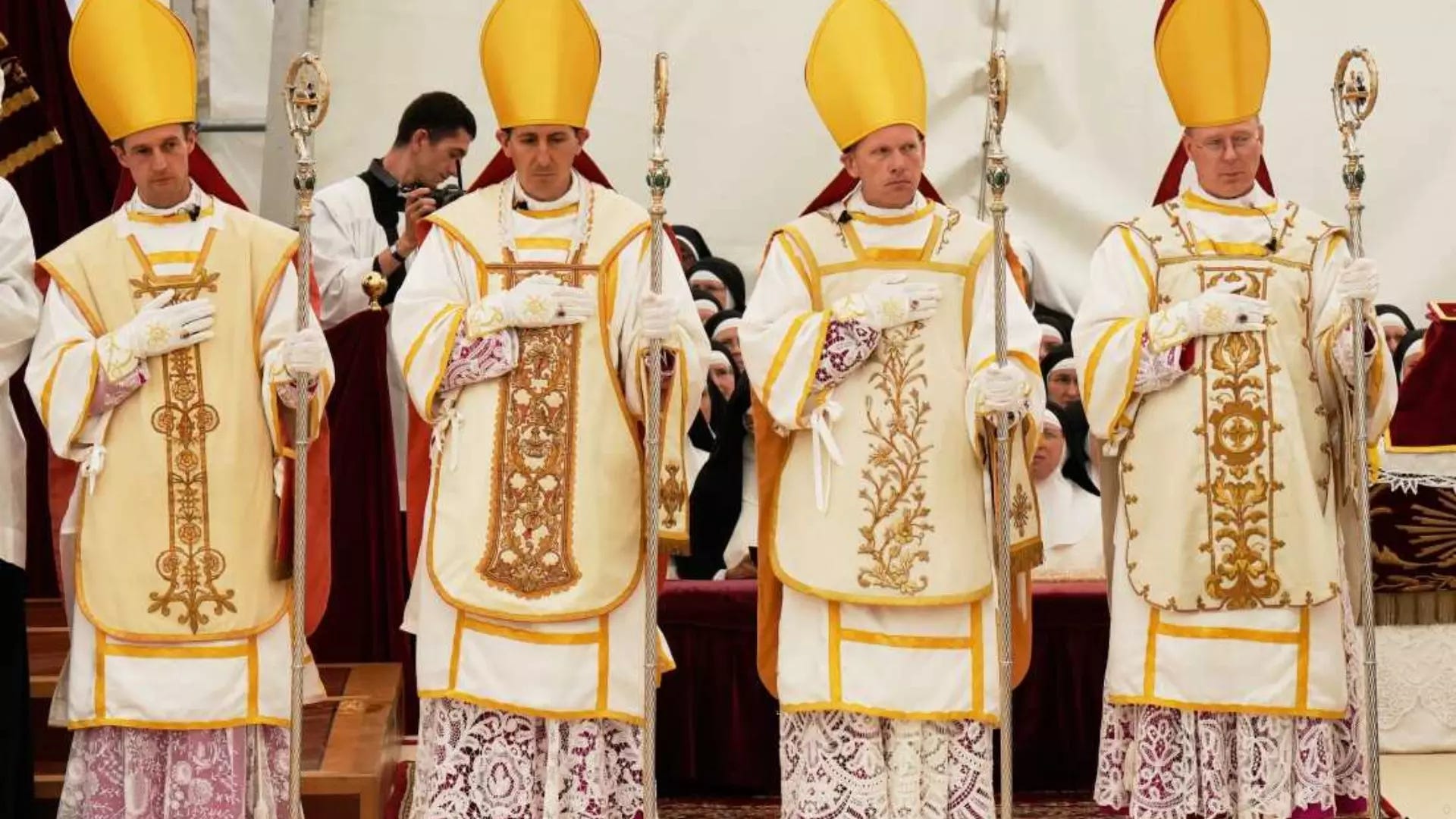
The four bishops illicitly consecrated for the Society of St. Pius X. Credit: SSPX.
Specifically, it remains an open question whether sacramental confession and absolution imparted by the society’s priests is valid, and whether those priests can validly receive the consent of Catholics contracting marriages.
Canonical questions were raised in July, without clear answers emerging from the Vatican, after a document from the Dicastery for the Doctrine of the Faith stated that both sacraments were invalidly performed by SSPX clergy.
However, reports of a new canonical opinion from a different Vatican department suggest the DDF statement on the subject may not be accurate — and that Vatican faces another issue in which departments will offer dueling interpretations of the Church’s law-in-force.
—
The Vatican declared in July the excommunication of five SSPX bishops for participation in an illicit episcopal consecration; one was the bishop who performed the consecration, and the other four the men who received the sacrament.
Alongside the decree, the DDF issued an explanatory note which offered more detail on the implications of the act of schism and its effects – moral and canonical– both for the society and those associated with it.
But for some, the explanatory note raised more questions than it answered. Key among them were questions about the canonical status of the priests affiliated with the SSPX, the lay people to whom they ministered, and the sacraments which were offered and received in SSPX chapels.
The DDF note appeared to be frank about the moral status of the society’s ministry and those that participated in it, while striking a nuanced position on the canonical effects. The document said that, following the schismatic consecrations, “the sacred ministers belonging to the Priestly Fraternity of Saint Pius X are in schism and must therefore be considered schismatic.”
While that might seem like a bald statement, even a legal declaration, it actually admits to a few important distinctions. The participation in a group which publicly sponsored an act of schism, and is led by schismatic bishops, would seem to be self-evidently schismatic. But the dicastery’s statement that the SSPX priests must, as a group, be considered to be schismatic isn’t the same, legally speaking, as declaring them individually to be schismatics and declaring the penalty of excommunication, as they did with the bishops.
The distinction is important: A person can commit the canonical crime of schism, and even incur the automatic penalty of excommunication, but until that penalty is declared formally by Church authorities, it does not have a full canonical effect.
As for lay people, the DDF was even more guarded in its assessment. Without walking back the schismatic nature of the SSPX itself, it allowed that determining the intention to commit or affiliate with the society’s schism was certainly possible for lay people, but could only be judged on a case by case basis.
One one point, though, the explanatory note was unambiguous and unnuanced: That “the sacred ministers of the Priestly Fraternity of Saint Pius X administer the sacraments illicitly and that the sacrament of penance administered by them and the marriage assisted by them are invalid.”
It was, as was noted at the time, a significant statement. But the DDF did not offer any canonical rationale for its assertion, and questions from The Pillar to the DDF on the subject went unanswered.
The issue was that to hear confessions and impart sacramental absolution validly (outside danger of death) requires a priest to have a canonical faculty. That faculty was granted to the priests of the SSPX as part of the Jubilee of Mercy by Pope Francis, and indefinitely extended by papal decree in 2016.
Similarly, Francis authorized – via a letter from the DDF – diocesan bishops to grant the faculty for SSPX priests to witness the marriages of Catholics and satisfy the requirements, for validity, of canonical form.
To date, the Holy See has not announced that those documents have been officially revoked.
This has created a canonical non-man’s land between the assertion of the DDF and the canonical reality on the ground, which remains unexplained and legally unaddressed.
Excommunication prohibits the exercise of faculties given, but doesn’t explicitly revoke them. And a priest laboring under an undeclared excommunication can, according to canon 1335, confer sacraments validly when a Catholic requests them
That the faculty to validly hear confessions remains intact seems to be the consensus opinion among canonists, including those working in various Roman dicasteries, since the 2017 decree granting them faculties is a formal act of papal governance, and as such can only be amended or withdrawn by another direct act of the pope.
The situation regarding marriages, however, has been more debated — at least until recently. The ability of SSPX clergy to receive the consent of Catholic parties for canonical form was not granted universally and directly by papal decree. Instead, in a letter from the pontifical commission Ecclesia Dei, which handles relations with the SSPX and sits within the DDF, the heads of bishops’ conferences were informed in 2017 that local bishops could themselves grant the faculty to SSPX priests at their own discretion.
Because the bishops extended the faculty themselves, they have been free to revoke it at any time. However, canonists have disagreed about the immediate impact of July excommunications and DDF explanatory note.
Some have argued that, absent a specific withdrawal of the 2017 letter, which communicates a papal legal authorization, those faculties granted by bishops remain intact unless withdrawn by the bishops themselves. Others contend that the letter is not itself a direct papal legal act and could be superseded by a simple statement from the DDF — though they usually concede a one-sentence declaration in an explanatory note would not appear to pass canonical muster.
Reiterating the consensus on the confessional faculties — that absent a papal withdrawal, the SSPX faculties remain intact — the DCLT response reportedly went further and said that “The Explanatory Note published on July 2, 2026, by the Dicastery for the Doctrine of the Faith states that marriages assisted by sacred ministers of the Society of Saint Pius X are invalid. However, it does not appear from the published text that such a declaration was approved by the Roman Pontiff with the intention of revoking or derogating from the provisions contained in the Letter of the Pontifical Commission ‘Ecclesia Dei’ of March 27, 2017.”
The full text of the reported response was not published, nor has The Pillar been able to confirm the text, so it is possible that the DLT document offers some further argumentation or contextualization.
But the appearance for the moment is that the DDF’s statement about the invalidity of SSPX confessions and marriages is, canonically speaking, simply wrong — at least according to the Vatican’s own authoritative canonical body.
That represents a significant point of pastoral confusion for bishops in their dioceses, to say nothing of pastors attempting to communicate to local faithful the very real and very really canonically declared state of schism the SSPX has chosen for itself.
It also suggests the possibility of an alarming failure by the DDF to properly prepare and score canonically a major document on an issue of global significance — one which was announced months in advance.
As Pope Leo continues his gradual reform of the Roman curia, the current DDF prefect, Cardinal Víctor Manuel Fernández, has widely been expected to remain in post at least until the expiration of his five year term of office, scheduled to end in 2028. That more than three months after the SSPX consecrations, his dicastery has still not clarified basic consequences of the society’s schism will likely serve to amplify calls for an earlier change.
Ambiguity and even error? From Tucho’s DDF? I’m shocked, shocked!
Thanks, Ed! Please continue to keep us posted. This kind of detailed, competent coverage on canon law issues is one of the topmost reasons why I'm glad to support the work of The Pillar!