Armenians ‘disappointed’ and ‘frustrated’ with Vatican over Azerbaijan ties
“Azerbaijan has been successful in preventing the Vatican from supporting the protection of our rights and especially our cultural heritage.”
Armenians from the region of Nagorno-Karabakh are “disappointed” and “frustrated” with the Catholic Church over its ties to Azerbaijan and a foundation that has funded hundreds of millions of dollars’ worth of restoration projects in the Vatican, a leading activist told The Pillar.
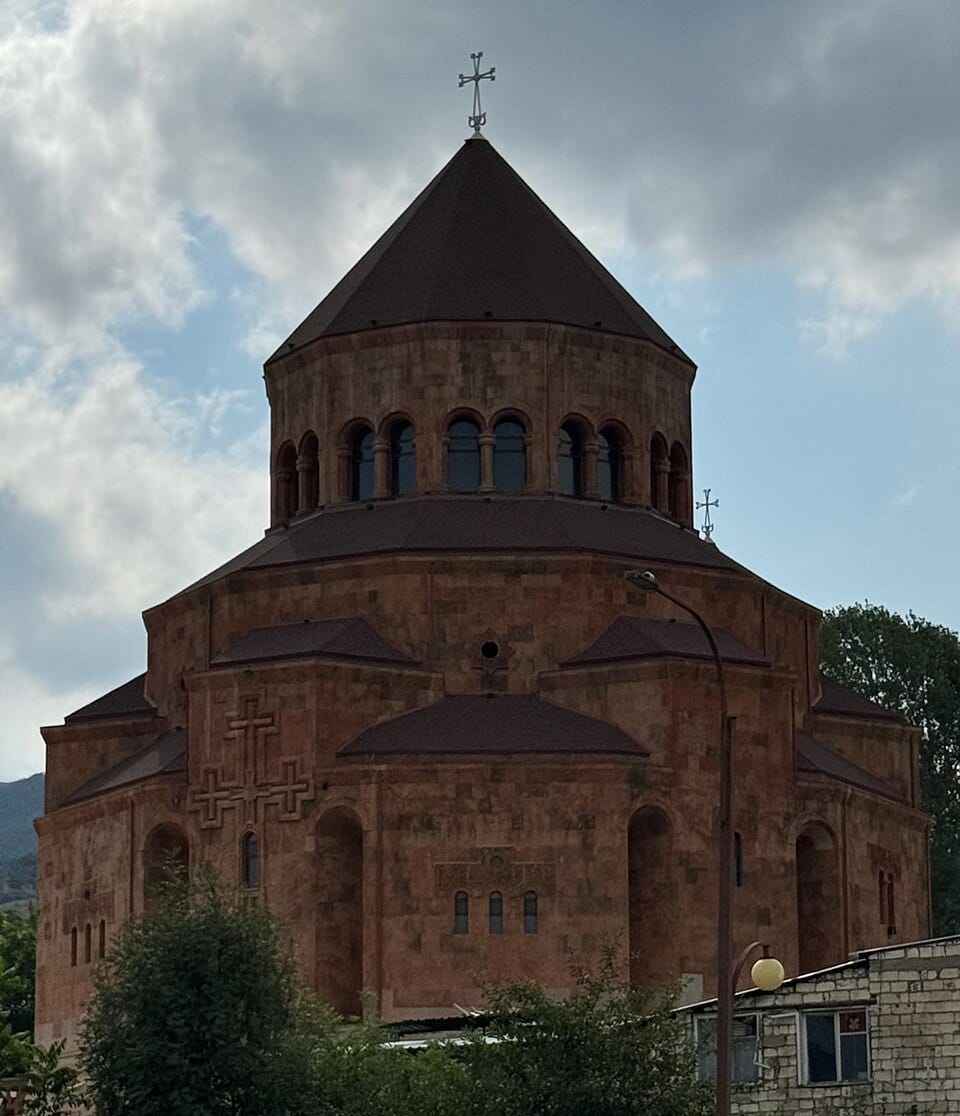
“Azerbaijan has been successful in preventing the Vatican from supporting the protection of our rights and especially our cultural heritage,” said Beglaryan Artak, former human rights ombudsman and chief minister in the Republic of Artsakh.
“We are quite respectful of the Catholic Church, but we are disappointed with its silence regarding cultural heritage and the rights of the Christian people, because we have been ethnically cleansed also because we are Christians,” he told The Pillar.
Beglaryan is also the founder and current president of the Artsakh Union, an organization that advocates for the rights of the former residents of Nagorno-Karabakh who fled or were expelled following the 2023 Azerbaijani invasion of the disputed region. Artsakh is the Armenian term for Nagorno-Karabakh.
“Azerbaijan has fully instrumentalized the Islamic world’s solidarity, even using ISIS terrorists and mercenaries from Syria and Libya in 2020, to fight against us,” he said.
“But we didn’t see any kind of tangible support from the Christian world, and this should have come, first and foremost, from the Catholic Church, which is the largest and most influential institution in the Christian world. That’s why we feel deep frustration about the Catholic Church’s passive attitude.”
Christian Armenians and mostly Muslim Azerbaijanis lived side-by-side in the mountainous region of Nagorno-Karabakh for centuries. Both Armenia and Azerbaijan were part of the Soviet Union, but as Moscow’s influence waned, tensions rose, until a full-scale war broke out between the communities in 1991. The war led to full Armenian control and the declaration of the Republic of Artsakh – which was never recognized by the international community – and the displacement of the entire Azerbaijani population.
In September 2023, Azerbaijan retook the entire region, leading to an exodus of Armenians.
Beglaryan’s organization monitors the status of Armenian heritage sites, including Christian ones, that are now in the hands of Azerbaijan.
“We have more than 6,000 monuments in Nagorno-Karabakh, mostly within 4,400 square kilometers. This is one of the densest and one of the richest examples of Christian heritage in the world and in Europe, with some churches dating back to the fourth century,” he said.
Significant sites include the 13th century Monastery of Gandzasar, which houses what is believed to be the head of John the Baptist.
But activists say that this heritage is now at risk, due to an Azerbaijani attempt to erase the Armenian identity in the region. Satellite imagery has shown the demolition of at least two major Armenian churches, and Beglaryan claims to have evidence of many more examples of vandalization and destruction, including of cemeteries.
“Many of our churches have been targeted by the Azerbaijani forces. Several of them have been fully demolished, and many have been vandalized,” he said.
The Azeris have also been accused of trying to erase Armenian cultural identity by labeling existing churches as “Caucasian Albanian” rather than Armenian.
One such incident took place in an exhibition on Christian heritage in Azerbaijan, which was held in Rome at the Pontifical Gregorian University.
Speakers criticized Armenians as “aggressive settlers” in Nagorno-Karabakh who had defaced Caucasian Albanian churches to present them as Armenian.
The incident prompted criticism of the Vatican, which has also been accused of allowing Azerbaijan to practice “caviar diplomacy,” in part for allowing an Azeri foundation to fund restoration projects of Vatican cultural sites, valued at hundreds of millions of dollars.
These restoration projects are funded by the Heydar Aliyev Foundation, which is run by Mehriban Aliyeva, wife of the current president of Azerbaijan.
An Armenian academic who asked not to be named told The Pillar that the Vatican’s decision in 2020 to award Mehriban Aliyeva the Order of Pope Pius IX, Dame Grand Cross, was “widely criticized in Armenian circles.”
“Critics interpreted it as prioritizing political and diplomatic interests over cultural and Christian solidarity,” he said.
“The Vatican, on the other hand, officially presented the recognition as an appreciation for cultural and interreligious cooperation, not as a political gesture. However, for a significant portion of Armenians, this cooperation raises moral contradictions, especially in the context of concerns over the state of Armenian churches and monuments in Artsakh,” he added.
Asked if he believed there was a direct connection between this partnership and the Vatican’s silence on the attacks on Armenian heritage, the academic responded, “There is no certain evidence that the Holy See’s public caution or limited response is directly due to its cooperation with the Heydar Aliyev Foundation.”
“Objectively, it should be noted that Vatican diplomacy has historically been very cautious and balanced in managing conflicts,” he continued. “It often avoids harsh public statements, seeking to preserve the possibilities for dialogue and mediation with different states.”
A curial cardinal who spoke to The Pillar on the condition of anonymity said that “the Holy See’s philosophy is to keep the channels of dialogue open with everyone.”
“And some good may come of that,” he said, adding that the Holy See maintains relations with both Armenia and Azerbaijan. “And, as trust grows, opportunities may present themselves for the Church to play a positive role in problems that already exist or that may arise.”
The cardinal noted that Pope Leo recently received a visit from an Armenian patriarch, His Holiness Aram I, Catholicos of the Great House of Cilecia, based in Beirut, Lebanon, which oversees part of the Armenian Apostolic Church in the diaspora.
A senior cleric of the Catholicosate declined to confirm to The Pillar whether Aram and Leo had discussed the issue of the Vatican’s relationship with Azerbaijan, but did say that the Armenian Apostolic Church holds the Holy See in high esteem and does not want to let issues such as this endanger good ecumenical relations.
Meanwhile, the relationship between the Vatican and Azerbaijan seems to be deepening. The prefect of the Dicastery for Interreligious Dialogue, Cardinal George Koovakad, recently visited Baku and met with the president, who extended an invitation for Pope Leo to visit the country. Azerbaijani press highlighted the cardinal’s visit, saying that he also went on a tour of two historical Caucasian Albanian churches.
Neither Cardinal Koovakad nor the Heydar Aliev foundation responded to requests for comment.

