Basilica occupation reignites Syro-Malabar liturgy dispute
The protest came days after the basilica resumed public Eucharistic liturgies.
The Syro-Malabar Church’s liturgy dispute flared again Wednesday when protesters occupied a basilica at the heart of the long-running controversy — this time from those favoring, rather than opposing, the Eastern Church’s reformed liturgy.
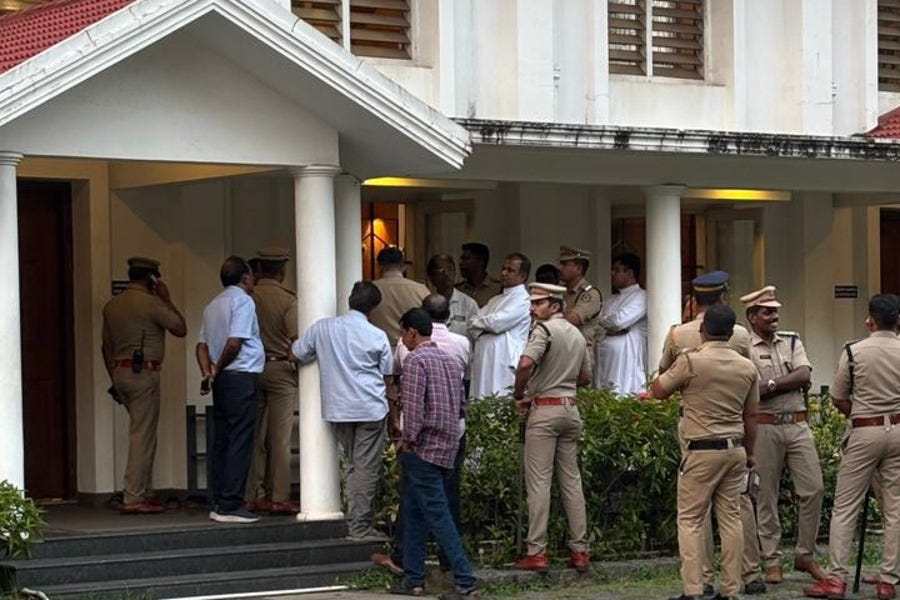
Dozens of protesters from the “One Church One Qurbana” movement, who support a new uniform Eucharistic liturgy, entered St. Mary’s Cathedral Basilica in Ernakulam, southern India, Dec. 10.
They reportedly locked the basilica from the inside, preventing worshipers from attending the 6 p.m. Eucharistic liturgy. The liturgy was due to be celebrated in an older style favored by the majority in the local Archeparchy of Ernakulam-Angamaly, in which the priest faces the people throughout (versus populum).
The protesters argue that the celebration of the versus populum Eucharistic liturgy breaches a 2021 decision by the Synod of Bishops — the Syro-Malabar Church’s supreme authority — that all eparchies (dioceses) should exclusively celebrate the uniform liturgy.
Video footage showed local police standing outside the basilica, talking through a grille to protesters inside the church. The police appeared to be monitoring the situation and there were no reports of arrests.
Public celebrations of the Eucharistic liturgy, known as Holy Qurbana, only recently resumed at the basilica after a three-year hiatus following physical clashes between supporters and opponents of the new liturgy inside the cathedral.
The Dec. 1 resumption of Eucharistic liturgies appeared to mark the end of a painful chapter in the decades-long liturgical dispute. But the occupation could imperil a fragile liturgical peace in the archeparchy.
The protestors’ move came amid rumors that Syro-Malabar leader Archbishop Raphael Thattil and Archbishop Joseph Pamplany, the archiepiscopal vicar of Ernakulam-Angamaly, were scheduled to meet before Christmas with Pope Leo XIV and officials at the Vatican’s Dicastery for the Eastern Churches.
The rumors suggested the archbishops were due to update Rome on developments since an agreement was reached in June 2025 permitting the Ernakulam-Angamaly archeparchy’s priests to continue celebrating the Holy Qurbana versus populum, provided that at least one uniform liturgy is offered in each parish on Sundays and feast days.
Opponents of the new liturgy in the Ernakulam-Angamaly archeparchy argue that the occupation was intended to disrupt the agreement ahead of the rumored Rome meeting.
But members of the “One Church One Qurbana” movement said they occupied the basilica because they believed the resumption of the Holy Qurbana versus populum violated court orders issued after the suspension of public Eucharistic liturgies at the basilica in December 2022.
Lay leader Joy Vettickal told the New Indian Express newspaper that, in response to the alleged violation, “parishioners in favor of uniform Holy Mass opened the church and decided to observe fast and say prayers as per Syro-Malabar Church and Vatican guidelines.”
The newspaper reported Dec. 4 that supporters of the uniform liturgy had filed a contempt petition with the High Court of Kerala, the Indian state where the basilica is located.
The paper added that public Eucharistic liturgies had resumed at the basilica following an Oct. 25 letter from Archbishop Pamplany to Fr. Thomas Mangatt, the basilica’s administrator. The letter reportedly asked Mangatt to ensure that the suspension was lifted at the start of Advent, which began Nov. 30, and Eucharistic liturgies were celebrated in line with the June 2025 agreement.
Mangatt celebrated the Holy Qurbana with a congregation at 6 p.m. on Dec. 1, after the Kerala High Court granted his request that police maintain order at the basilica as public celebrations resumed.
The Dec. 1 Holy Qurbana was celebrated versus populum. Other Eucharistic liturgies were expected to be celebrated in the same style, with the exception of one Sunday Holy Qurbana celebrated in the uniform mode, as required by the June 2025 agreement.
Parishioners favoring the uniform liturgy claimed they were blindsided by the resumption of public Eucharistic liturgies and believed prior court orders remained in place.
The basilica became a major flashpoint after the Synod of Bishops approved the universal introduction of the uniform liturgy from November 2021.
On April 10, 2022, Cardinal George Alencherry, the then-head of the Syro-Malabar Church, launched the uniform liturgy at St. Mary’s Cathedral Basilica under police protection due to local opposition to the change.
Archbishop Andrews Thazhath, the then-apostolic administrator of the Ernakulam-Angamaly archeparchy, was blocked by protesters when he attempted to celebrate the uniform liturgy at the basilica on Nov. 27, 2022.
Police later cleared the protesters and locked the gates to prevent further incidents, leaving the basilica closed to worshipers. During the basilica’s temporary closure, local Catholics prayed outside the locked gates for several days.
When the cathedral reopened later in 2022, supporters of the versus populum liturgy occupied it, holding continuous prayer services.
On Dec. 24, 2022, lay people entered the sanctuary while priests who supported the versus populum liturgy were praying at the altar. The protesters pushed the portable altar to the side of the sanctuary. The priests were jostled as they tried to prevent the altar from being moved. Police in khaki-colored uniforms then penned in the protesters beside the altar.
Public liturgies, beginning with Midnight Mass, were suspended indefinitely at the basilica. Public celebration of the Eucharist ceased entirely for the next three years.
The basilica was reopened on March 26, 2024, after 486 days of full closure, following a local court order. Parishioners were able to pray the rosary and Stations of the Cross, and attend confession.
Talks between clergy of the Ernakulam-Angamaly archeparchy and Syro-Malabar bishops resulted in the June 2025 compromise on the celebration of the Holy Qurbana versus populum, which paved the way for the basilica’s full reopening at the start of the Church’s new liturgical year.
