
A consultation over whether three English dioceses should be merged revealed “a remarkable consensus” in favor of unification, the bishop overseeing the process said in a report published Wednesday.
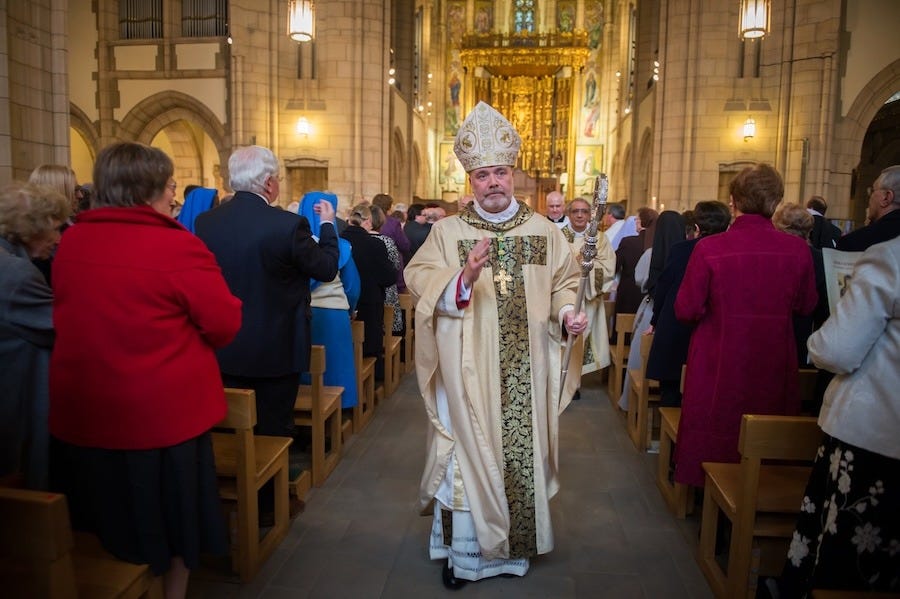
Bishop Marcus Stock said in a 46-page consultation report, issued Oct. 14, that he believed a merger of the Hallam, Leeds, and Middlesbrough dioceses “would help to strengthen the mission of the local Church.”
According to the report, the unified diocese would serve a total of 495,817 Catholics, combining 140,571 from Hallam, 229,453 from Leeds, and 125,793 from Middlesbrough.
A possible U.S. analogy — in terms of the size of the Catholic population — would be a hypothetical merger of the Youngstown, Erie, and Greensburg dioceses. There is no such merger on the table, of course, but as a thought experiment it is arguably similar.
The Diocese of Youngstown, Ohio, serves 124,206 Catholics, according to the latest figures at catholic-hierarchy.org. The Diocese of Erie, Pennsylvania, which borders the Youngstown diocese, has 194,456 Catholics. The Diocese of Greensburg, Pennsylvania, which borders the Erie diocese, has 135,100 Catholics.
In this analogy, Youngstown has a similar Catholic population to Hallam, Erie to Leeds, and Greensburg to Middlesbrough. A hypothetical unification of the three U.S. dioceses would create a single jurisdiction with 453,762 Catholics.
The American analogy can give a sense of the scale of the proposed English triple merger. But Catholic population size is by no means the sole factor in the proposal to unite the Hallam, Leeds, and Middlesbrough dioceses. Another important consideration is historical.
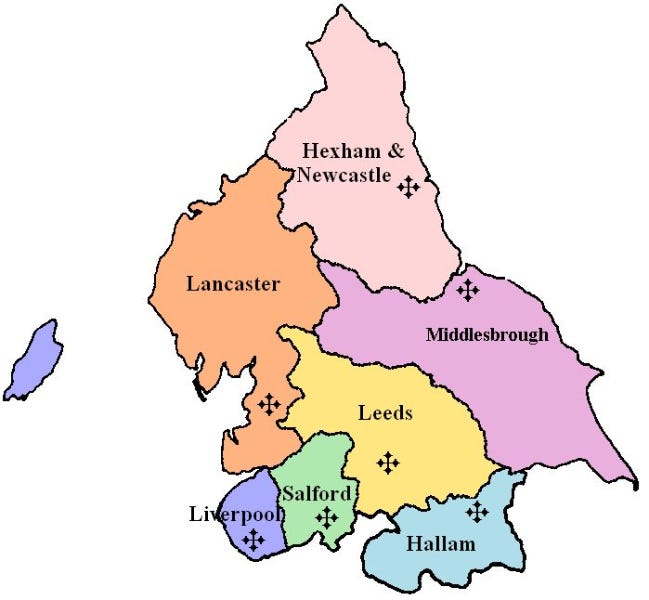
If the three English dioceses were unified, they would cover an area that broadly corresponds to the historic county of Yorkshire, in northern England. This would, in a sense, amount to a reunification because Yorkshire was previously covered by the single Diocese of Beverley.
In 1878, Beverley was divided into the dioceses of Leeds and Middlesbrough. In 1980, Hallam was established from territory belonging to both Leeds and Nottingham dioceses. So there is a strong historical rationale for a unified diocese in this area of England.
The dioceses have in recent years been brought together under Stock’s leadership, while remaining distinct jurisdictions.
The 65-year-old has served since 2014 as the Bishop of Leeds. Since December 2025, he has been the apostolic administrator of Middlesbrough. And since March 2026, he has also been the apostolic administrator of Hallam.
Let’s look at the background to England’s potential triple merger, what happened during the consultation, and what conclusions emerged.
What’s the background?
In his consultation report, Bishop Stock noted that all three dioceses had recorded substantial declines in pastoral statistics between the year 2000 and 2025.
Combined average Mass attendance in the three dioceses fell from 83,409 in 2000 to 40,221 in 2025. This represents a decline of around 52% over 25 years.
Over the same period, annual baptisms fell from 4,569 to 2,786, a drop of approximately 39%.
In this period, the number of incardinated priests holding office declined from 347 to 128, a fall of 63%. At the same time, the number of parishes has decreased from 274 to 193, a drop of 30%. The report said this meant an increase in the average workload for priests.
The three dioceses altogether consist of 193 parishes, supported by 116 diocesan priests in active ministry, 51 missionary and religious priests, and 41 permanent deacons.
“These figures illustrate common pastoral trends across all three dioceses, including declining sacramental participation, fewer clergy, and ongoing parish reorganization,” Stock wrote.
“A unified diocese would bring together resources, personnel, and expertise to respond more effectively to these challenges while continuing to serve a large and geographically diverse Catholic community across the region.”
How the consultation worked
Bishop Stock’s report offered a meticulous account of the consultation process.
It noted that there were nine in-person consultation meetings, where participants were asked to reflect on two questions:
1) How could bringing the Dioceses of Leeds, Middlesbrough, and Hallam under one bishop strengthen or challenge our shared mission and pastoral care across the region?
2) What practical, spiritual and structural implications would working under one bishop have for the clergy, parishes, schools, and diocesan services?
An online version of the consultation questions was circulated across the three dioceses, generating a total of 840 responses.
Stock met with the priests and deacons of the three dioceses at separate meetings. He also met with the members of religious communities present in the Diocese of Middlesbrough and invited those across the Diocese of Leeds and Hallam to take part in an online questionnaire.
The bishop held meetings of the college of consultors in each diocese. He also met with the council of priests and diocesan pastoral council in the Diocese of Leeds.
Stock consulted with the boards of trustees of each of the three dioceses, as well as members of the curia in each diocese.
Senior leaders of diocesan multi-academy trusts, which oversee groups of Catholic schools, were asked to submit reports.
There was also a consultation specifically for parishes in the Hallam diocese that were previously part of the Nottingham diocese and therefore not part of the historical Beverley diocese.
The bishop’s report offered detailed breakdowns of the results of each of the separate consultations.
What’s the conclusion?
The report’s main finding was that the consultation had found a high degree of support for the triple merger.
“In conclusion, the consultation has gathered a remarkable consensus among the clergy and lay faithful that the unification or ‘reunification’ of the three dioceses as one diocese could offer a significant opportunity to strengthen the life, mission and witness, and the charitable outreach of the Church across the region,” Stock wrote.
But the bishop suggested the consensus did not guarantee that a triple merger would be a smooth process.
“Unification will need to preserve what is best in each diocese, honor local histories and identities, build trust through good communication, invest in clergy and lay formation, draw more fully upon the gifts of religious communities, strengthen Catholic education, and ensure that governance, finance, safeguarding and administration are effective in supporting and fostering the pastoral life of the Church,” he commented.
Stock prepared the report in response to a request from the Holy See. The document’s official title is “Report for His Holiness Pope Leo XIV and the Dicastery for Bishops.”
The text concluded with a votum, or formal recommendation, offered by the bishop to the pope and the bishops’ dicastery.
Stock wrote: “Having carefully considered the spiritual, pastoral, canonical, and ecclesiological needs of the Dioceses of Leeds, Middlesbrough, and Hallam, and having listened attentively to the clergy, religious, lay faithful, and the consultative bodies constituted under canon law within the ecclesiastical circumscriptions of those three local Churches, it is my opinion that the unification of the three dioceses would help to strengthen the mission of the local Church, support the work of evangelisation more strategically, and provide greater opportunities to fulfil our responsibility to reach out to the poor and disadvantaged within our region.”
The bishop signed the report on Aug. 25, suggesting it has probably already dropped through the letterbox of the Dicastery for Bishops in Rome, where the next steps will be decided.