A bishop with three hats: Stock on England’s potential triple diocesan merger
Bishop Marcus Stock is currently in the unusual position of overseeing three dioceses.
England’s Bishop Marcus Stock is currently in the unusual position of overseeing not one but three dioceses.
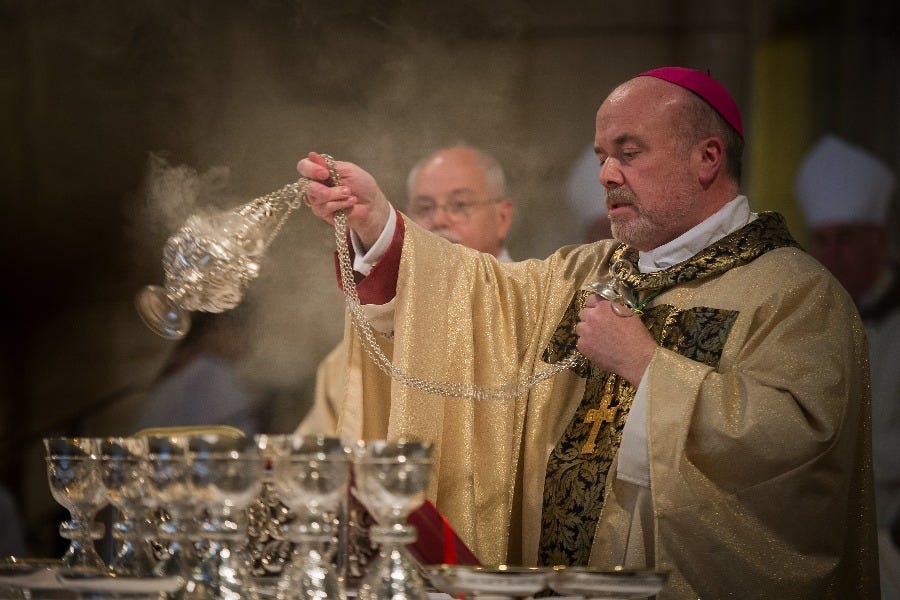
The 64-year-old has served since 2014 as the Bishop of Leeds, a historically influential northern English diocese with around 170,000 Catholics.
Since December 2025, he has been the apostolic administrator of the neighboring Diocese of Middlesbrough, with roughly 98,000 Catholics.
And since March 2026, he has also been the apostolic administrator of another neighboring diocese, Hallam, which has approximately 66,000 Catholics.
That means he’s now responsible for a grand total of 334,000 souls, located mainly in the historic county of Yorkshire. This daunting assignment could become permanent, as Pope Leo XIV has asked Stock to lead a consultation over whether the three dioceses should be merged.
One factor favoring a merger is that the dioceses have a common historical origin. When Pope Pius IX restored the Catholic hierarchy in England in 1850, following centuries of anti-Catholic persecution, he established the Diocese of Beverley in Yorkshire.
The Beverley diocese was divided in 1878 into the dioceses of Leeds and Middlesbrough. The Hallam diocese was formed in 1980 with territory taken from the dioceses of Leeds and Nottingham. A merger of Leeds, Middlesbrough, and Hallam dioceses could therefore be styled as a reunification of sorts.
But why is a potential triple merger on the table now? How is the consultation being conducted? And does it have a predetermined outcome? Stock answered these and other questions in a May 8 interview with The Pillar.
This interview has been edited for clarity and length.

What was the background to the pope’s request that you begin consultations on the future of the dioceses of Leeds, Middlesbrough, and Hallam?
The first I knew about it was when I was asked to be the apostolic administrator of Middlesbrough diocese. That was just before Christmas last year. The nuncio contacted me and said the Holy Father had appointed me as the apostolic administrator of Middlesbrough diocese, and asked if I accepted the appointment, which I did.
That was initially to talk about the reunification of the Middlesbrough and Leeds dioceses. “Reunification” is my word. I don’t want to put that into the mouth of the Apostolic See. But effectively, that’s what it is, because obviously we were one diocese many years ago.
Then just before Holy Week, I was contacted again by the nunciature to say the Holy Father had appointed me also as the apostolic administrator of Hallam. So that’s how it came to be the three dioceses. The appointments didn’t take place together.
Middlesbrough followed the retirement of Bishop Terry Drainey after turning 75. The other one followed the resignation of Bishop Ralph Heskett because he had been unwell.
What are the reasons for considering an amalgamation of the three dioceses?
I’ve been having consultation meetings. There are nine organized across the three dioceses. I’ve done six so far. The sixth was last night in Bradford. Part of the explanation I’m giving to people is that we mustn’t feel singled out by the Holy See. This process of looking at whether dioceses should merge has been going on for a number of decades now, across various jurisdictions around the world. In Italy, it’s been going on for decades and in Ireland for quite a number of years. We’ve already had our first merger in Wales: Cardiff and Menevia.
In relation to Middlesbrough, specifically, in the ad limina report that Bishop Drainey submitted to the Holy See in 2018, he said that perhaps now was the time to consider whether Middlesbrough diocese should be merged with another diocese, though he didn’t specify Leeds.
This followed discussions that had taken place even earlier within the diocese, about the future viability of the diocese, because of the relatively small number of priests incardinated in the diocese — that is, priests that are actually members of the diocese itself, rather than religious priests or priests from missionary institutes.
So that question was already buzzing around. As I understand it, the intention was that following the ad limina visit, the metropolitan archbishop [of Liverpool] would be invited to come and look at that question with the bishop across the diocese. But then COVID intervened, and that wasn’t followed up.
Presumably, after COVID, Bishop Terry was approaching his retirement, so probably it was then put on hold, but I don’t know for certain.
If that’s in an ad limina report, then it would have been noted and picked up. When any subsequent bishop is appointed, they look at the ad limina reports to see what the state of the diocese is when they consider who they might appoint.
Quite a number of statistics are provided to the Holy See in those reports, and they would be looking at that as well.
There would be some questions over whether, even in 1878, Middlesbrough was going to be a viable diocese because of the way the borders were drawn up. There was an academic study in 2014 which argued that from day one it didn’t really have much of a chance because of the way the division took place.
And you could also argue the same in 1980, when Hallam was created.
It didn’t have enough people to sustain it?
Enough people, and also the number of diocesan clergy and the vocations that historically have come from those areas was quite low.

What reactions have you had to your presentations in the dioceses?
Remarkably positive so far, from both clergy and laity. The meetings are being conducted in the synodal fashion, if you like. Having attended the synods myself, I decided to try and mirror the process. Participants are divided into smaller groups, tables of about 10 people, sometimes a few less or few more, depending on the total size.
People are invited to discuss the two questions in the consultation document. The consultation responses are being collated by my secretary in Middlesbrough, who will help me to draft a report that we will then share with the laity and clergy of the diocese before I submit a final report to Rome.
Is this the ‘conversation in the spirit’ method, with people seated at a round table?
That’s correct. I explain to people what we did in Rome, that we went around the table once, with each person being able to say what their thoughts were about the proposition and not being interrupted by anyone.
We went around the table a second time and people were then invited to reflect on what they had heard others say. And the third time, you go around the table to see if there are points of convergence or divergence on what is being discussed. And that forms the report from that table.
Then we receive the feedback from those tables, so people can hear the feedback from each other. Then I make a response, if I can, to any of the points, for clarification.
It’s important to note that these aren’t open meetings. What I asked for was the clergy from each parish, the chair of the parish finance committee (or their delegate), and the chair of the parish pastoral council (or their delegate). If a parish doesn’t have a parish pastoral council, then a leading lay person who is very active in the life of the parish.
The reason for that is because, obviously, the chair of the finance committee and chair of the parish pastoral council are people who are already investing time and energy in the life of their parish. But also they bring to the consultation meeting quite critical knowledge. The chair of the finance committee will have a good understanding of the life of the parish in terms of its resources. The person from the pastoral council will have a good understanding of the wider life of the parish, its pastoral and spiritual needs.
The information we’re getting at the consultation meeting is to the point. The last thing we need is any old person coming along and telling me what flavor of ice cream they like. You need information that’s going to actually help you in the consultation process.
This sounds like a middle way between a fully open public assembly and a narrow consultation with, say, just the priests of the diocese.
The consultation is also open to anyone to make comments online. We encouraged parishes to meet as groups and make a response as a group or as individuals through the online consultation. It will all be considered as part of the information that’s collated.
Why did you choose to have a fairly expansive consultation, rather than a quick and narrow one?
Well, I’m trying to do it quickly. I would hope to have a report by the end of the summer that I can send to the Holy Father, because a lack of certainty is not very helpful to people in these situations. That’s why I’ve tried to conduct the whole process fairly expeditiously.
I just think it’s important to follow the sign that the Holy Father has asked us all to undertake, which is to act synodally in the way we operate as bishops.
This will have an impact on the life of both the clergy and the faithful. You could argue that the impact of whether it’s one diocese or three dioceses isn’t necessarily felt at a very local level, at a parish level. But it will do eventually as we look at the needs and capacity across the diocese to provide priests, and how we’re going to support local communities to live out their mission in the future.
What would you say to the cynic who argues that, despite the synodal element, this is essentially a tick-box exercise: you’ve been asked by Rome to unite these three dioceses, regardless of what anyone has to say about the issue?
The fact is, the Holy Father hasn’t asked me to unite them. He’s asked me to conduct what he called “a phase of study” and discussion about the possibility of the dioceses being united. I haven’t been given a task to undertake other than the consultation.
It will be his decision, not mine. I’ve been saying rather cheekily, I suppose, at these meetings that if there’s any one person who’s got an investment in it all going pear-shaped it’s me — because I get to go back to being just the Bishop of Leeds and having far less work to do.
Could you foresee the return, in some form, of the Diocese of Beverley, which covered the whole of Yorkshire from 1850 to 1878?
I can see the benefits of it, despite the inconvenience and extra work for myself. I can see that strategically it makes good sense, especially when you look at the statistics regarding the number of clergy and the number of parishes that we currently have across the three dioceses. There does need to be some real strategic thinking about how we’re going to exercise our mission in the future.
Is the consultation in Leeds, Middlesbrough and Hallam part of a broader review of dioceses in the British Isles?
The Scottish bishops, for example, have been asked to reflect on “whether the present situation of eight dioceses is suitable.”
I’m not aware of any request from the Holy See for our own episcopal conference — that is, England and Wales — to undertake a review at this time, although it is just generally part of our responsibility as bishops anyway to look at whether the borders of our dioceses need to be adjusted.
Quite often, there are adjustments to diocesan borders, for instance. I’ve transferred parishes to other dioceses and other dioceses have transferred dioceses to me when it makes geographical sense. But that’s slightly different to what you’re talking about, which is mergers of dioceses.
But the open and transparent answer to your question is: if there’s been a request made to the president of the bishops’ conference, it’s not been told to me.
Any other observations about the process?
It’s a challenge for me, but it’s exciting. I know the three presbyterates are very much behind it, which surprised me, because I thought there might be resistance.
I suppose it’s because many of our priests know each other already over the years. There is this sense of being part of the one historic county of Yorkshire. There’s a willingness to make it work.
Rather touchingly, they’re all rather more concerned about me than they are about the process, which is lovely.


Not an unrealistic combination. Even Connecticut's smallest Catholic diocese has about the same Catholic population as these three dioceses combined.
Daunting?