‘Brother’s keeper?’ What an Ivory Coast case asks about clericalism
What is the greater scandal: crime and sin, or drawing attention to it?
The Vatican announced this week that the former bishop of the Ivory Coast’s Diocese of Man has been transferred to an auxiliary position in another diocese. A move which appears to draw to a close a simmering two year dispute.
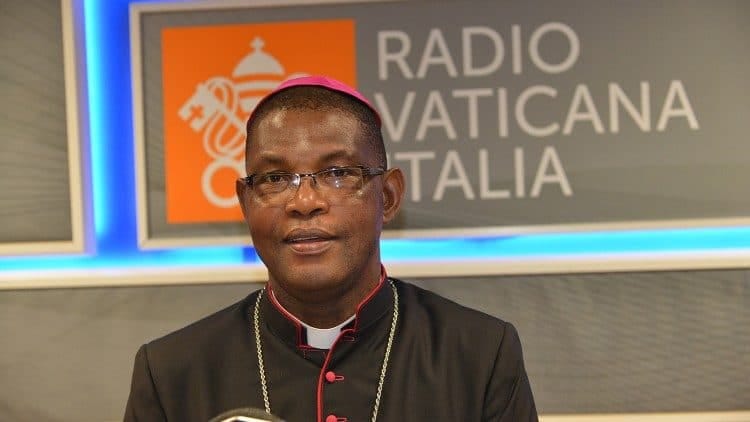
Bishop Gaspard Béby Gnéba. Credit: Vatican media.
Since 2008, the diocese had been led since Bishop Gaspard Béby Gnéba, 63.
But the bishop had been at odds with local clergy since January 2024, when he published a letter to Catholics in which he asked that they denounce priests living in concubinage, maintaining illicit families, or committing other crimes of sexual or financial abuse.
The response was uproar among local clergy, leading to a standoff with the bishop, an apostolic visitation ordered by Rome, the temporary sidelining of Gnéba, and the appointment of a caretaker bishop later that year.
The transfer of the bishop may resolve the impasse in Man, but the bishop’s apparent demotion and the publicly unaddressed conclusions of the apostolic visitation of the diocese highlight wider tensions — both in the Church in Africa and globally — about clerical misconduct and scandals, and the way Catholics are expected to respond.
—
In his letter, titled “Urgent, Important, and Necessary,” Gnéba called on any Catholic “who knows that a priest is not faithful to his celibacy, has a wife or child, has committed sexual abuse or economic crimes, must have the courage to denounce him to the bishop, otherwise he commits a sin of complicity before God, the Pope and the Church.”
The bishop similarly ordered priests living in such illicit situations to “come to see me as soon as possible to present their resignation” from the clerical state so they could, in an honest fashion, devote themselves to the women and children dependent upon them.
The letter drew international attention, and appeared to underline often-cited concerns about clerical celibacy in African dioceses and the problem of priests maintaining “secret families.” The result in the diocese was, effectively, a wholesale revolt against the bishop by his priests, bringing his ability to govern the diocese to a grinding halt.
There followed local, much less internationally publicized, allegations from local clergy against the bishop for poor administration and a Vatican intervention within months and the bishop’s removal by transfer this month.
Of course, Gnéba is not the first and will not be the last bishop to depart a diocese having essentially lost the ability to govern it effectively.
But some details especially worth noting about Bishop Gnéba are his age — 63 — and that prior to his incendiary letter in 2024 he had already been bishop of the diocese for more than a decade and half.
Gnéba was not a recently arrived outsider to the diocese who took sudden and dramatic action based on a first or partially formed impression of the local Church. On the contrary, he was a demographic contemporary of many of his priests and with, it seems reasonable to assume, a well-informed understanding of the place and people he was addressing.
Absent any findings to the contrary, it would seem unreasonable to dismiss the bishop’s concerns as fanciful or unfounded — and the response to his intervention among local clerics was, by all accounts, not confusion, but outrage.
Those concerns remain substantially unaddressed, and will now be left for his successor to either wrestle with, or quietly ignore.
How well or how fast things in the Diocese of Man return to normal remains to be seen, and how desirable that normal actually is may never be made clear to the global Church.
But the transfer of Bishop Gnéba does leave open serious questions for Catholics everywhere to consider — not least his thesis that Catholics who turn a blind eye to clerical misconduct are complicit in it.
—
In the shadow of the Chuch’s global sexual abuse crisis of the last quarter century, there has been a secondary debate among bishops, canonists, and commentators over other kinds of clerical misconduct, be they sexual, financial, or other.
As the fallout from the McCarrick scandal illustrated, with its recognition of a broad category of “vulnerable adults,” clerical sexual misconduct apart from cases involving minors can still be and often is a source of deep scandal in the Church and one which has been imperfectly recognized and addressed for many years.
And, as reporting has shown, financial and sexual misconduct are often linked in practice and both contribute to a wider culture of tolerance within closed networks of limited accountability, often characterized as the phenomenon of “clericalism.”
Despite major instances of proven misconduct, though, and institutional commitments to concepts like accountability and transparency, there remains a sizable body of opinion within the Church — both as a hierarchy and as a wider society — that the act of coming forward with knowledge of misconduct is itself a kind of scandalmongering, and that clerics, be they priests or bishops, have a right to private lives of serious sin, even if they enjoy senior positions of spiritual and institutional leadership.
On the other hand, many others, in all ranks of the Church, would note that many of the behaviors like those identified by Bishop Gnéba are not merely private sins but often crimes in canon law. Absent exacerbating factors like age or vulnerability of the partner, individual sexual lapses by celibate clergy, for example, are not constituted delicts in the Code of Canon Law, but stable relationships of concubinage of the sort he described are — as too are financial crimes and other abuses of office.
At the core of the tension between arguments for privacy and calls for transparency, though, is a bigger question of accountability — and whether the Church is a coherent society of laws to which its members, and especially leaders, are accountable, or a collection of individuals affiliated only through bonds of religious profession and obedience.
While Bishop Gnéba asserted that turning a blind eye to clerical misconduct — and canonical crime — is a sin of complicity, his removal from his diocese suggests that his is not a view shared either among his local clergy or more widely in the hierarchy.
And for many working within the structures of the Church globally, clerical and lay, there remains the perception that reporting serious — even canonically criminal — misconduct is itself an occasion of scandal, as much as the sinful or criminal actions themselves may be.
When allegations are brought forward through the proper channels of authority, whistleblowers often report no acknowledgement of their complaints, even when they later learn of subsequent investigations being undertaken. Some even continue to report — or suffer — institutional retaliation for whistleblowing, especially those incardinated or employed by the Church.
And it is the case that, even when serial, even criminal misconduct is widely known among a local community and clear proof presented, there remains a strong institutional preference for addressing such cases with the relative dignity of resignations and even transfers — rather than any kind of public reckoning or redress for the wider communities affected.
The result is a sense among affected communities that truth and reconciliation remain secondary priorities to avoiding public scandal. Contrary to Bishop Gnéba’s notion that silence is a kind of sinful complicity with canonical crime, there is a real strain of thought in some parts of the Church which holds that speaking out about such situations is itself a kind of sinfully scandalous behavior.
This in turn has been used as a rationalization for a kind of neo-Donatism on some fringes of the Church, with groups like the SSPX using accusations of institutional acceptance of clerical sexual misconduct to justify arguments for a kind of ecclesiastical “emergency” justifying schismatic actions.
The specific lessons of the Diocese of Man are not yet known, due again to a lack of any public accounting by the hierarchy for what has happened, and why.
But the issues at play there make clear how far the Church still has to travel in reconciling how it thinks and speaks of itself, and how it acts, as an institution and as a society.

