
Hey everybody,
Today’s the first Tuesday in ordinary time, and you’re reading The Tuesday Pillar Post.
I’ve often got a saint up here for you, or a bit of historical trivia, but it turns out there’s very little historically remarkable about Jan. 13, I’m afraid.
So I’ll tell you instead about a saint coming up on Thursday: St. Ita of Kileedy.
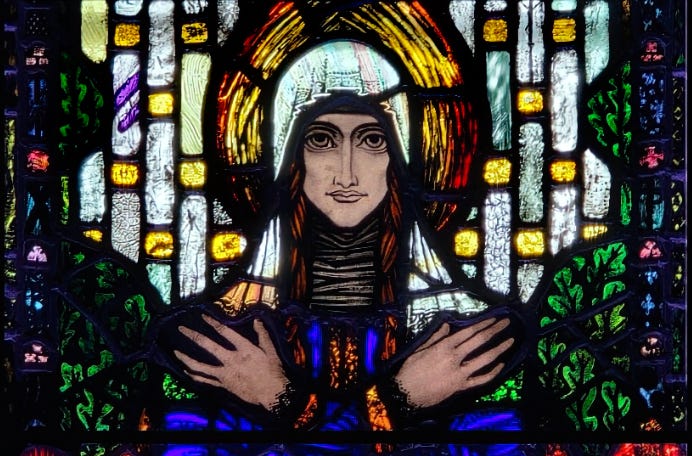
She was born in the late 400s in Ireland, baptized with the name Deidre. She was the daughter of a somewhat noble Irish chieftain who had converted to Christianity. Given her lineage, her parents expected her to marry a man from another noble family.
But Deidra wanted a monastic life. So she fasted for three full days and nights — and then her father had a dream pointing to his daughter in religious life, and he gave her his blessing.
She took the habit, and the religious name Ita — which meant, in the Irish language, a thirst for holiness.
She joined a small community, and her father arranged for noble landowners to offer them large lands on which to settle. But Ita, representing the nuns, said they just wanted just four small plots to farm, because they wanted to live without the wealth that large holdings would provide.
The monastery became a center of catechesis and culture, and people came from across Ireland for spiritual counsel from Ita and other nuns.
The community founded a kind of boarding school for boys, especially those whose parents could not take care of them. Some were orphans. Among them was St. Brendan, who became a monk, and one of the greatest Irish saints.
According to her biographers, Ita taught Brendan that God loved most three things: “True faith in God with a pure heart, a simple life with a grateful spirit, and generosity to the poor inspired by charity.”
Her life was penance, asceticism, prayer, and the children she instructed. Because of that work, she is known in Ireland as the “foster mother of the saints of Erin.”
But whatever saints came through her community — they didn’t start that way. They started, many of those children, as kids whose parents couldn’t take care of them, or as orphans, with all the psychological and emotional challenges those things entail.
Ita loved God, loved them, and conveyed to them the love of God.
So here’s the point: There are some 400,000 children in America who also need foster parents. They need especially foster parents who believe they can be saints. Some of them need homes forever, some need places to live while their parents get things together, and prepare to parent again.
Thursday is the feast of St. Ita — maybe for some Pillar readers, it will be an occasion to consider her call.
Who, I wonder, will be the foster mother (or father) for the saints of America? Who’s called to love God that way?
The news
The Holy See is expected to announce in coming weeks a date for the beatification of Archbishop Fulton Sheen, the Emmy-winning American prelate known for catechetical television programs in the 1950s and 1960s.
When might he be beatified? When will it be announced?
—
Vatican City’s highest appellate has rejected an appeal from the Vatican City’s chief prosecutor in the sprawling financial crimes trial that concluded at the Vatican more than two years ago.
The decision means that future appeals will not focus on efforts to reduce the charges and sentences against convicted defendants, including Cardinal Angelo Becciu.
This is, ladies and germs, the trial process that never really ends. But it is lurching toward its final, final steps.
Why?
Because the Archdiocese of Cape Town, which got a new bishop, is a study in sharp contrasts: It is home to striking affluence, and to desperate poverty. Thrown in the mix is corruption and stark social division.
And Bishop Sithembele Sipuka, who was appointed to the see, is known across South Africa as an advocate for peace, and social reconciliation in a divided nation. Sipuka is also regarded as ethically upstanding, with high expectations for people around him. All of that means he might soon become a lightning rod across South Africa.
Sr. Ranit is the former superior general of the Missionaries of Jesus, a religious community operating in the Jalandhar diocese. After she made a police report alleging the rape, her sisters — and other religious sisters — protested publicly to demand that the bishop be arrested, drawing international attention to the case.
Mulakkal was arrested eventually, and in 2022, he was acquitted of the rape. His resignation from office was soon after accepted.
But Sr. Ranit gave an interview last week insisting that she will continue pursuing appeals to Indian’s Supreme Court, because she will “continue my fight for justice.”
It is not clear whether Mulakkal will eventually face a canonical penal process, though it would likely come after India’s Supreme Court adjudicates the allegation.
Edgar Beltran broke down several key points in the text.
For myself, I was struck by the pope’s lament that “new Orwellian-style language is developing which, in an attempt to be increasingly inclusive, ends up excluding those who do not conform to the ideologies that are fueling it.”
Orwellian-language, the pope said, leads to a kind of reframing moral realities, in a way that erodes the freedom of conscience.
“Conscientious objection allows individuals to refuse legal or professional obligations that conflict with moral, ethical or religious principles deeply rooted in their personal lives. This may be the refusal of military service in the name of non-violence, or the refusal on the part of doctors and healthcare professionals to engage in practices such as abortion or euthanasia,” he said.
The pope lamented especially that “religious freedom risks being curtailed” — both in countries where Christians face violent persecution, and in the developed West.
These recognitions are important, of course, as are the pope’s recognition of threats to the family, the unborn, and others on the margins, but I am struck most at the solutions embedded in the pontiff’s speech.
Because the address was not merely a call for human efforts like “dialogue” or “fraternity.” It did not have the character of a can’t-we-all-just-get-along invocation.
Instead, it grounded the solution to the world’s problems squarely in Christ, “who took upon himself our humanity in order to make us partakers in his divine life.”
Framed in his own Augustinian viewpoint, the pope aimed, like Augustine, to “interpret events and history” according to the model of two cities: the city of God, and the earthly city.
And the pontiff was direct: “the earthly city is centered on pride and self-love (amor sui), on the thirst for worldly power and glory that leads to destruction,” while “the city of God .. is eternal and characterized by God’s unconditional love, as well as love for one’s neighbor, especially the poor.”
In that framing, the pope invited global diplomats into a Christian worldview, with a sense that imitation of God himself is the means for a just and constructive politics.
This is not a call for conversation. It is a call for conversion.
I’ve been struck by that approach of Leo XIV from the beginning.
When he came out on the loggia just hours after his election, he wished peace on the people of Rome and the people of the world. But it wasn’t a vague sense of peace, it wasn’t the peace of human solidarity, it was, explicitly: the peace of Christ.
Leo is revealing himself to be — in the work of his office and even in the language of diplomacy — an evangelist, whose discussion of temporal realities is meant to point his audience to the eternal and transcendent — to God himself.
This is good news for the Church. Whatever his style, his irenic disposition, his approach to governance proves to be — none of those things should miss what is emerging as a fundamental point about the pope: He sees, believes, and teaches, at near every opportunity, that the answer to the problems of the world is Christ himself — that dialogue and fraternity are not ends in themselves, but that they are made possible through communion with the eternal God.
This is the lesson the pope wants to convey.
Let those who have ears hear it.
Cat videos
Finally, guys, the internet is made for cat videos. So I’ve got for you perhaps the greatest and corniest cat video ever created:
Now, perhaps you think a video like that is a perfect waste of time, and perhaps you’re right.
But there’s a reason I’ve posted it here.
I have been following, like many of you, the fallout from the shooting death of Renee Nicole Good, who was killed January 7 by an ICE officer.
Like a lot of you, I’ve watched the videos, and I have an opinion on what I see happening. But my opinion isn’t what I want to discuss here.