Cardinal Ambongo: Rebel gains show limits of US-backed accord
'How can we fail to see the limitations of these Accords, which subtly exclude the Congolese people and seek to normalize the systematic plundering of Congo?'
Congolese Cardinal Fridolin Ambongo urged leaders Sunday to embrace an inclusive peace plan proposed by Catholic and Protestant leaders amid renewed clashes in the troubled eastern region, despite a U.S.-brokered peace deal.
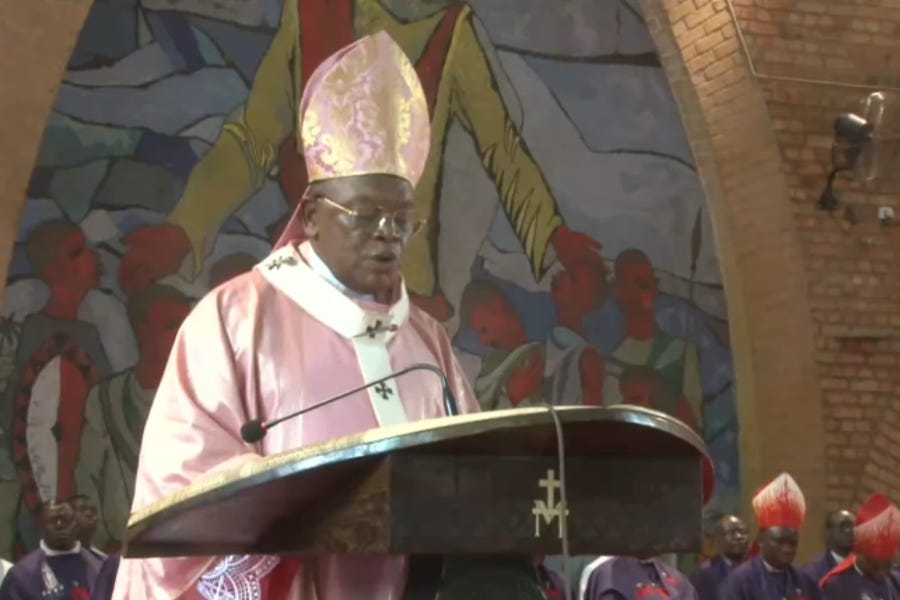
In a Dec. 14 homily, the Archbishop of Kinshasa lamented the occupation of the city of Uvira by rebel forces less than a week after the presidents of the Democratic Republic of the Congo and Rwanda ratified a peace agreement in Washington, D.C.
Commenting on the Dec. 4 agreement, known as the Washington Accords for Peace and Prosperity, the cardinal said: “How can we fail to see, in this collapse, the very limitations of these Accords and other initiatives, which subtly exclude the Congolese people and seek to normalize the systematic plundering of Congo’s resources?”
Ambongo argued that the agreement’s setbacks vindicated a broader plan to secure lasting peace advocated by the Congolese bishops’ conference and the Church of Christ in the Congo, a union of 62 Protestant denominations. The Church leaders’ plan is known as the “Social Pact for Peace and Living Well Together in the DRC and the Great Lakes,” referring to the wider region surrounding the Democratic Republic of the Congo.
Alluding to Pope Leo XIV’s appeal shortly after his election for “a peace that is unarmed and disarming,” Ambongo said: “At present, this Pact appears to be the only way to achieve an unarmed and disarming peace, an authentic and lasting peace.”
“Unarmed, because this Pact rejects the logic of retaliation, exclusion, and fleeting triumphalism. Disarming, because this initiative seeks to address the roots of conflict by restoring truth, justice, and dignity to every person.”
“This is the place to call on all the protagonists of the crisis in the Democratic Republic of the Congo, all the driving forces of our country, as well as the international community, to support this initiative and move it forward.”
Ambongo argued that parties to the conflict could have saved lives if they heeded Catholic and Protestant leaders’ appeals, particularly after the rebels captured the border town of Bunagana in 2022. The event marked a major escalation in the insurgency led by the M23 paramilitary group.
“But alas! What a waste of time! What a waste of victims that could have been avoided! That is why we condemn, with the utmost energy, as we have already done in other circumstances, all those who see war as the solution to this crisis,” the cardinal said.
Ambongo delivered the homily at a Mass at Our Lady of the Congo Cathedral in Kinshasa, following a plenary assembly of the Association of Episcopal Conferences of Central Africa, which brings together bishops from Burundi, the Democratic Republic of the Congo, and Rwanda.
The Democratic Republic of the Congo is home to around 112 million people, roughly half of whom are Catholic, making it the country with the world’s fifth-largest Catholic population.
The current upheaval in the mineral-rich eastern Congo can be traced back to the Rwandan genocide in 1994, when ethnic Hutu extremists murdered up to a million Tutsis and moderate Hutus. When the Tutsi-led Rwandan Patriotic Front seized power in Rwanda, almost two million Hutus crossed the border with the Democratic Republic of the Congo, settling in refugee camps in the North Kivu and South Kivu provinces.
The turbulence in the east led to the overthrow of longstanding Congolese dictator Mobutu Sese Seko and a battle for power that drew in many of the country’s neighbors, prompting comparisons to the First World War because of its high death toll and international dimensions.
Amid a chaotic and frequently shifting battlefield, the M23 group emerged as a major force in the east, seizing Goma and Bukavu, the capitals of North Kivu and South Kivu respectively, in early 2025.
Catholic and Protestant leaders launched the Social Pact in January 2025. But they encountered resistance from the Congolese government because their plan called for discussions between all parties to the conflict, including the M23 rebels. Congolese authorities have expressed reluctance to engage in direct talks with M23, regarding it as a proxy force backed or controlled by the Rwandan government.
Following a U.S. push for peace, Congolese President Félix Tshisekedi and Rwandan President Paul Kagame ratified the Washington Accords in the presence of President Donald Trump.
In defiance of the peace agreement, M23 rebels advanced rapidly Dec. 9 on Uvira, a city of strategic importance in South Kivu province, and declared full control Dec 10.
Catholic life is reportedly returning to normal in Uvira following its seizure. Local Bishop Sébastien-Joseph Muyengo Mulombe celebrated a Gaudete Sunday Mass Dec. 14 for young people in the city’s St. Paul’s Cathedral.
