
Days before the traditionalist Society of St. Pius X’s new episcopal consecrations, Cardinal Gerhard Müller appealed for the re-establishment of a Vatican commission to help disillusioned members return to full communion with the pope.
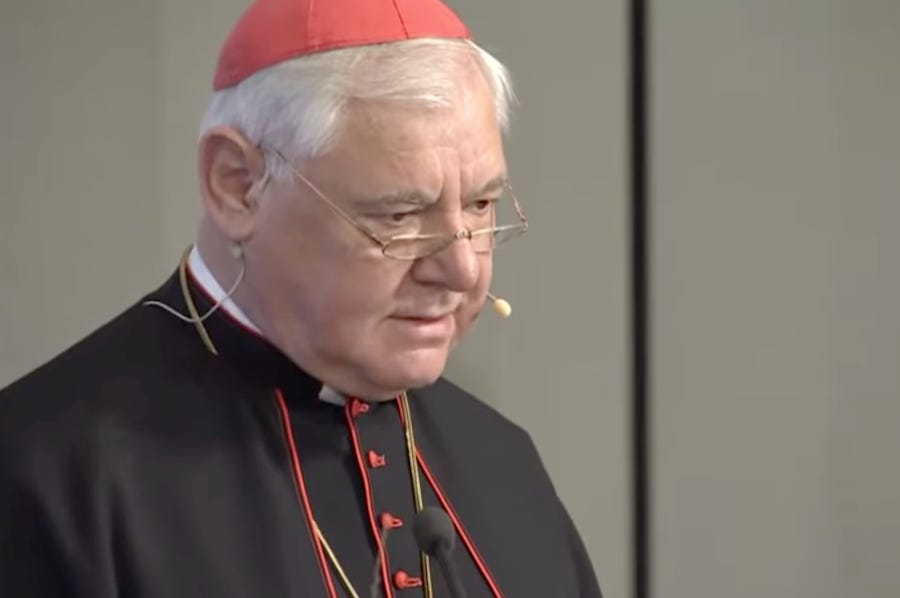
The former Vatican doctrinal chief made the appeal in a June 26 speech at the extraordinary consistory of the College of Cardinals in Rome, in which he condemned the consecrations, which are scheduled to take place without papal mandate July 1.
“I propose the establishment of a commission, along the lines of the former Ecclesia Dei, to enable those who have embraced this schismatic position to return to full communion with the pope,” he said, in an intervention published June 28 by the Rome-based U.S. journalist Diane Montagna.
The Ecclesia Dei Commission was established by Pope John Paul II in 1988, after SSPX founder Archbishop Marcel Lefebvre ordained four bishops without papal approval. At the time, the SSPX consisted of hundreds of priests and tens of thousands of laypeople.
The Ecclesia Dei Commission’s purpose was to help priests, seminarians, religious communities, and individuals affiliated with the SSPX “to remain united to the Successor of Peter in the Catholic Church, while preserving their spiritual and liturgical traditions.”
Pope Benedict XVI reorganized the commission in 2009, after lifting the excommunications of the four SSPX bishops. He decreed that the prefect of the Congregation for the Doctrine of the Faith would serve ex officio as the commission’s president. Müller oversaw the commission during his 2012-2017 tenure as doctrinal prefect.
In 2019, Pope Francis suppressed the body and assigned its tasks fully to the doctrinal congregation. The Argentine pope suggested the commission had largely fulfilled its original mandate of reconciling groups previously affiliated with the SSPX. He added that the remaining issues between the SSPX and the Vatican were mainly doctrinal in nature, and therefore should be handled by the doctrinal congregation.
In his intervention, Müller noted that the SSPX had sent an open letter to Pope Leo XIV and the world’s cardinals on the eve of the June 26-27 extraordinary consistory.
The letter was accompanied by a 154-point “Profession of Catholic Faith.” The letter expressed hopes that the document could one day serve “as a basis for an honest discussion with the Holy See.”
Referring to the letter, Müller said: “It is our duty by virtue of our office, both individually and as a college, to reject the scandalous accusation that the Roman Church has departed from the Catholic faith.”
“In the face of the schismatic act of episcopal consecration carried out without the prior grant of communio [communion] with the pope, there must be no ambiguity.”
But the German cardinal said it was also necessary to address pastoral and liturgical issues with sensitivity. He suggested that an Ecclesia Dei-style commission could help to meet pastoral and liturgical needs following the July 1 episcopal ordinations.
The SSPX first announced the new episcopal consecrations Feb. 2, arguing they were a legitimate response to an “objective state of grave necessity.”
Only two of the four bishops consecrated by Lefebvre are still alive: Bishop Bernard Fellay, 68, and Bishop Alfonso de Galarreta, 69. Bishop Bernard Tissier de Mallerais died in 2024 and Bishop Richard Williamson in 2025.
The SSPX rejected Feb. 18 a Vatican request to postpone the ordinations and engage in a structured theological dialogue on Vatican Council II. The ecumenical council’s decrees and subsequent liturgical changes led Lefebvre to found the SSPX in 1970.
The SSPX announced May 26 the names of the four priests who will be consecrated bishops July 1 at its headquarters in Écône, Switzerland, with de Galarreta serving as principal consecrator and Fellay as co-consecrator.
The priests are the French national Fr. Marc Hanappier, aged 36, French national Fr. Michel Poinsinet de Sivry, 42, U.S. citizen Fr. Michael Goldade, 46, and Swiss national Fr. Pascal Schreiber, 53.
Current Vatican doctrinal chief Cardinal Víctor Manuel Fernández described the episcopal ordinations May 13 as “extremely grave.”
“This act will constitute ‘a schismatic act’ … and ‘formal adherence to the schism constitutes a grave offense against God and entails the excommunication established under Church law,’” he said.
The two presiding bishops and four priests taking part in the July 1 ceremony will commit an act of schism and be subject to the canonical penalty of excommunication.
But Fernández’s statement indicated that those who formally associate themselves with the schism initiated by the organization’s leadership could also incur excommunication, if they meet criteria set out in 1996 by the Vatican’s legal department. The criteria require both internal and external manifestations of support for an act of schism.
The 1996 criteria appear to be fulfilled by SSPX clergy, but not by all laypeople who attend the organization’s chapels.
One possible course of action after the consecrations would be for the Vatican to declare that the SSPX as a whole is in a state of schism. But to make such a declaration, Rome would first have to formally recognize the SSPX as a valid legal body in Church law.
Alternatively, the Vatican could focus on the SSPX at a local level by inviting diocesan bishops to identify SSPX clergy operating within their territories and issue declarations of automatic excommunications for schism.
Another local option could be for diocesan bishops to issue particular laws proscribing the SSPX as a forbidden society.
As well as clarifying the canonical consequences of the July 1 ceremony, the Vatican could also strengthen its provisions for SSPX members who wish to be reconciled to Rome, either individually or in groups.
Leo XIV could take up Müller’s proposal for a revised Ecclesia Dei commission, consider loosening restrictions imposed on the celebration of the Traditional Latin Mass by the 2021 motu proprio Traditionis custodes, and encourage the integration of former SSPX clergy into traditionalist institutes in full communion with the pope.
It is currently unclear how many SSPX clergy and laypeople will break with the organization following the new consecrations.
After the 1988 consecrations, 12 priests left the SSPX and established the Priestly Fraternity of St. Peter in Hauterive, Switzerland, with papal approval. Today, the FSSP has more than 300 priests with 35 different nationalities.
The FSSP ordained a record 25 priests in 2026, the German Catholic news agency KNA reported June 23.