
Archbishop Joseph Li Shan of Beijing and Cardinal Stephen Chow of Hong Kong defended the controversial policy of Sinicization of the Catholic Church in China and obedience to state religious laws at a Nov. 5 conference in Rome, comparing the state ordering of religion to the practice of synodality in the Latin Church.
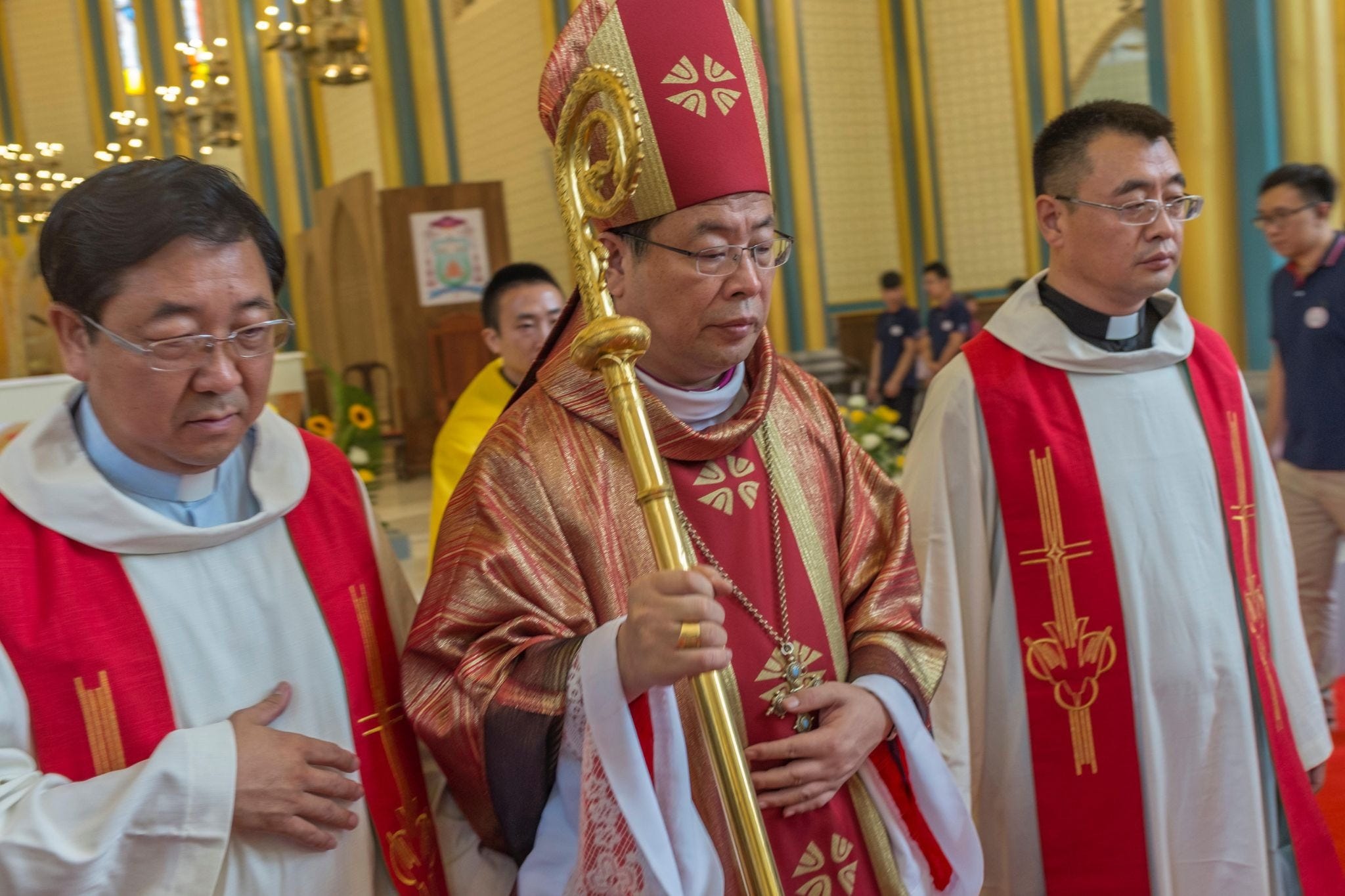
In his speech at a Nov. 5 conference commemorating the centenary of the consecration of the first Chinese-born Catholic bishops at the Urbaniana University, run by the Dicastery for Evangelization, Li said that the Communist Party’s regulation “sets the legal boundaries for religious activity and fully guarantees the Church’s normal evangelization and pastoral care, as well as the legitimate rights and interests of the faithful.”
Cardinal Chow also addressed the conference, saying that the main challenge for Chinese Catholics is how to be both “loyal to our government and loyal to our faith.”
The policy of sinicization has been a controversial aspect of the Vatican’s 2018 agreement with the Chinese government, which paved the way for unity between the state-sponsored and schismatic Chinese Patriotic Catholic Association and the underground Church and allowed the state to vet and propose candidates for episcopal office on the mainland.
The policy requires the Church, including bishops and priests, to recognize and accept the supremacy of state authority and Communist Party dogma over the Church’s hierarchy and teachings.
In his speech Thursday, Li framed the policy of sinicization within the history of the Chinese Church, claiming that the idea predates the Communist regime in China, as the National Council of Shanghai in 1924 had already “rejected the mistaken practice of the Church relying on the political power of the Western powers, and… put forward many ideas and proposals that remain beneficial to this day, once again opening the process of the sinicization of Catholicism.”
“In order to provide for the missions in a manner suited to the times and to establish the Church in China more fully, including diocesan and religious clergy, religious vocations in China must be fervently attended to and fostered,” Li said, quoting the National Council’s final document.
Li added that the local Church “loudly proclaimed the urgency of building a [local] Church and forming native clergy: ‘The Church of China to the Chinese!’”
The Beijing bishop then called the Chinese revolution, a 22-year long civil war that caused an estimated 8 million deaths, “the founding of a New China” that “completely changed the situation in which the Church in China depended on Western political forces.”
“While remaining faithful to the essence of the faith and keeping its basic doctrine and canonical discipline unchanged, how the Church could better adapt — under the Chinese government’s policies and laws on freedom of religious belief — to a new type of Church-State relationship with Chinese characteristics became a question that all Christians had to resolve,” Li added.
He also said that Chinese Catholics “embraced the newborn socialist China and set out on the path of development of loving the country and loving the Church, of independence, self-governance and self-administration.”
The bishop also connected the project of sinicization of China to the synod on synodality, saying that “just as the most recent Synod of Bishops promoted ‘walking together,’ the affairs of the Church in China are entirely managed jointly by Chinese clergy, women religious and the faithful, and all of the Church’s holy works are flourishing.”
“The Church in China, which was once constrained by colonial forms, has an especially unforgettable experience of this. This is precisely the meaning of the sinicization of the Church that we propose today,” he said, calling it “not an external add-on to the Catholic Church, as if it were optional, something one could do or not do; rather, it is intrinsic to the Church’s catholicity.”
In 2025, the CCP’s National Religious Affairs Administration banned foreign nationals from common worship with Chinese citizens, and required all visitors to affirm the national independence of Chinese Churches and faith communities.
According to the regulations, “foreigners who engage in religious activities in China must abide by Chinese laws, regulations, and rules, abide by the principle of China’s religious independence and self-management, and accept the legitimate management of the Chinese government.”
The rules also require all liturgies take place in officially sanctioned places of worship and be presided over by authorized Chinese ministers. Only in extraordinary circumstances and with official permission can a foreign national preside at a liturgy or worship in an unsanctioned space, and common worship between Chinese and non-Chinese faithful is prohibited.
Before the conference this week, Cardinal Pietro Parolin, the Vatican’s Secretary of State and chief architect of the 2018 Vatican-China deal and noted defender of the policy of sinicization, took questions from the press.
The cardinal was asked about the current status of the Vatican-China deal, saying that one of the main challenges was reconciling “being Chinese, with all the specific features that this entails, but at the same time being in profound communion with the pope and with the universal Church. The fact that today, on this occasion, there are two Chinese bishops here fills us with joy, precisely because it goes in this direction.”
“All agreements are imperfect, and so is the one on China,” Parolin said. “All the more so since it was not such an easy agreement, given the complexity of the situations and conditions in which we found ourselves acting, in which we find ourselves acting. But the path is open… So let us go forward, trying to perfect what is imperfect. But perfection is not of this world.”
Also at the conference in Rome this week, Cardinal Stephen Chow, S.J., of Hong Kong also gave an address, in which he claimed that one of the challenges of the Chinese Church is to reconcile being “both Chinese patriots, nationals, but also loyal people of God.”
Chow defended the idea that sinicization is a form of inculturation.
“Inculturation is the Gospel transforming a culture, while a culture, with its own values and expressions, enriches our faith and our Church life,” Chow said.
“Under President Xi, there is the sinicization of religion. Actually, sinicization happens in different domains of life in China, not just religion, and definitely not just for the Catholic Church. It doesn’t target the Catholic Church, but all religions. It’s about aligning [religion] with the Chinese Communist Party’s ideology, socialist values and the spirit of patriotism,” he added.
He said the Chinese government’s main concern was that religion might be used as a “vehicle for foreign intervention.”
“Religions and other sectors should have that patriotic spirit. For President Xi, all religions in China should be aligned with Chinese politics and culture, and that’s the only way to keep religion in China stable,” he said.
While the Diocese of Hong Kong does not fall under the terms of the Vatican-China deal, Chow’s predecessor, Cardinal Joseph Zen, was arrested in 2022 under national security laws for the crime of collusion with foreign powers. He was eventually convicted of failing to properly register a humanitarian relief fund of which he was a trustee.
Chow said that the main question under sinicization was how to be both “patriotic and faithful believers.”
“How do we live that out? How do we understand each other? That’s the main point we need to work on: Being loyal to our government and being loyal to our faith, the universal faith,” he said.
This echoed a 2023 statement by Chow during a five-day visit to Beijing, in which he prayed “that the Holy Spirit will guide us so that we can learn how to love our country and our Church at the same time.”
Chow then proposed “interculturality” as a model for the relationship between Church and state in China and for the relationship between Chinese and Catholic culture.
“When we come together, like today, we try to form a new meaning of what it is to be a Christian, to be Catholic, in China… This co-construction is not like the past, and it is mutually influencing… It’s not that I only talk to you because I need to influence you; it’s mutual,” he said.
Chow finished his speech by comparing interculturality with synodality.
“When we look at this intercultural dynamic, it shares a lot with synodality… when we encounter one another, we need to see how we can become Christian, true Christian, and true Chinese,” he added.
“It is through genuine sharing and through respectful and active listening that we can come to meet each other. We have come to identify convergences, and we can also appreciate the divergences,” he concluded.
The Vatican-China deal was last renewed in 2024 for a four-year period.
Blink twice if you are under duress, bishops.
Just going to leave this here. Same cardinal, btw.
https://www.pillarcatholic.com/p/hong-kong-bishop-hopes-for-womens