
Closing arguments were delivered this week in the landmark trial of a Polish bishop accused of failing to notify law enforcement promptly about abuse allegations, with a verdict expected at the end of October.
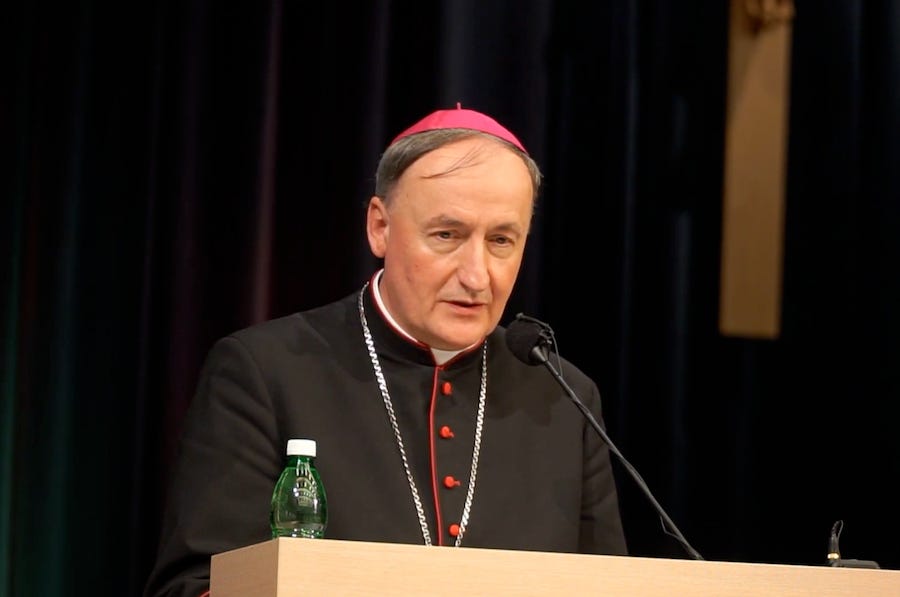
The prosecution and defense delivered their closing arguments Oct. 15 in the trial of Bishop Andrzej Jeż of Tarnów, southern Poland.
Jeż is accused of failing to promptly notify law enforcement after receiving credible information about alleged sexual offenses against children under 15 by two priests in his diocese. He denies the charges.
Prosecutor Marcin Stępień requested a 10-month prison sentence, suspended for three years, and a fine of 20,000 złotys (around $5,140), if the bishop is found guilty, the Polish Press Agency reported.
Stępień argued that the diocese reported the cases to law enforcement more than three years after an obligation to report sexual offenses against minors came into force in 2017.
He added that the diocese only reported allegations against one of the priests after they were publicized in a blog post. The prosecutor said the delay in reporting the allegations meant that the offenses fell outside of the statute of limitations.
Stępień also accused the 63-year-old bishop of failing to apologize for his alleged negligence, offering only general condemnations of sexual abuse and the duty to combat it.
He commented: “There are no reasons that could justify concealing pedophilia. If someone believes they were doing it for the good of their own environment, or out of fear of criticism from society, then they deserve punishment all the more.”
The defense called for Jeż’s acquittal, arguing there was legal uncertainty about whether the duty to promptly report offenses introduced in 2017 applied to offenses committed before the change took effect.
Poland’s Supreme Court clarified in 2022 that the reporting obligation, which took effect on July 13, 2017, also applied to people who had already received credible information about offenses before that date but failed to notify law enforcement after the obligation came into force.
The defense argued that Jeż should not be judged as though the legal interpretation was settled at the time he made the decisions concerning the two priests.
The defense also noted that the allegations against one of the priests were known to others in authority.
Defense lawyer Zbigniew Ćwiąkalski said: “One cannot be held responsible for the institution itself, for the knowledge possessed by other people, or for years of inaction by numerous institutions, including state institutions. Yet in this particular case, no one seems eager to bring charges against the officials or employees of those institutions.”
He added: “The accused cannot be judged on the basis of knowledge acquired later or a legal interpretation developed subsequently. Therefore, in the defense’s view, the only conclusion to be drawn is that the accused should be acquitted of both charges.”
The defense insisted that justice would not be served if the bishop was convicted out of a desire to symbolically hold the Church accountable for its broader failures to combat abuse.
Defense lawyer Paulina Majtkowska said: “Justice does not mean finding someone to convict in every tragic story. It means convicting only the person whose guilt can genuinely be established.”
The verdict is expected to be announced Oct. 29.
The district prosecutor’s office in Tarnów filed an indictment against Jeż in April 2024, accusing him of violating Article 240 of the Polish Penal Code, which requires people to report certain specified offenses to law enforcement. The amendment that took effect in 2017 expanded the offenses to include specified sexual offenses against minors under 15.
The indictment referred to the cases of two priests of the Tarnów diocese, identified only as Fr. Stanisław P. and Fr. Tomasz K.
Polish media have reported that Fr. Stanisław P. allegedly abused at least 95 boys in Poland and Ukraine between 1987 and 2008. Fr. Tomasz K. is accused of abusing three minors between 2008 and 2010.
The bishop’s defense team called for the bishop to be acquitted also because of doubts over jurisdiction as many of Fr. Stanisław P.’s offenses were committed in Ukraine.
The Tarnów diocese has previously said that it opened a canonical process against Fr. Stanisław P., informing the Vatican’s Dicastery for the Doctrine of the Faith, which launched canonical administrative and penal proceedings that ultimately resulted in the priest’s dismissal from the clerical state.
Polish criminal law treats sexual offenses against under 15s with particular severity, while Church law defines sexual abuse of a minor as involving a person under 18.
Defense lawyers said that Jeż initially believed that all of Fr. Tomasz K.’s victims were over 15 years old, but promptly contacted law enforcement when he learned that one victim may have been under 15.
The Tarnów diocese has previously said that Fr. Tomasz K was punished by the Church for acts committed against minors under the age of 18, before it was known that one of the victims may have been under 15.
Prosecutors filed an indictment against Fr. Tomasz K. before the district court in Nowy Sącz in 2024.
The bishop’s trial, which is described as unprecedented by Polish media, opened Feb. 18. Jeż apologized to abuse victims but denied the charge, insisting that the cases were reported to the authorities in accordance with the law.
The Tarnów diocese consistently records the highest level of Catholic practice in Poland. The latest statistics, published in December 2025, showed the diocese has the highest rate of Sunday Massgoers in the country (62.3%), well ahead of the next highest dioceses of Rzeszów (52.4%) and Przemyśl (50.0%).
The diocese also has the highest proportion of recipients of Holy Communion (26.2%).