
Pillar paid subscribers can listen to JD read this Pillar Post here: The Pillar TL;DR
Hey everybody,
Tomorrow’s Lent, and you’re reading The Tuesday Pillar Post.
First, let me say that thanks to my friends in Louisiana, I now love king cake. One year ago, I complained about the grocery store variety on offer in Colorado, and they sent me the real McCoy, just to set me straight. Colorado king cake is inedible. The real deal is life-changing. Accept no substitutes.
King cake is nearly as delightful as the best Fat Tuesday entremet I’ve ever enjoyed: In small-town Austria, nearly 25 years ago, I ate in Shrovetide a treat given out at the village post office: A piece of hot toast, smeared with lard instead of butter, then sprinkled with brown sugar, and best eaten outside, as wet spring snowflakes fall around you.
You can’t replicate that at home, I promise, but if you find yourself in small town Austria today, get to the post office before it closes.
Anyway, I’ve been thinking about Pope Leo as we get ready for Lent.
He’s got a solid nine months in the job already, and the way he’ll lead as the Roman Pontiff has begun steadily to emerge. But he’s still new enough in the papal gig that he hasn’t even moved into permanent digs yet, and people are still asking “who’s the real Leo” type questions.
And the pope hasn’t yet had the experience that seems central to Petrine ministry: Celebration of the Easter vigil, as the successor of St. Peter, and the vicar of Christ on earth.
Easter is — or should be — the absolute center of our Catholic lives, and the vigil is Easter’s most central, dramatic, and beautiful liturgy.
It seems to me that there is something about celebrating that Mass which is central to the identity of the pope, as the leader of apostles’ successors, and as Peter, especially.
Peter is a central figure in the Easter drama — he is first the denier, and then, on the seashore with the Lord alive, he is the one to affirm that Christ is risen, jumping into the water with his clothes, and swimming hard to the shore.
Peter, who denied the Lord, experienced in Easter a personal redemption — not only forgiveness, but a commission, to tend the sheep and feed the lambs.
It’s a gift for us to have this Church, which guides us through the drama of the Incarnation, walks us through the agony of crucifixion, and then the unmerited and ineffable gift of Resurrection.
And first, she asks of us only a period of quiet, of penance, of fasting and giving generously, she asks us to focus ourselves wholly on what has occurred, and on the promise of what’s yet to come.
That’s Lent, the period into which we now enter.
If you’re not yet sure about how to observe it well this year, Pope Leo himself has suggestions.
The pope’s first Lenten message urged two things:
First, listening to the Word of God in the liturgy, and through that, to “those who are anguished and suffering.”
“Our God is one who seeks to involve us,” the pope wrote. “Even today he shares with us what is in his heart. Because of this, listening to the word in the liturgy teaches us to listen to the truth of reality. In the midst of the many voices present in our personal lives and in society, Sacred Scripture helps us to recognize and respond to the cry of those who are anguished and suffering. In order to foster this inner openness to listening, we must allow God to teach us how to listen as he does. We must recognize that ‘the condition of the poor is a cry that, throughout human history, constantly challenges our lives, societies, political and economic systems, and, not least, the Church.’”
Second, fasting — both fasting ascetically, from food, and “fasting” spirituality from harsh or undue criticism.
“Abstaining from food is an ancient ascetic practice that is essential on the path of conversion. Precisely because it involves the body, fasting makes it easier to recognize what we “hunger” for and what we deem necessary for our sustenance. Moreover, it helps us to identify and order our “appetites,” keeping our hunger and thirst for justice alive and freeing us from complacency. Thus, it teaches us to pray and act responsibly towards our neighbor,” Leo explained.
Further: “I would like to invite you to a very practical and frequently unappreciated form of abstinence: that of refraining from words that offend and hurt our neighbor. Let us begin by disarming our language, avoiding harsh words and rash judgement, refraining from slander and speaking ill of those who are not present and cannot defend themselves. Instead, let us strive to measure our words and cultivate kindness and respect in our families, among our friends, at work, on social media, in political debates, in the media and in Christian communities. In this way, words of hatred will give way to words of hope and peace.”
Sounds like a good reminder, especially, for those of us who spend too much time online, where “harsh words and rash judgment” are the currency of the realm.
Here’s the pope’s full Lenten exhortation.
—
Before we get to the news, I’ve got two other Lenten suggestions for you.
First, if you want to listen better to Word of God, consider Sunday School, our weekly Sunday readings podcast with Dr. Scott Powell. Every week, I learn far more about Sacred Scripture than I expect to. You can subscribe wherever you listen to podcasts.
Second, if you want to spend less time online each day, or less time consuming news, consider Starting Seven, our every-single-morning news roundup, which comes right to your inbox, and will only ask seven minutes to keep you updated on the entire life of the Church.
The hitch is that you’ve gotta be a paid subscriber to get Starting Seven. If you are already, you can set Starting Seven to come to your inbox right here.
If you’re not already a paid subscriber, you’re in luck. I so much want you to read Starting Seven that we’re offering a 25% off subscription sale, right now:
The news
While the big 206 event for the U.S. Catholic Church will be the beatification of Archbishop Fulton Sheen, the TV prelate is not the only person slated to become a blessed this year.
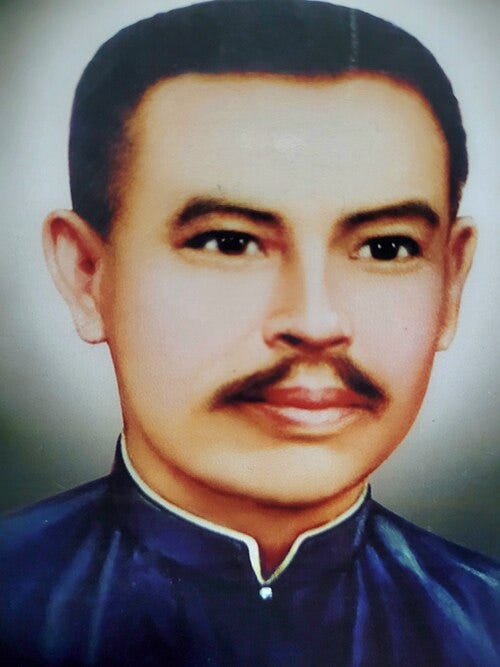
Meet Salvador Valera Parra, Jan Świerc and companions, Jan Bula and Václav Drbol, Francis Xavier Truong Buu Diep, and Elia Comini, Ubaldo Marchioni, and Nicola Capelli — the other venerables figures who will be beatified in 2026.
Plus, read about some unconfirmed-but-likely 2026 beatifications, in this report from The Pillar’s Luke Coppen.
—
And while you’re thinking about Fulton Sheen, we’ve got something else for you.
The Pillar sat down yesterday with Peoria’s Bishop Louis Tylka, who will be — potentially — the presider at Sheen’s beatification Mass, and if not, he’ll be at least the man who organized the whole thing.
Tylka talked with us about what Sheen means to him, what Sheen might mean for the world, and what it’s like to plan for a very big event, when you’re not even sure what the budget will be.
Plus, he talked about Peoria’s “Sheen experience.”
So don’t miss this conversation.
—
Pope Leo this week confirmed the members of the Vatican’s Dicastery for Bishops, including two lay people apportioned by Pope Francis to the body, and appointed another lay person — Sr. Simona Brambilla — to the body.
Those appointments contribute to an ongoing discussion about laity, orders, and the power of governance in the life of the Church.
But the most surprising contribution to that discussion this week was an essay from Cardinal Marc Ouellet, who took a new tack on the question of lay governance in the Church, and who brought some theological depth to the conversation.
Regardless of the outcome, Ed Condon argues, that amounts to a reboot of the conversation.
—
Speaking of Leo, the pontiff dissolved this month the Pontifical Commission for World Children’s Day, a papal committee that you probably didn’t know was a thing.
But it was a thing, established by Pope Francis in 2024, after the celebration of the first Vatican-sponsored World Children’s Day, which you probably also did not know was a thing.
Well, they’re going to keep World Children’s Day on the calendar, but the commission charged with organizing it will be absorbed into other Vatican offices.
So why does this matter? Because while Leo is making headlines for the Francis-era things he’s kept in place — like the members of the Dicastery for Bishops — he has been quietly unraveling a number of Francis administrative decisions, in a pattern that probably looks a lot like streamlining Vatican governance.
—
A corner of the internet was abuzz last week, as news spread that Charlotte’s Bishop Michael Martin had made a video on his “pastoral vision,” which he wanted all parishes to show during weekend Masses, preferably at homily time.
Given all of the controversy surrounding the Charlotte diocese, there was widespread speculation about whether the video would address the hot-button diocesan issues of liturgy, priestly formation, synodality, or governance models. All that was fueled amid reports that the video would be password protected, even for clergy, until just hours before Saturday afternoon Masses.
“When we think of missionaries, we think of people who are so in love with Jesus that they would go to remote places in the world to spread his love. No need for us to travel, since there are already so many places in our daily lives that we have made remote by never bringing Jesus there,” the bishop told Catholics.
The video is news in some ways for what it wasn’t — not some controversial liturgical message or otherwise vexatious plan, just a fairly ordinary call from a bishop to do some of the things that Christians are supposed to do. And it was probably, sources say, part of a pastoral vision plan that will undergird the upcoming diocesan capital campaign.
That’s a good reminder that amid the controversial stuff prompting dubia and dissension in places like Charlotte, the ordinary day-to-day of the Church marches on too. Not everything is a hot-button thing. Sometimes, bishops just say bishop stuff.
Here’s the bishop stuff Martin said.
This is a sharp conflict in a troubled region — especially for Christians.
But as Luke Coppen points out, it’s not likely one in which the Holy See will be able to play a role — both because Armenians tend to reject outside intervention in domestic affairs, and because the Holy See is unpopular in the country, because it is perceived to be too close to Armenia’s antagonistic neighbor Azerbaijan.
So why is the Vatican perceived to be close to an oil-rich authoritarian 97.3% Muslim state which has a close military partnership with Russia?
Good question.
Money. Money is the answer. At least, if you ask the Armenians.
See, Azerbaijan is rich, but not that popular in the West. So it has this program called “caviar diplomacy,” where it gives money to cultural projects in other countries, in an effort to buy make friendships and buy gain influence.
For the Holy See, the Azerbaijanis have funded restorations at the Vatican Apostolic Library, the Vatican museums, a bunch of churches, including St. Peter’s Basilica, and funded a major restoration at the Basilica of St. Paul Outside the Walls.
(Somewhere I have a photo of a “thank you” plaque in some Roman church to the Azerbaijani Heydar Aliyev Foundation, but as of press time, I can’t find it.)
Armenia says that Azerbaijan is a despotic regime which wants to erase the culture and Christian history of the Armenian people, and wants to use caviar diplomacy to buy legitimacy towards that end. It’s a bit of an issue, and it means that when there are troubles in the Caucus region, the Church is sorely lacking in local credibility.
Pope Leo is aware of all that. So is Secretary of State Cardinal Pietro Parolin. And arguably, taking money from state actors impacts their ability to help make peace. Whether they’ll address that remains to be seen.
Liturgical tasks
Pope Leo on Sunday offered Mass at the Roman parish of Santa Maria Regina Pacis, and urged parishioners to understand “the disarming strength of meekness” as they aim for “coherence between faith and life.”
The pope is a diocesan bishop — the Bishop of Rome — and it’s normal and good for him to visit his parishes.
But in media coverage, the pope’s visit has been overshadowed by the service of the parish’s cadre of altar servers, which include girls among their number.
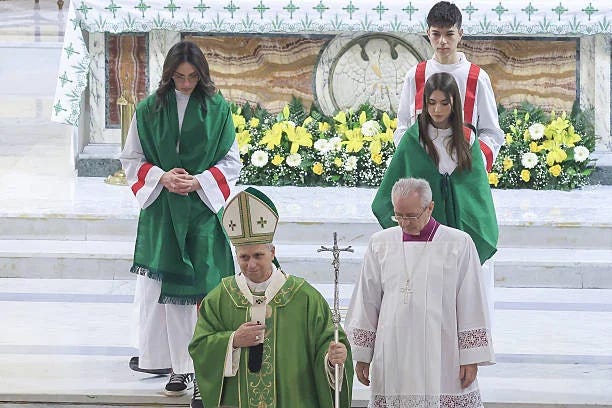
Voices on all sides have tried to make hay out of this, to blow a parish visit into a controversy — with some commentators taking it as a papal rebuke of the parishes and dioceses reserving altar serving to boys, and others taking it as sky-is-falling evidence that Pope Leo is a Marxist or a feminist or an Indigo Girls fan or something.
All of this is silly. A diocesan bishop visited one of his parishes, and graciously participated in the life of the parish, as things had been arranged for him. None of that says anything about his own personal preferences or viewpoints, and none of it was intended to be a coded winking message to terminally online Americans. I promise you.
Every diocesan bishop knows that when you show up for a liturgy, the liturgy that’s planned is the liturgy you get. The vestments they’ve laid out, the hymns they’ve chosen. Every diocesan bishop knows that being gracious means dying to preferences when you’re a guest in a place where people are eager to welcome you. Eventually, of course, diocesan bishops make known some preferences for when they visit parishes, but the good ones aren’t draconian about things.
Graciousness isn’t a failure of leadership, it is a critical component.
In other words, we can’t extrapolate some universal meaning or signal from the fact that the pope celebrated a parish liturgy in the way the parish planned it.
But the whole thing has prompted a predictable conversation about what serving at the altar really is — is it a mode of priestly discernment, or is it a means of simply participating in the Mass, which is appropriate for all the baptized?
When I tell people what I think on this subject, I invariably make them angry. But at the risk of doing so with you, dear readers, I’ll gladly offer a perspective.