Martin urges evangelization in widely anticipated ‘pastoral message’
“Imagine if all the nearly 600,000 Catholics in our region so loved Jesus that we shared him with others.”
A widely anticipated pastoral message from North Carolina Bishop Michael Martin focused on a call to evangelization, urging Catholics in the Diocese of Charlotte to be committed to proclaiming the Gospel of Jesus Christ.
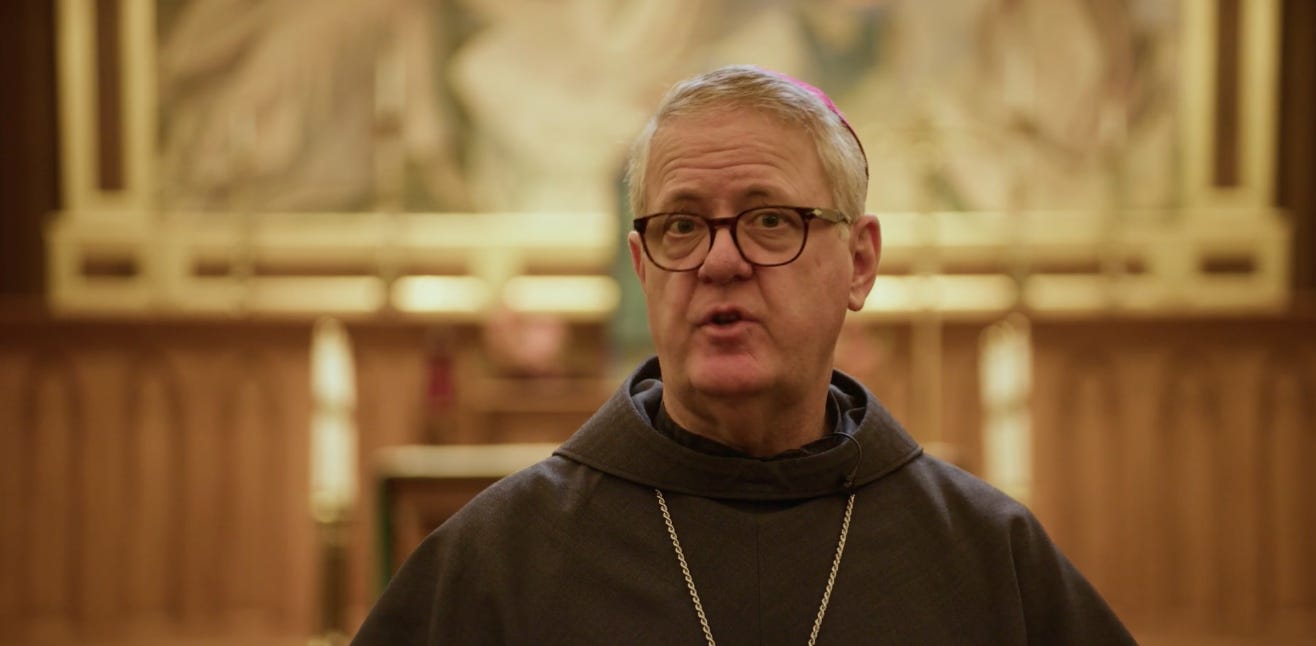
While the Charlotte diocese has been the center of controversy in recent months over proposed liturgical and formation changes from Martin, the bishop’s Feb. 14 video — intended to be shown at all Saturday and Sunday Masses this weekend — focused on a sense of mission, without reference to the contentious elements of his tenure.
—
Martin distributed to clergy on Saturday a link to his video, with instructions that it be shown at weekend Masses during the time of the homily. A version of the video was also posted on the Charlotte diocesan YouTube channel.
The message, “Everyone so Loves Jesus, We Share him with Others,” was presented as a “pastoral vision” for the Charlotte diocese, and comes some 20 months after the bishop’s installation in the Charlotte diocese.
The message began with Martin’s wish that he could “create a mirror where, when we look at it, we would see ourselves as God sees us. Imagine that.”
“If we could see ourselves as God does, we would understand how beautiful and infinitely loved we are. Too often we judge ourselves harshly, but God sees beyond our judgments, to the person he created deep within. And he loves us regardless, sins and all,” the bishop said.
It pivoted to a three point vision for the future of the Charlotte diocese — “a future where … everyone so loves Jesus, we share him with others.”
“Imagine if all the nearly 600,000 Catholics in our region so loved Jesus that we shared him with others,” the bishop encouraged.
To accomplish that vision, Martin said, three “action steps” are necessary, which “need to be taken repeatedly, and flow from one to the other.”
The steps, mostly drawn from Pope Francis’ 2013 apostolic exhortation Evangelii Gaudium, were identified as the need to “form missionary disciples,” “become the family of God,” and “go out and proclaim the Gospel.”
On forming missionary disciples, Martin noted that two-thirds of Catholics do not regularly practice the Catholic faith, requiring the the Church “rethink” its catechetical and sacramental formation.
The bishop opined that “the difference between being a believer and a disciple is the difference between being a Carolina Panthers football fan, and being a Carolina Panthers football player.”
“Fans are nice; the world needs players,” Martin explained.
“When we think of missionaries, we think of people who are so in love with Jesus that they would go to remote places in the world to spread his love. No need for us to travel, since there are already so many places in our daily lives that we have made remote by never bringing Jesus there,” the bishop added.
As to “becoming the family of God,” Martin noted “family implies an intimate connection that is not determined by our choice, but rather by our birth.”
“As children of God, we don’t get to choose our own brothers and sisters in Christ. Rather, as we know from our own biological siblings, family is hard work, requiring forgiveness, love, and selfless giving.”
Focusing on parish life, the bishop said that “our parish is primarily the place where we encounter the love of God. And yet, too often we come to church looking to be served, rather than to serve. As guests, rather than hosts.”
“More importantly, the parish can not be a place of serving God’s family, if our homes are not the first and most important place where we live as God’s family.”
“Imagine a world where the holiness of our family life is what we bring with us to share each week at church, rather than the other way around,” Martin encouraged.
On the topic “Go out to proclaim the Gospel,” Martin offered that “to be a disciple of Jesus and not go out to proclaim his message is like holding a winning lottery ticket, but never cashing it in.”
“The good news that Jesus came to proclaim is that our Father loves us unconditionally, and wants to save us from the death of sin.”
“The real joy of the Gospel is not simply in hearing it, but also in sharing it. That is what Jesus came to do, and what we’re called to do as well,” the bishop said.
Concluding those points, Martin prayed that the Holy Spirit would “guide as, we continue to envision a new heaven and a new earth, with the Holy Spirit, in western North Carolina — so loving Jesus that we share him with others.”
He urged Catholics to “entrust this vision to the first missionary disciple, Mary, Mother of the Church.”
“May we follow her example of saying yes,” the bishop urged.
—
Martin told Catholics that more would be shared about the pastoral vision in months to come — though it is not clear whether that refers to some additional reflections on the issues raised, or whether the themes of the vision will form the basis for an upcoming capital campaign planned for the diocese, which is expected to aim for raising some $150 million.
The video’s focus on missionary discipleship and evangelization is consistent with themes emphasized by Martin during his leadership in the Charlotte diocese.
It came after anticipation of the bishop’s pastoral message spread on social media this week, fueled by ample recent news coverage of controversy over leadership and liturgy in the diocese.
Speculation about the video’s contents was amplified when priests were notified in a Feb. 5 memo that the video would be released this weekend, and that Mass celebrants were directed to offer a “brief homily” before announcing and playing the video — unless “for a pastoral reason,” the video needed to be shown immediately before the final blessing.”
The video was uploaded on Wednesday but protected by a password until Saturday afternoon, leading some to speculate that the message might be a substantial policy announcement for the diocese, or that Martin was concerned about the prospect of leaks.
But clergy who spoke to The Pillar after its release emphasized the content’s consistency with Martin’s basic emphases during his episcopal tenure.
—
Martin’s leadership of the diocese has been marked by widespread media attention to liturgical and governance disagreements in western North Carolina.
In January, more than 30 priests in the Diocese of Charlotte submitted a set of questions to the Vatican related to recent liturgical changes announced by the local bishop, including a decision to ban the use of altar rails and kneelers for communion.
In the same month, some Charlotte Catholics raised concern over the bishop’s decision to reassign a priest to ministry after he was removed amid allegations of child abuse, in a case which points to the difficulty posed by differing uses of the term “credible” to characterize allegations of abuse.
In December, priests told The Pillar they were concerned about a change to priestly formation in the diocese, which would see seminarians spend a year as high school or middle school teachers. Martin said the move will give seminarians a chance to experience the “ordinary demands” of Catholic lay life, and to better understand how to teach the Catholic faith.


Credit where it is due: this is good.
First of all, what was the point of shrouding this in mystery and intrigue. I only skimmed through it, but there is nothing controversial here.
Second, why hire a video-production team to do this. This is something could easily have been read from the pulpit by every pastor. There’s nothing groundshaking here that needs to come from the bishops mouth.
I work in video production. This is a very simple two-camera shoot. But that still costs money, even if you have an in-house team doing it. If hire a production company, this simple shoot could easily cost a couple thousand. Just in labor alone, you hire two camera ops (+ camera rentals), an audio guy, and lighting guy (+ rentals and expendables) and production manager from the company.
This looks like it was done on the cheap (I don’t say the dismissively… it didn’t require more than this and this is exactly what I would have done/recommended)… but still it did cost money. They invested money in something that could have been done (in my opinion) more effectively with a mix of pamphlets, mandatory readings from the pulpit and social media.
And done all without the mystery and drama.