
A group of 35 Brazilian bishops signed a letter this week saying that right-wing presidential candidate Flávio Bolsonaro “threatens democracy, national sovereignty, and the common good” in Brazil.
The letter – an unusually direct intervention into electoral politics for the country’s bishops – comes two days before the Oct. 25 runoff between Bolsonaro and incumbent president Lula Da Silva.
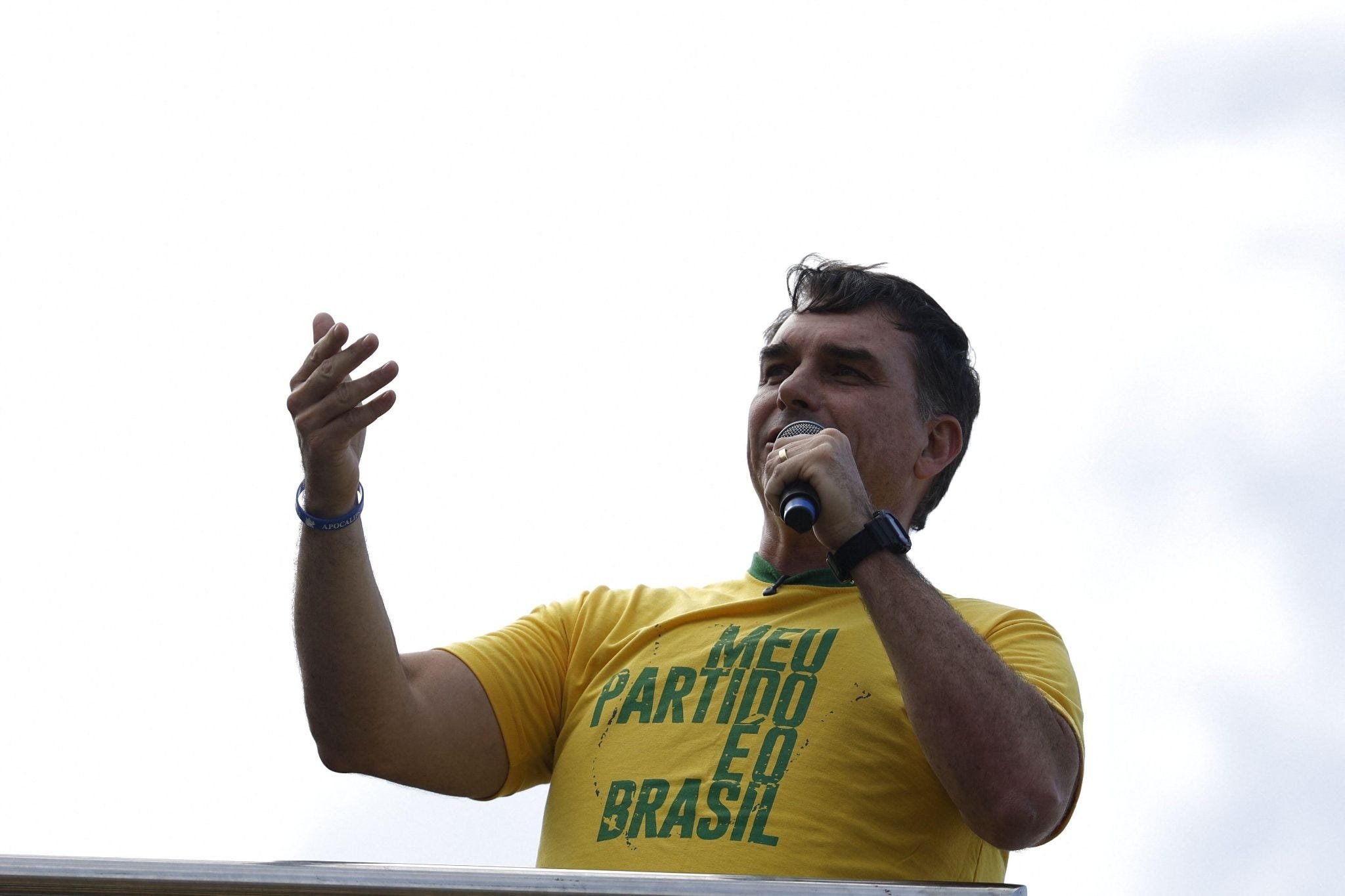
Bolsonaro unexpectedly won the first round of the election with 47% of the vote, and is now leading in the polls heading into the Oct. 25 election. He is the son of former president Jair Bolsonaro, who is under house arrest for a coup attempt.
Da Silva, who hails from the left-wing Workers Party, has advanced campaign proposals including lowering the standard work week from 44 to 40 hours without reducing salaries, expanding Brazil’s welfare program, offering free public transport, and enacting more environmental protections.
Bolsonaro, the candidate for the right-wing Liberal Party, has promised to reduce taxes and public spending, and implement tougher policies on crime, including extended prison sentences and chemical castration of men found guilty of rape.
In diplomatic matters, Da Silva has proposed greater involvement with the global South, while Bolsonaro intends to strengthen ties with Israel and the United States. On social issues, Da Silva has been ambiguous with regards to abortion and supports LGBT rights, while Bolsonaro is against abortion and says he will fight against LGBT materials in schools.
Da Silva, whose presidency has been plagued by allegations of corruption, describes himself as a Catholic, saying frequently that he does not attend Mass as often as he used to, but receives communion when he does. Bolsonaro is a practicing Evangelical.
The bishops’ letter, which includes three archbishops among its signatories, alleges that Bolsonaro, who is a close Trump ally, “promises to subject Brazil to the United States.”
The letter also says that Bolsonaro “promises to allow broad access to firearms, as his father did during his administration,” and “does not recognize the climate crisis and denies ecological problems.”
Bolsonaro says he supports gun ownership for self-defense. He questions human-caused climate change, and while he has promised to crack down on illegal forestation, he has also pledged to soften environmental regulations that he views as unnecessary and harmful to the economy.
The bishops’ letter stops short of endorsing Da Silva, but says that while the current president can be “subject to criticism, has always demonstrated a sense of responsibility toward the poor and our Common Home and has acted within the bounds of the democratic order, respecting the Constitution.”
It says that disliking Da Silva’s government “is not a reason to hand the country over to those who display such a contradiction with the teachings of our Church.”
“This is not merely an electoral choice, as has so often been the case in Brazil, but the possibility of a profound change in the nation’s course—one whose historical precedents in the 20th century have left cruel and bitter memories,” the letter argues.
“One of the candidates is the son of a president who was convicted and imprisoned for undermining democracy and who continues to follow his father’s ideas. He has made several statements threatening the constitutional order, and, if elected, will govern with an absolute majority in the National Congress, creating the conditions for a usurpation of power and the subjugation of the country to his ideology.”
According to Brazilian newspaper Folha de São Paulo, the letter was drafted by a group known as “Bishops of Dialogue for the Kingdom,” which had previously released another letter in August criticizing “authoritarian conservatism.”
While 35 bishops is a significant number of signatories, it includes emerituses and auxiliaries, and Brazil has almost 500 total bishops, including ordinaries, auxiliaries and emerituses.
Most local watchers would identify the general leaning of the Brazilian bishops’ conference as progressive. However, not all members share the same political leanings.
One senior official of the Brazilian bishops’ conference told The Pillar that he thought it was misguided to single out Bolsonaro for criticism.
“The Supreme Court is a mess, it’s corrupt, it’s politicized, it’s a danger,” the bishop said. “And Lula has many issues too. Bolsonaro is dangerous, but part of the reason why he’s popular comes from how bad Lula’s government has been, and the perception of corruption surrounding his administration.”
Brazil has the highest number of Catholics of any country in the world, and while the number has fallen for decades, the Church still plays a highly influential role in the public discourse.
According to the 2022 census, 56.7% of Brazilians identify as Catholic, with Evangelicals at 26.9%. In 2010, 65.1% of the population identified as Catholic, compared to 21.6% who identified as Evangelicals.
Politically, Catholic and Evangelical voting intentions form almost a mirror image, with 50% of Catholics and 26% of Evangelicals saying in polls that they would vote for Da Silva, and 52% of Evangelicals and 32% of Catholics saying they would vote for Bolsonaro.
This is not the first time the Catholic Church has seen itself involved in the presidential campaign in Brazil.
Bolsonaro’s campaign reacted immediately to say there was no such plan, and that Da Silva had spread fake news with the help of the Catholic Church.
There is no record of Bolsonaro making statements about changing the status of Our Lady of Aparecida in the country.
However, an Evangelical congressman close to the Bolsonaro family had proposed back in 2008 to change the wording of Our Lady’s legal status, from “patron saint of Brazil” to “patron saint of Brazilian faithful of the Roman Catholic and Apostolic Church.” The proposal was never adopted.
In addition, Bolsonaro’s Evangelical pastor has made controversial statements about devotion to Our Lady Aparecida in the past – saying that “God hates the worship of the Queen of Heaven” and arguing for her removal from the role of patron saint.
The issue was brought into the headlines after a Sept. 24 social media post from Brazilian comedian António Tabet, who said that: “The militia-linked family hates black women so much that they have even attacked Our Lady of Aparecida.”
For his part, Flávio Bolsonaro reacted furiously to Tabet’s post, blaming “people within” the Brazilian bishops’ conference for helping the Workers Party to spread “fake news.”
The bishops responded by saying that “you cannot fight one lie with another,” and assuring Bolsonaro that they had played no part in rumor-mongering. While the candidate thanked the bishops for the clarification, the perception that the conference had been involved had already begun to spread.
On Sept. 28, Bolsonaro was handed at an outdoor rally a small Aparecida figure by a Catholic supporter. He smiled and raised the figure in the air, to the applause of the crowd.
Soon after that, a local politician presented Da Silva with an image of Our Lady of Nazareth, the patron saint of Pará, asking that she might “bless his victory.” Da Silva proceeded to lift the image above his head, and solemnly process across the stage with it.
Ugh. The Church in Brazil is collapsing, and their union with just terrible, backward, corrupt governance (of which Da Silva is a poster child) is undoubtedly a part.
Alas, alas, poor Brazil.
oh no, not Our Democracy!