
Poland’s bishops announced Saturday that they had approved the revised statutes of a long-delayed independent commission investigating abuse in the Church and named a historian to lead it.
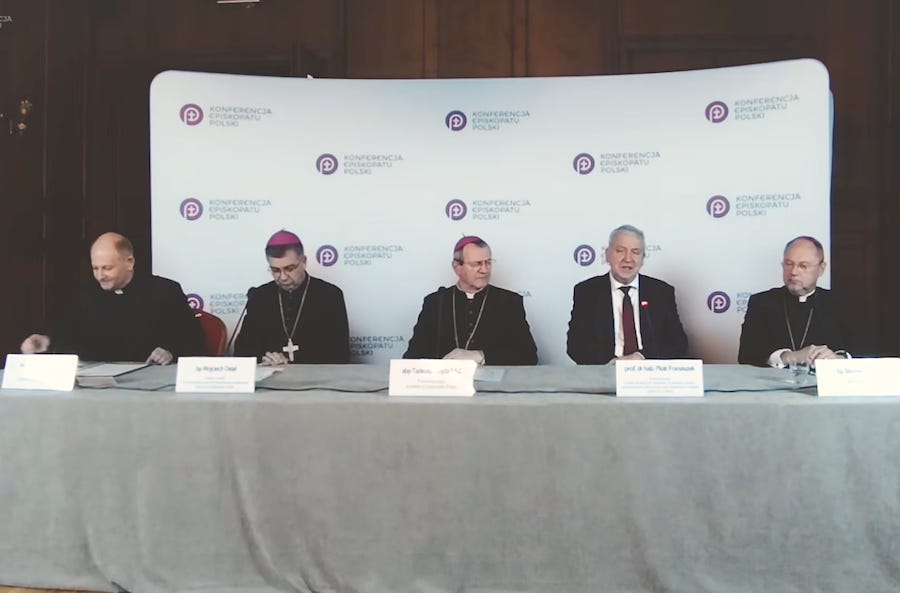
The Polish bishops’ conference said Oct. 24 that the commission of independent experts (Komisja niezależnych ekspertów) — initially approved in 2023 — would be led by Piotr Franaszek, a professor at the Jagiellonian University in Kraków.
In a statement at the end of their Oct. 22-24 plenary meeting in Zakopane, the bishops said the revised statutes would be submitted to a Polish government ministry as part of the process of securing legal personality for the commission under Polish law. This step will give the independent commission a legal status distinct from that of the bishops’ conference.
Speaking at a press conference, bishops’ conference spokesman Fr. Leszek Gęsiak, S.J., said that the approval of the revised statutes and appointment of a chairman testified to the bishops’ methodical approach to the commission.
“The way the bishops are working demonstrates tremendous consistency in preparing a very solid and substantive foundation, so that this matter can be thoroughly clarified and investigated, and so that respect can also be shown to those who have been harmed,” he said.
“This is a very well-planned process. The successive steps taken by the bishops show that the Church in Poland is preparing to clarify these matters with great calm, consistency, and wisdom.”
Amid rising abuse claims, the Polish bishops unanimously decided in March 2023 to create a team to draw up a blueprint for an independent abuse commission. The decision followed a controversial documentary alleging that St. John Paul II covered up abuse during his tenure as Archbishop of Kraków from 1964 to 1978.
The bishops indicated that the commission would examine state and Church archives, considering legal, historical, and sociocultural contexts, following similar initiatives in France, Germany, Portugal, and Spain. In June 2023, the bishops voted to establish the commission, focusing on the period from 1945 onward.
In February 2025, the bishops’ legal council issued a critical opinion on the commission’s draft operating principles, questioning the legitimacy of the June 2023 vote due to procedural issues, such as the lack of prior notice and a written resolution.
The council also raised concerns about the commission’s investigative nature, its potential to question bishops, and its possible conflict with Vatican authority over senior churchmen.
Polish abuse survivor advocates criticized the council’s opinion and accused it of seeking to limit the commission’s scope. They also lamented the delay in establishing the independent body.
At a March 2025 plenary assembly in Warsaw, the bishops reaffirmed the need to establish the commission, stressing its historical and interdisciplinary focus. They called for further consultations with male and female religious bodies to refine the draft principles.
At a June 2025 plenary meeting, the bishops decided that the project would be entrusted to Bishop Sławomir Oder, a canon lawyer best known for serving as the postulator of Pope John Paul II’s canonization cause. Oder took over responsibility for the commission from Poland’s Primate Archbishop Wojciech Polak, a prominent figure in the Polish Church’s safeguarding efforts.
In March 2026, the bishops’ conference submitted an earlier draft of the commission’s statutes to Poland’s Ministry of the Interior and Administration, requesting its approval as a legal entity in state law. Five other state institutions examined the text. In July 2026, Polish media published the opinions of four of the bodies. They called for sharper definitions of the commission’s powers, legal safeguards, and relationship with state institutions.
At the press conference, Oder outlined the steps that must still be taken before the commission can begin its work.
“Until now, it has been an empty legal structure. Steps had to be taken to obtain legal personality under state law,” said Oder, the Bishop of Gliwice.
He confirmed that the revised statutes would be submitted again to the Interior Ministry. The revised statutes will not be published until they have been approved by the ministry.
Oder added: “The selection of Professor Franaszek opens the way for a team of experts to be established. This is the task of the person appointed as chairman of the commission.”
Franaszek, the commission’s new chairman, noted at the press conference that “we are right at the beginning, but we now have an established commission, statutes, and a chairman.”
He said: “The next step will be to reach out to people and invite them to serve on the commission. The commission will be made up of specialists with considerable expertise to contribute in the field for which the commission was established.”
He added that the commission would then develop its working methodology. He said the commission would likely draw on the experiences of similar commissions in other countries, including neighboring Germany.
Fr. Andrzej Kobyliński, a philosopher and head of the ethics department at the Cardinal Stefan Wyszyński University in Warsaw, told the Polish Press Agency he thought the commission’s work would have limited impact.
“Unfortunately, it is already too late for the commission’s work to make an effective contribution to halting the rapid secularization of the younger generation. That might have been possible 15 to 20 years ago,” he said.
Kobyliński argued that the topic of clerical abuse no longer appeared to be a priority at the Vatican under Pope Leo XIV.
“As a result, interest in this issue is also declining in Poland. This means that the commission’s final report, which will be published in a few years’ time, will be of primarily historical value. Its social impact will be very limited,” he said.
Kobyliński added that Franaszek was not a well-known public figure and had never previously conducted academic research into the sexual abuse of minors or vulnerable adults.
Robert Fidura, who was sexually abused by a priest and campaigns on behalf of survivors, raised questions about Franaszek’s background and political associations.
He wrote on social media: “For my part, I would add that the professor is a Benedictine oblate and served on Kraków City Council and the Council of the Institute of National Remembrance as a PiS [Law and Justice party] representative. He specializes in the socio-economic history of the 19th and 20th centuries. And as for the statutes — they still don’t exist [in published form].”
Under an agreement between the Polish bishops’ conference and the superiors of religious orders, the commission will be funded via the St. Joseph Foundation, which was founded by the Polish bishops’ conference in 2019 to support abuse survivors and strengthen safeguarding efforts.
The foundation said: “At this stage, we do not yet know the details needed to assess the scope and scale of the planned funding for the commission’s work. It will be necessary to establish a budget, a timetable, and the rules governing the transfer and accounting of funds.”
In the statement at the end of their plenary meeting, the Polish bishops also responded to an Oct. 20 decision by the lower house of Poland’s parliament’s to pass two bills seeking to liberalize the country’s abortion laws.
Observers believe that if the bills also pass the upper house of parliament, they will be vetoed by President Karol Nawrocki. He has previously indicated that he would not sign a bill liberalizing abortion.
The bishops said: “Concern for the lives of the defenseless, especially unborn children, is a matter of conscience and an expression of every person’s social responsibility.”
“Even if the measures adopted by the Sejm [lower house] were to be rejected at subsequent stages of the legislative process, the very fact that they are being considered contributes to the development of social acceptance of abortion as a morally neutral solution, which is contrary to the truth.”
“The bishops appeal for respect for the life of every child, including the unborn, who is a subject of law, and call for concrete, effective, and long-term assistance to be provided to women facing difficult circumstances in life and to their families.”
“For its part, the Church has been offering such assistance for many years.”