How free is the pope to choose German bishops?
What do concordats expect of the pope?
Archbishop Hubertus van Megen formally took up the role of apostolic nuncio in Germany Thursday, when he presented his credentials to President Frank-Walter Steinmeier in Berlin.
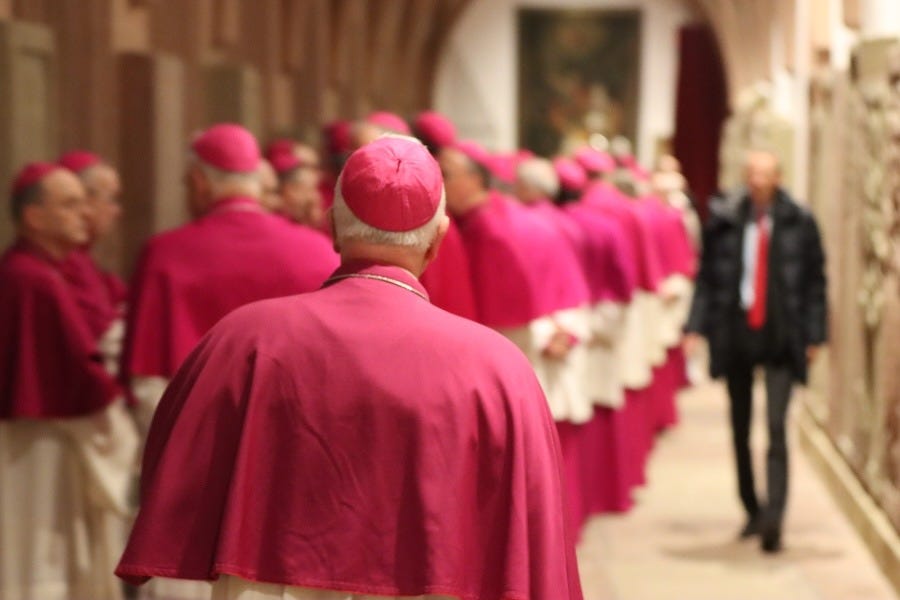
Among the Dutch archbishop’s most important responsibilities will be advising Pope Leo XIV on the selection of new German bishops when vacancies arise.
Diocesan bishops who will reach the standard retirement age of 75 in the coming years include Bishop Gerhard Feige of Magdeburg (74), Bishop Heinrich Timmerevers of Dresden-Meissen (73), Cardinal Reinhard Marx of Munich and Freising (72), Bishop Wolfgang Ipolt of Görlitz (72), and Archbishop Heiner Koch of Berlin (72).
But van Megen will be well aware that the pope faces a distinct set of constraints when it comes to appointing their successors.
What rules govern the nomination of the country’s bishops? And how free does this leave the pope to select his favored candidates?
What rules govern appointments?
When the vast majority of the world’s dioceses fall vacant, the pope is free to appoint his chosen candidate directly.
This is expressed in Canon 377 §1 of the 1983 Code of Canon Law, which says that “the Supreme Pontiff freely appoints bishops or confirms those legitimately elected.”
But the appointment process is not always so straightforward. In China, for example, the pope has less room for maneuver, if he wants to balance his appointment prerogative with an effort to normalize the state of the Church in the country.
Announcing a new episcopal appointment in the country this week, the Vatican noted that the pope had appointed the bishop after approving his candidature within the framework of the 2018 provisional agreement between the Holy See and the Chinese government. The agreement’s exact terms have never been published, making it difficult to know precisely how candidates are nominated.
This atypical arrangement, in which a state plays a notable role in the choice of bishops, has historical precedents. For example, the Concordat of 1801 gave Napoleon the right to nominate French bishops, while the pope canonically appointed them.
Exceptional arrangements also emerged in Germany for historical reasons connected with the country’s relatively late emergence as a unified nation-state.
Before the country’s unification in 1871, individual German states signed concordats, or formal agreements, with the Holy See that governed bishops’ appointments. Some of these arrangements survived unification and were later modified by new concordats, leaving Germany with a patchwork of nomination procedures.
The three main concordat arrangements governing diocesan episcopal appointments today are the Bavarian Concordat (1924), the Prussian Concordat (1929), and the Baden Concordat (1932). It’s worth noting that these apply to the nomination of diocesan ordinaries, rather than auxiliary bishops, who are appointed through the standard process.
The Bavarian Concordat covers eight dioceses. These are Bamberg, Würzburg, Eichstätt, Passau, Regensburg, Augsburg, and Munich and Freising — all situated in the southern state of Bavaria — and Speyer, which is located in the Rhineland-Palatinate state, but for historical reasons is associated with Bavaria.
Under the Bavarian Concordat, diocesan bishops and cathedral chapters are required to submit lists of potential new bishops to the Holy See every three years, regardless of whether there is a vacancy. When a bishop resigns, the cathedral chapter submits its recommendations to the Holy See, which selects a candidate according to the concordat’s procedures.
If he observes the terms of the concordate, the pope therefore does not have the same freedom of appointment in Bavaria that he has in most dioceses worldwide. Instead, the text delineates that he must choose from among candidates presented through the concordat process.
Once the pope has made his choice, the Bavarian state government is informed of the decision and has a right to object to an appointment on political grounds before the appointment is formally announced.
The Prussian Concordat applies in 15 dioceses — Berlin, Hamburg, Cologne, Paderborn, Aachen, Erfurt, Essen, Fulda, Görlitz, Hildesheim, Limburg, Magdeburg, Münster, Trier, and Osnabrück — making it the most widespread arrangement in Germany.
When a diocese falls vacant, the cathedral chapter presents a list of candidates to the Holy See. Rome reviews the list and sends a list of three names to the chapter, which chooses one. The chapter communicates the election result to the state government, which has the right to raise political objections to the chosen candidate. The pope then confirms the election. Minor variations can occur in the process within some dioceses.
The Baden Concordat applies to just four dioceses: Freiburg, Rottenburg-Stuttgart, Mainz, and Dresden-Meissen.
It closely resembles the procedure of the Prussian Concordat, in which the cathedral chapter elects a candidate from a list of three sent by Rome, but with some procedural differences.
In recent years, there has been a concerted push to increase the laity’s role in German episcopal appointments, linked to the country’s controversial synodal way.
Church law already allows lay people to participate in a limited way. Canon 377 §3 says that apostolic nuncios — the pope’s ambassadors — can seek the opinions of “laity outstanding in wisdom” on potential candidates.
A 2022 synodal way resolution called on cathedral chapters to work with an elected body representing “the entire people of God in the diocese” to determine a list of suitable candidates that the chapter sends to the Vatican.
But dioceses have found it difficult to enact the resolution because appointment processes are strictly governed by concordats and cannot be changed unilaterally.
How constrained is the pope?
Overall, the pope has a slightly freer hand in the appointment of bishops to eight out of Germany’s 27 dioceses (the Bavarian ones), but faces a significantly restricted choice in the remaining 19 dioceses (the Prussian and Baden ones).
This is important to take into account in any discussion of whether Pope Leo XIV could overhaul the German hierarchy, if he so wished.
If that were his intention — and he has given no obvious indication that it is — he would likely face considerable local resistance. This point is speculative, but there are precedents from the pontificates of John Paul II and Benedict XVI that are worth considering.
The Polish pope, for example, appointed the conservative-minded Wolfgang Haas as the coadjutor bishop of Chur in 1988, effectively bypassing the Swiss diocese’s normal episcopal election procedure in which the cathedral chapter played a pivotal role. But Hass encountered so much opposition that in 1997 he was put in charge of the newly created Archdiocese of Vaduz in Liechtenstein.
In 2009, Benedict XVI appointed Fr. Gerhard Maria Wagner, another temperamentally conservative figure, as an auxiliary bishop of Linz, Austria. Although no cathedral election procedure applied to the appointment, it raised local hackles because Wagner was not among the candidates proposed by the Linz diocese. Following protests by priests and lay people, Wagner asked the German pope to withdraw the appointment, and he accepted the request.
These two cases arguably highlight the difficulties of going against the grain of local ecclesial culture in the German-speaking world.
If Pope Leo wished to alter the course of German Catholicism, episcopal nominations alone would probably not be sufficient. After all, appointments are downstream from the ecclesial culture that produces future bishops. Any lasting change would likely depend on reshaping the culture itself, perhaps by supporting grassroots movements that offer an alternative to the now-dominant synodal way.

I was thinking about this specific question after reading the recent news piece about Cardinal Marx and wonder what it would take to amend any of these concordats (if there was even any desire). Would the Holy See negotiate with the relevant German state governments? Would the national government need to be involved? I’m not sure how German federalism works but can’t imagine that the national government wouldn’t be included as a party to a future treaty.
Also, nice choice on the map colors!
Thank you, this is very informative.