India’s bishops have condemned alleged police brutality during a march in Delhi by supporters of the country’s youth-led Cockroach movement, a satirical political party in the country that has become the center of a now serious political and social conflict.
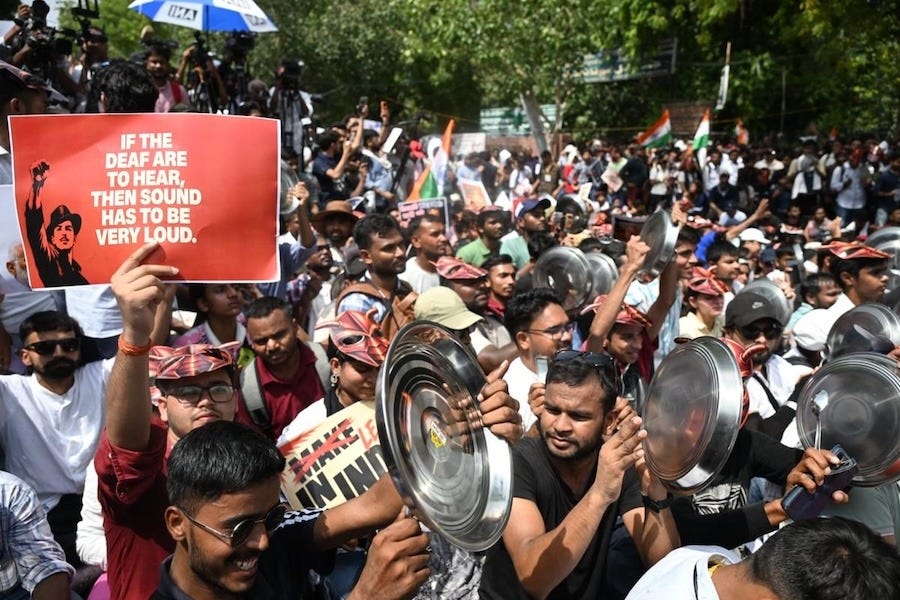
The Catholic Bishops’ Conference of India — which represents the nation’s Latin Catholic, Syro-Malabar, and Syro-Malankara bishops — expressed solidarity July 21 with thousands of protesters who gathered in the capital in defiance of police orders to demand the resignation of Education Minister Dharmendra Pradhan.
The demonstrators were affiliated with the Cockroach Janta Party, a parody political party founded in May in response to comments by India’s Chief Justice Surya Kant appearing to liken unemployed youth who embrace activism to cockroaches.
The bishops said they felt “profound anguish” after video footage showed police firing tear gas and wielding lathis, or long bamboo sticks, as they drove back protesters attempting to reach India’s parliament.
“Our youth, the true future of this nation, took to the streets with legitimate demands for urgent accountability and reforms in our education system. Meeting their peaceful, democratic expression with disproportionate force is a heartbreaking assault on the very soul of our democracy,” the bishops commented.
“The CBCI stands firmly united with all the students who faced this harrowing brutality. We share your pain, hear your voices, and echo your righteous cry for a transparent and just education system.”
Delhi Police have rejected allegations that they responded to the protests with excessive force.
The Cockroach Janta Party exploded in popularity online after it was launched in jest by political communications strategist Abhijeet Dipke. The party’s name alludes to India’s ruling Bharatiya Janata Party, with the middle word in both cases meaning “the people.” The CJP portrays the BJP as authoritarian, corrupt, and out of touch.
The CJP’s official website describes the party as the “voice of the lazy and unemployed” and features an image of a besuited spokesman with a cockroach’s head. It presents the insect, which is common in India, as an image of resilience.
The CJP’s Instagram account has amassed millions more followers than the BJP’s account, despite existing for only two months. The CJP says its membership requirements include being unemployed, physically lazy, chronically online, and capable of ranting to a professional standard.
Although it is not a formally registered political party, the CJP has gained traction by channeling frustration at high youth unemployment and a shortage of entry-level jobs for graduates, despite economic growth in the world’s most populous country.
Student protests have played a significant political role in the neighboring countries of Bangladesh, Nepal, and Sri Lanka in recent years. BJP supporters have alleged that the CJP’s online rise was driven by individuals outside of India — a claim the movement rejects.
Several prominent figures within the Catholic Church in India have commented positively on the rise of the CJP.
After the Cockroach movement held its first public rally in Delhi June 6, Bishop Ambrose Pitchaimuthu of Vellore described the CJP as “a sign of the awakening of young people in India.”
Clergy such as Fr. Suresh Mathew Pallivathukal, O.F.M. Cap., and Fr. George Mutholil, S.J., have written in broadly favorable terms about the phenomenon.
The immediate trigger for the CJP’s large-scale Delhi protest was the cancelation in May of India’s national medical college entrance examination days after it took place.
More than two million people competing for only 130,000 places were obliged to resit the exam, which is considered extremely demanding, following an alleged leak of questions. The CJP has claimed that around 20 students took their lives after the initial exam was cancelled, but the information has not been independently verified.
The movement announced a July 20 march to India’s parliament in Delhi to call for an overhaul of India’s education system and the resignation of its education minister.
The CJP gained further attention after the prominent educationalist Sonam Wangchuk began a hunger strike in support of the movement June 28. Police forcibly relocated the 59-year-old from the Jantar Mantar observatory in Delhi, a traditional protest site, to a government hospital July 18.
India’s bishops expressed their “steadfast solidarity” with Wangchuk, who they described as a “visionary activist” who had “selflessly endured a prolonged hunger strike” in support of educational reforms.
The CBCI said it was concerned about his well-being following his forced admission at Safdarjung Hospital. Wangchuk has since been moved to the Medanta hospital in Gurgaon, a satellite city of Delhi.
“We urge the authorities to address his noble demands with compassion and understanding, not repression,” the CBCI said.
“We appeal to the government to immediately engage in meaningful dialogue, and protect the fundamental rights of all the citizens.”
Despite the police crackdown, CJP supporters extended their protest in Delhi to a second day July 21.
Rahul Gandhi, the leader of the opposition in the lower house of India’s parliament, expressed support for demonstrators by holding a sit-in outside the prime minister’s residence with dozens of fellow Indian National Congress lawmakers — a move that the AP described as a “dramatic escalation.”
