
Inside France’s 2026 baptism boom
Here’s what we know about the people behind the figures.
You have likely read that France will once again see a record number of non-infant baptisms this Easter.
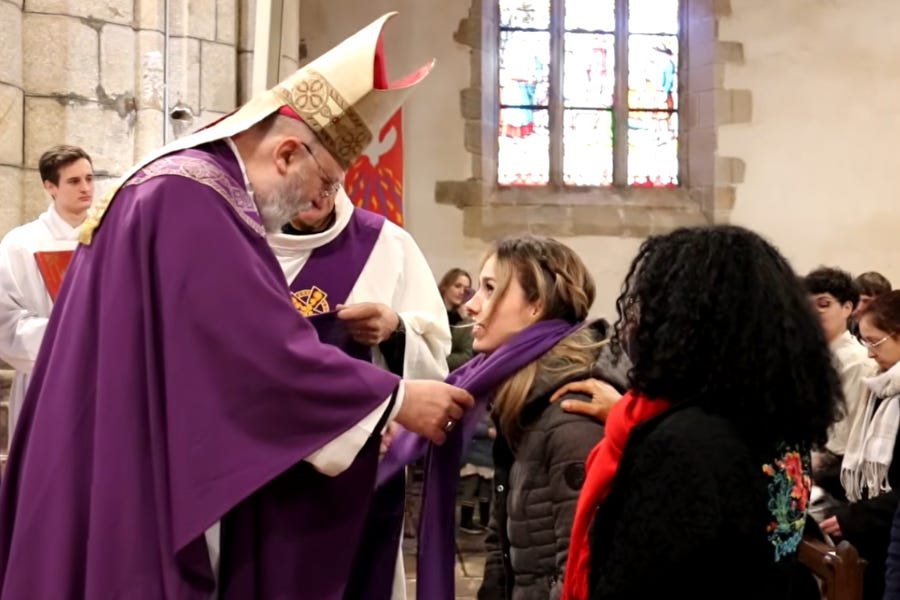
But what do we know about the people behind the figures? Thanks to a 32-page report, published March 25 by the French bishops, we can grasp something of their motivations, as well as how they are likely to fare after they become Catholics.
But first, let’s remind ourselves of the headline figure. At this year’s Easter Vigil, a total of 21,386 people will be baptized in France, up from 17,788 in 2025, which was itself a record-breaking year.
The report distinguishes between two broad categories of catechumens, or baptismal candidates. The first is adults, defined as over-18s, and the second is adolescents, who are roughly aged 11 to 17.
Among the record 13,234 adults preparing for baptism in France this Easter, 42% are aged 18 to 25 and 40% are aged 26 to 40. So we are dealing with a strikingly young cohort.
Women account for 62% of adult catechumens and men for 38% — a pattern that the report says has remained stable. This is notable because coverage of the influx of new Catholics in the English-speaking world often presents it as a male-dominated phenomenon, inspired by online influencers preaching a “macho Christianity.”
A quarter of French adult catechumens are students, while a third are either manual workers, technicians, or office employees.
Most (71%) reside in cities, while a minority (29%) live in the countryside. This is significant, as one school of thought argues that the influx of young catechumens in inner-city parishes is creating “a magnifying effect” that leads observers to mistake it for a wholesale revival of the Catholic faith in France.
What is actually happening, according to this view, is that Catholics are fewer in number but seem more dynamic because they are grouped more closely together due to urbanization.
The proportion of adult catechumens who come from another Christian background is 45% in 2026, down from 52% in 2025.
Of the remainder, 27% do not know their religious background and 19% come from a non-religious background. Those figures were 19% and 18% respectively in 2025.
Only 3% have a Muslim background, down from 4% in 2025, although France has one of Europe’s largest Muslim populations.
All of France’s ecclesiastical provinces are seeing a rise in adult baptisms, with the Ecclesiastical Province of Poitiers witnessing an especially sharp increase, from 248 in 2025 to 379 in 2026, an almost 53% rise.
The Diocese of the French Armed Forces has seen a jump from 204 in 2025 to 500 in 2026, a 145% rise. Many will be baptized during the International Military Pilgrimage to Lourdes in May.

Hundreds of people are baptized into the Church through the armed forces diocese every year, a mark of the Catholic ethos that permeates the country’s military despite France’s rigorously enforced secularism.
While the number of adolescent catechumens has also hit a new high of 8,152, the report notes that the rate of increase has slowed, from an extraordinary 42% in 2025 to 10% in 2026.
It also points out that the data for this category may be incomplete, as not all French dioceses have a department dedicated to preparing adolescent catechumens for baptism.
The gender breakdown is similar to that of adults, with 65% girls and 35% boys.
There is a growing trend in French dioceses to hold a Rite of Election specifically for adolescent catechumens. This is separate from the one for adults, though both groups are generally baptized together at the Easter Vigil in their parishes.
In 2023, 28 dioceses held a Rite of Election for adolescents. By 2025, this had increased to 60 dioceses, out of approximately 100.
There is another group of adults who will become full members of the Catholic Church in France this year. Members of this group, who have previously been baptized, will receive the sacrament of confirmation on Pentecost Sunday.
In France, people taking this path are called recommençants (“returnees”), because they were baptized Catholic and may have made their first Communions, but did not complete their Christian initiation by receiving the sacrament of confirmation.
This is somewhat different from the phenomenon in the Anglosphere, where many adults who have been baptized in another Christian tradition are received into full communion with the Catholic Church when they receive the sacraments of confirmation and the Eucharist at the Easter Vigil.
The number of “returnees” is rising steeply in France, from 6,889 in 2023 to 9,427 in 2024 to 11,218 in 2025. The 2026 figure is not yet available as the ceremonies generally take place at Pentecost.
Once again, the majority are women (61%) and men are in the minority (39%).
A survey of around 1,450 catechumens from 60 French dioceses conducted between January and March 2026 explored the motivations for becoming Catholic.
Asked to identify the main factors, 40% said it was prompted by a challenging life experience, such as illness or bereavement, 34% said the trigger was asking questions about Christianity, 32% said it was a powerful religious experience, 23% a visit to a beautiful place of worship, and 22% reading the Bible.
Only 11% cited the role of Christian social media influencers, who are just as prevalent in France as in the English-speaking world.
Reading the Bible has been highlighted previously as a major element in French catechumens’ decision to seek baptism. The new survey found that 61% of catechumens had already started to read Scripture before they began their formal journey toward baptism. Most (54%) read the Bible both online and in print, while 34% read a physical copy only, and 12% just online.
The researchers also questioned 850 newly baptized individuals from 65 dioceses.
Although 72% said they felt well supported in their first year after baptism, 26% sometimes felt alone, and 8% drifted away from parish life.
This variety in experiences has prompted the Church in the Île-de-France, the country’s most populous region, to convene a regional council focusing on care of catechumens and the newly baptized. The council will enter its formal assembly phase May 31.
Among the newly baptized, 49% attend Mass weekly, 24% at least once a month, and 17% more than once a week, 15% from time to time, and 5% rarely.
Archbishop Olivier de Germay of Lyon, who oversees the catechumenate on behalf of the French bishops, noted in an introduction to the report that the number of catechumens has increased by 20% year on year.
“But that is not the main point,” he wrote. “The Church’s greatest challenge is to support them over the long term so they can become disciples — and thus full-fledged members of parish communities.”
“In response to this joyful development, numerous initiatives are emerging. The dioceses of Île-de-France have launched a regional council; some dioceses are organizing assemblies; several bishops have published pastoral guidelines; services are being created to better accompany the newly baptized; and opportunities such as pilgrimages or participation in certain councils are being offered to them.”
He added: “This outreach to catechumens has a boomerang effect. For many ‘veterans of the Christian life,’ it provides an opportunity to reexamine their faith and rediscover how God can burst into a person’s life and turn it upside down. For this is the sign we are given today: the paths of human beings and God are meant to cross.”
Quanto piacciono a Luke i numeri e le statistiche!!! 🤣