Meet Germany’s first non-European bishop
Fr. Joshy Pottackal will make history this month
Fr. Joshy Pottackal will make history this month, when he becomes Germany’s first non-European Catholic bishop.
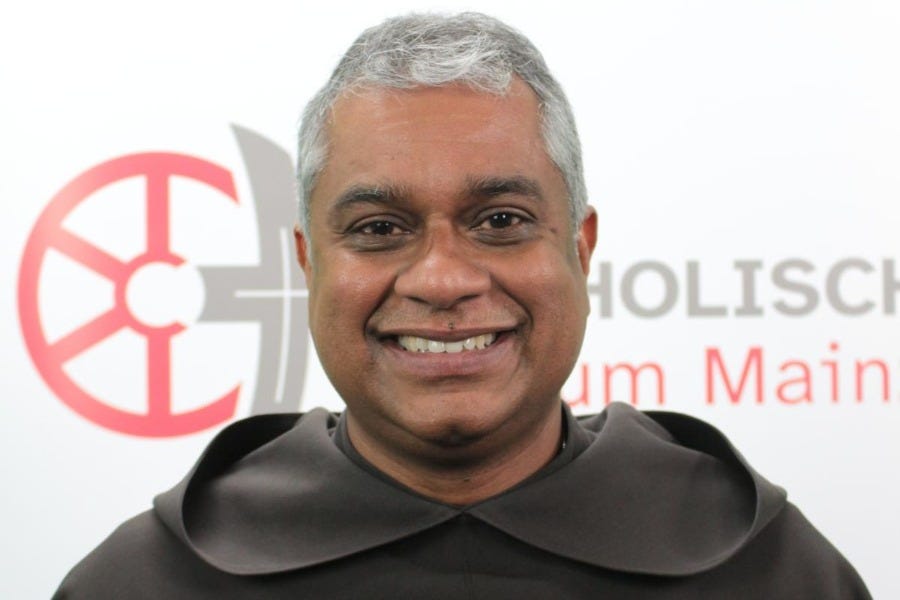
The new auxiliary bishop of Mainz was born more than 4,000 miles away from Germany, in the southern Indian state of Kerala.
The 48-year-old Carmelite priest’s appointment highlights the rising number of Catholics in Germany born in other countries. In 2024, 16.7% of Catholics held foreign citizenship. In the Mainz diocese, the proportion was 26.6%.
A significant Indian Catholic community began to form in the 1960s and 1970s as Germany turned to Kerala to help address a shortage of health care workers. In recent decades, a growing number of Indian priests have filled vacancies left by a decline in local clergy.
Fr. Joshy, as he is affectionately known in the Mainz diocese, was born on April 30, 1977, in Meenkunnam, a village known for its waterfalls, paddy fields — and a giant replica of Michelangelo’s Pietà. He was the second of three sons. One brother is a school teacher in Kerala. The other also joined the Carmelites and serves as a pastor in Canada.
The Carmelite order in Kerala is closely associated with Germany. It was the order’s Upper German province that decided in 1973 to establish the first O. Carm. foundation in India. Carmel Nivas, the order’s first Indian house, was erected canonically in 1982. The Carmelite Province of St. Thomas was established in India in 2007.
According to a biography compiled by the province, Fr. Joshy joined the Carmel Nivas Minor Seminary in 1992. He entered the novitiate in 1995, the year that his mother died in an accident. The following year, when he made his first profession, his father also died following a long illness. His aunt stepped in to support the three brothers.
Fr. Joshy dreamt of being a missionary in northern India or Africa. But following his priestly ordination in 2003, he was sent to Germany. He arrived in Mainz having completed a German beginner’s course in India. He initially served in the city as a youth chaplain, while continuing to develop his proficiency in the language.
In 2016, he was named regional superior for members of the Province of St. Thomas in Germany. In 2022, he was appointed vicar for clergy, becoming responsible for the welfare of the Mainz diocese’s priests.
When he is ordained a bishop at Mainz Cathedral on Sunday, March 15, he will adopt the motto Per fidem ductus (“Guided by faith”), inspired by Psalm 37:5. He will serve as Mainz’s episcopal vicar for religious.
Bishop Peter Kohlgraf has described Fr. Joshy’s nomination as a bishop as “a powerful and important signal for our time.”
“Anyone who finds Fr. Joshy’s appointment extraordinary should remember that Bishop Prevost was an American who served as bishop in Peru,” the Mainz bishop said when the nomination was announced in November 2025.
How does Fr. Joshy personally view his appointment? What does he see as the big differences between Catholicism in India and Germany? What does he think of Germany’s synodal way? And does he like bratwurst and unpredictable weather? The Pillar asked him in an email interview.
Were you raised as a member of the Syro-Malabar Church, and did you transfer to the Latin Church at some point?
I was indeed raised as a member of the Syro-Malabar Church in Kerala, India. However, I am a member of the Order of Carmelites, which is very international. As such, I was also introduced to the Latin Church when I joined the minor seminary of the order at the age of 15.
After my priestly ordination, I came to Germany, and in order to celebrate in the Latin Rite, I was granted an indult of biritualism. That means I obtained a special faculty from the Apostolic See. This cannot be considered an insertion into the Latin Church, though.
The decision to appoint me, a member of the Syro-Malabar Church, as a bishop in the Latin Church was an individual decision by the Holy Father. Once I am ordained as a bishop in the Latin Church, I will need to obtain an indult of biritualism if I wish to celebrate a Pontifical Mass in the Syro-Malabar rite or to administer sacraments.
How did you end up serving in Germany? And when did you become a German national?
I am a member of the St. Thomas Province of the Carmelite order in India, which was founded by what was then the Upper German province of the Carmelite order. That means I actually took my vows and was ordained as a priest as a member of the Upper German province, which then invited me to come to Germany and serve there. I learned German and completed my pastoral formation in Germany. The reason I ended up in Mainz was that the province sent me there.
I became a German national in 2014, after 10 years of service in Germany.
What are the biggest differences between Catholicism in India and Germany?
Church culture and mentality in India are quite different from Germany. We mustn’t forget that India is the most populous country in the world, with about 1.5 billion people. Christians are a minority — only around 3% of the population are Christians, compared to about 45% in Germany. In the northern parts of India, Christians even face persecution and violence.
There are three Christian rites in India: Roman Catholic, Syro-Malabar, and Syro-Malankara. Members of the Syrian rites pride themselves on being St. Thomas Christians, tracing their origins to Thomas the Apostle, who came to India as early as in the first century, in AD 52. The Portuguese brought Roman Catholicism to India in the 16th century. Each rite has its own characteristics.
Generally speaking, Christianity is much more traditional in India than it is in Germany. Mass attendance is significantly higher in India. Piety and devoutness play a much bigger role, and practices like Adoration, praying the rosary or novenas, or the blessing of new cars or new houses are very popular. However, mass blessings of, for example, motorbikes or pets, which are more common in Germany, are considered unusual in India.
Traditional fasting in the form of abstinence from food or alcohol during Lent or Advent is widely practiced in India. Other forms — like abstaining from driving your car for environmental reasons or from using electronic devices, for example — are almost unheard of, while they have become more widespread in Germany in the last couple of years.
It can be noted that Christians in India are generally more obedient to the churches’ authorities and less critical of them than their German counterparts. Churches in Germany face criticism not only from the inside, but also from the outside and society as a whole.
Many issues that are much discussed in Germany hardly have any relevance in India at all — for example, the role of women in church, the attitude towards LGBTQ, or priestly celibacy. The reviewing and prevention of cases of sexual abuse within the Church is a big topic in Germany, while safeguarding efforts in India are still in their infancy, so to speak.
Another big difference is that ecumenism is practiced more intensively in Germany.
Also, the influence of charismatic movements has been increasing in India for years, while they only play a minor role in Germany.
From an organizational perspective, administration plays a more important role in Germany than it does in India. Decision-making processes in Germany are longer but often based on mutual consultations. And of course, there is no church tax in India. The funding of the churches there is similar to the U.S.
With regard to vocations, the numbers in India are still very high, while the Church in Germany and in Europe as such really struggles in this respect. However, as many young people leave India in search of a better future, it remains to be seen how this affects the number of vocations.
The status of priests in society is higher in India than in Germany; on the other hand, [there are different] expectations regarding things like smoking or consuming alcohol in social settings. Even wearing only a moustache instead of a full beard is considered inappropriate.
Personally, I appreciate that priests — just like everybody else — in Germany are expected to take care of their mental and physical well-being, for example by actually taking holidays, etc. Also, I like that priests in Germany have more freedom to add personal and individual touches to church services.
How does it feel to be the first non-European bishop appointed in Germany?
I must say that I feel both honored and humbled to be the first non-European bishop to be appointed in Germany. I hope I will not be the last!
I will stand out because of how I look, of course, and will also get more attention because of my Indian origin. Media interest has been quite high ever since I was appointed.
After completing my pastoral formation here and having lived here for 21 years, Germany has become my second home, and I am familiar with all aspects of German culture and religious life. Due to my work in youth ministry, different parishes, and as the vicar for clergy of the Diocese of Mainz, I am also familiar with both the issues and questions of the people and the German church in general.
I am keen to see what consequences my appointment will have.
Why do you think the pope made this groundbreaking appointment in Germany at this moment in time?
I can’t say much about the reasons the Holy Father had for making this appointment.
I was one of three priests suggested for the office of auxiliary bishop by the Bishop of Mainz, though, and I can see the reasons for that: 25% of Catholics in Germany have a non-German background, and so do 25% of the priests serving in Germany, the lion’s share of both groups coming from non-European countries. My appointment is both a reflection and an appreciation of this fact.
Moreover, my appointment can be considered as a way of taking a stand against growing racism and xenophobia in Germany. Immigration is a part of Germany, and therefore immigrants are a natural part of all areas of society.
For this reason, I am grateful for my appointment, as it shows my fellow immigrants that we are seen and appreciated.
At the press conference announcing your appointment, you said: ‘I am not a theorist with a doctorate.’ If you’re not a theorist, how would you describe yourself?
I said that because it is considered normal that a bishop has a doctorate in theology. After my appointment, Indian media automatically referred to me as Dr. Joshy Pottackal!
I consider myself a pragmatist who favors pragmatic solutions. I have worked in pastoral care for many years, and I feel that my strengths lie in pastoral work and working with people, not in scientific or theoretical research. This fits in with my duties as an auxiliary bishop, whose main task it is to support the bishop in his pastoral work.
Given my background as a Carmelite, I will also be responsible for religious orders in the Diocese of Mainz.
What do you think are the positives and negatives of the German synodal way?
Although I did not take part in the synodal way myself, I have been following it closely over the years.
In my opinion, addressing the original issue that led to the synodal way — the abuse scandal — and other topics was necessary and the right thing to do. I think it is a positive that the synodal way led to quicker reforms and brought about a change in attitudes.
Against the backdrop of continuing major challenges, it is now crucial to keep up the dialogue in the synodal conference, of course in close coordination with the global Church, and to find viable ways forward together.
What do you like most about Germany? Is it perhaps the food — or maybe the weather?
I like many things about Germany. You forgot about the cars!
You mentioned food and the weather. I do like most German food actually, and I really like the fact that there are four distinct seasons with different temperatures here, whereas in Kerala, we only have the dry and the rainy season.
I have also come to appreciate some “typically” German traits like punctuality and order. I like aspects such as social security, universal health care, and free education, and especially the fact that the dignity of a person does not depend on his or her status or wealth. There is a great willingness to support the poor, even on a global level, where many projects in developing countries get financial help.
I also appreciate being able to travel freely with a strong German passport.
What I like most, though, is the people. Although Germans might appear to be reserved at first, I found them to be warm and hospitable once you get to know them a bit better. I love how they have always welcomed, accepted, and supported me.

