Nigerian activists divided over Trump stance
Donald Trump has put a spotlight on Nigerian Christians. Will it help them?
Peace and interfaith dialogue activists in Nigeria are divided over allegations of genocide against Christians in the country, and especially statements on the subject from the Trump administration.
Christians have been facing violent persecution in parts of Nigeria for more than a decade.
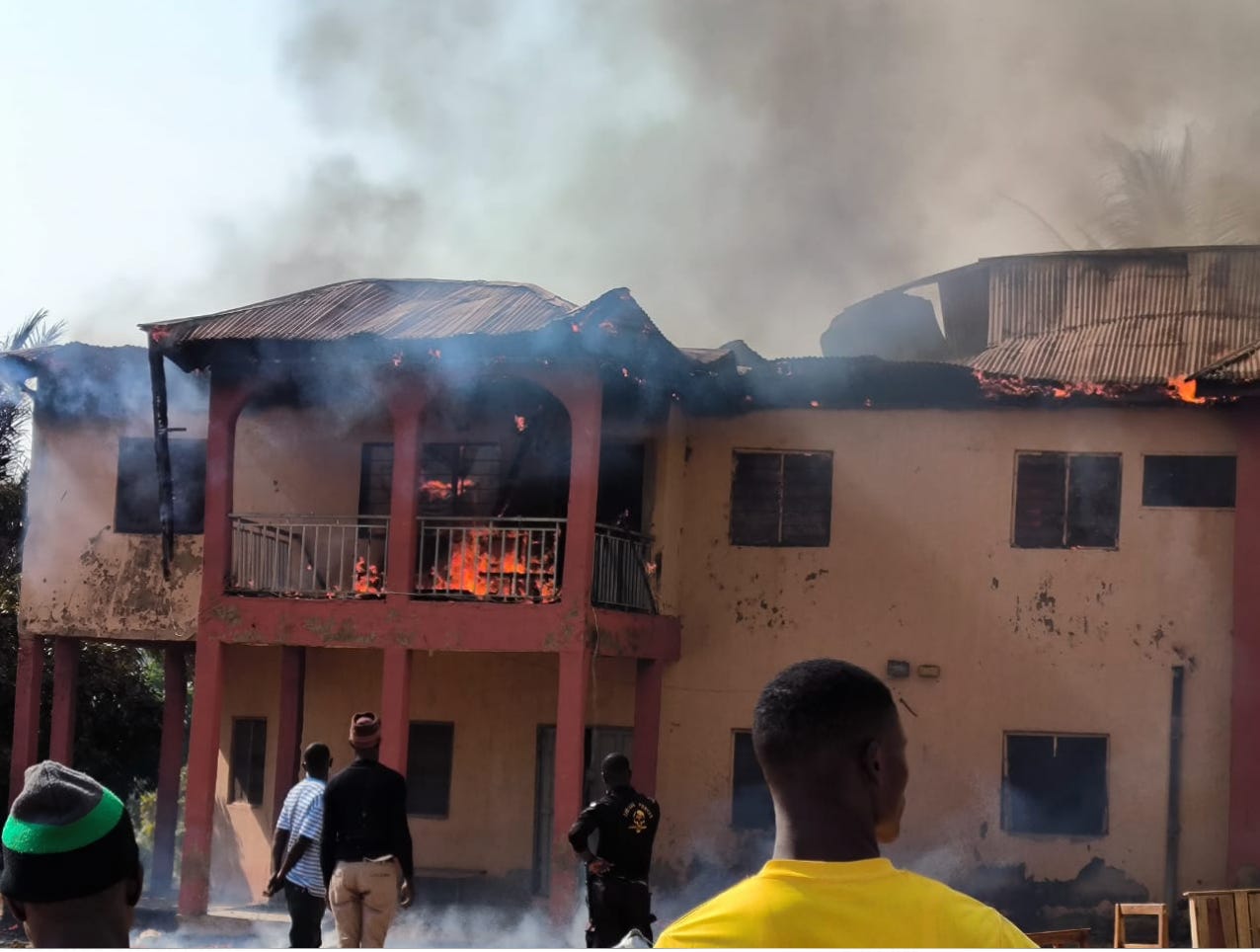
The decision came after President Donald Trump posted on Nov. 1 a threat to intervene militarily if the Nigerian government did not take measures to safeguard the country’s Christian population — and while that post was taken largely as political posturing in the United States, in Nigeria the tweet got serious attention.
The Pillar spoke with three Nigerian activists who are involved in peace efforts in the country, each with different views on the question.
Lantana Bako Abdullahi, a Muslim from Jos, in Nigeria’s restive Middle Belt and the national coordinator of the Nigerian Women Mediators Network, said she believes that recent developments have had a negative effect on peace efforts in the country.
“These kinds of statements have taken us backwards, instead of uniting us. The progress we have made in creating opportunities for interfaith engagement has been eroded by this statement from the United States president,” Abdullahi told The Pillar.
But Sister Agatha Chikelue, executive director of the Cardinal Onaiyekan Foundation for Peace, insisted that Christians were overwhelmingly positive about Trump’s rhetoric:
“Many Nigerians, especially the Christians, welcomed them with open arms. In fact, they were pleading with him to please come. But even some Muslims have been saying they are not against what Trump said.”
Both Sister Agatha and Lantana Abdullahi are part of a fellowship program of the KAICIID - International Dialogue Centre, a Saudi-backed foundation which promotes interreligious dialogue and peacebuilding and is headquartered in Lisbon, Portugal.
They spoke to The Pillar on the sidelines of a conference celebrating the 10th anniversary of the program.
Also attending the event was Fr. Stephen Ojapah, a priest of the Missionary Society of St Paul of Nigeria, who worked in Sokoto for several years before being transferred to the UK. Sokoto is the historic heartland of a 19th-century Fulani Muslim Caliphate, and life for the Christian minority can be difficult there.
“In the entire State House Assembly there is not a single Christian. There are institutions where Christians don’t have access to chapels, and sometimes they don’t get promotions in the public sector because of their faith. These kinds of situations breed the feeling of persecution, anger and lack of opportunity,” he told The Pillar.
The majority-Muslim northern states of Nigeria, where terrorist jihadist groups like Boko Haram operate, all have some degree of Sharia law. Because of ownership policies, Christians often face difficulty securing land to build churches.
In 2022, Ojapah was kidnapped by two armed Fulani men. He was held for 33 days before being released, and has written a book, “Tears and Torture,” about his experience.
The Fulani are often mentioned as one of the main agents of anti-Christian persecution in Nigeria. But a closer look shows how multilayered and complex the situation is.
Fulanis are traditionally a nomadic tribe. Communities travel with their herds in search of grazing. As their traditional pastures dry up, they have taken to travelling further south in search of fertile land, most of which is already occupied by Christian farmers.
Fulani herders have always carried weapons, but when dictator Muammar al-Gaddafi’s Libyan regime fell in 2011, black markets were flooded with cheap firearms, and herders traded in bows and spears for Kalashnikovs, making the traditional conflict with farmers much more deadly.
That circumstance has led some analysts to argue that the bloodshed in Nigeria is rooted in climate change; while others blame ancestral rivalries over land and ethnicity – “a social conflict,” as Vatican Secretary of State Cardinal Pietro Parolin referred to it recently.
But some see the Fulani advance as a form of anti-Christian jihad. Fr. Ojapah and Sister Agatha subscribe to that viewpoint.
“A dispute over land? People can hide under that sort of thing to make it sound less provocative. But at the core of it, it has to do with religious extremism,” the priest said.
“This is their history in Nigeria,” said Sr. Agatha, in reference to the Fulani Caliphate, which ruled much of northern Nigeria, and other regional territory, for about a century. “First you conquer, then you settle. This is the way some Nigerians, especially Christians, are interpreting it. It has been their methodology since the beginning.”
Where others see complexity, Fr. Ojapah does not.
“Christians are dying. There is no complexity there,” he told The Pillar.
That perspective makes Ojapah receptive to Trump’s threats against the Nigerian government. “Trump has raised people’s consciences. I don’t want to dwell on his messaging, rather on the message, and the message is that Christians have gone through a lot of difficulties.”
For her part, Lantana Abdullahi wanted to stress her view that Nigerian Muslims are suffering as well from conflict in the region.
“I’m not denying that Christians are being killed, definitely Christians are being killed. But I think for us the concern is to amplify all stories, not just one. Because there are always two sides to a story, and I think it is fair to say Christians are being killed, but it is also fair to say others are being killed.”
Abdullahi has first-hand experience in the matter. In the Middle Belt, where the Muslim north and the Christian south meet, communities tend to be more mixed and in the early years of the 21st century, especially, violence sometimes went both ways.
“In 2002, my village was completely destroyed. Some members of my family were killed, some were displaced. From my husband’s side, from another village, a lot of his family were also killed. And since I moved to Jos, I’ve had to run many times from my home to military or police barracks, just to find safe haven during violent conflict,” she said.
Faced with those situations, Abdullahi made a decision. “I felt it was not okay to keep talking about being a victim. At the end of the day, we are all victims of violent conflict, whether Muslim, whether Christian. And that’s why I found solace in the fact that I can move away from being a victim to being a key actor in finding solutions to the conflicts that we face together.”
Both Abdullahi and Sr. Agatha work specifically in interreligious dialogue initiatives involving women, and they believe that female voices need to be heard in Nigeria.
“The way Africa is structured, women are also very important, especially when it comes to homemaking and peacemaking,” said Abdullahi.
“Women are the fabric that holds society together, and peace begins with building social trust, so creating those opportunities for women is very important for durable and lasting peace. Women need to keep moving away from just being survivors or victims, to becoming actors in the peace processes.”
Sr. Agatha said that when violence does break out, women suffer most.
“We are still the greatest losers when all these things happen,” she said. We are the ones who lose our families, who lose their husbands, who lose children, are abused, raped. We have to join hands to fight this menace.”
She also emphasized that suffering is not limited to Christians.
“The jihadists are targeting Christians, but they are also targeting Muslims. They are killing a lot of Christians, driving them out of their communities and settling in them, and in those communities, there may be a few Muslims also. So, it is affecting all of us.”
In her view, the culprits are practicing a warped form of Islam, she emphasized, saying that terrorists are not “the real Muslim groups in the country, but these… jihadists… have been spoiling the name of Islam.”
Nonetheless, Sr. Agatha lamented that mainstream Muslim leaders are not doing enough to call out their co-religionists. “When you keep quiet in the face of atrocities and evil, you become an accomplice, and they have not spoken out.”
Abdullahi argued that in her view, cultural differences and media influence shaped the global perception of northern Nigeria.
“In Nigeria the media is mostly concentrated in the south, which is mostly Christian. When something happens, they are capable of really amplifying it and making sure it reaches everywhere. They also are more educated, more aware of their rights, and are able to engage in advocacy to share those impacts of the conflict.”
“But in the north, which is mostly Muslim, you find that the culture has programmed us to believe that we cannot talk against our leaders, we cannot demonstrate, we cannot protest, we cannot report, and we cannot demand accountability from our leaders. These are challenges that the northern people face, because they don’t come out to share their own stories,” she added.
Speaking out against leaders is certainly not a problem for Sister Agatha and for Fr Stephen, who openly denounced their government’s approach to dealing with the violence.
“The government has failed us. If the government had been realistic, things wouldn’t be going this badly,” said Fr. Ojapah.
“We are suffering from failed governments. We are suffering from these jihadists that have decided to take over the country, and from the failed, stupid governments we have, because they don’t want us to live together. They don’t want to live up to their expectations, yet, they want to be in power,” Sr. Agatha said.
Both agree that the situation began to worsen during the recent tenure of former President Muhammadu Buhari, who is himself a Fulani Muslim, and was in office from 2015 until 2023 — along with a brief term as the country’s military dictator in the 1980s.
In Buhari’s recent term, “we felt that the government, most of the time, has turned blind eye to it. They have refused to do what they’re supposed to do. President Buhari even emboldened the Fulani jihadists. He turned a blind eye to all that they do,” Sr. Agatha said.
Ojapah expressed optimism, however, about Nigeria’s current president, Bola Ahmed Tinubu, a Muslim married to a reportedly devout Christian. The priest explained that some Nigerians believe Tinubu is sincere in his attempts to promote reconciliation, and an end to violence.
“This president seems to actually listen, but the problem is that men like Buhari compromised the entire security structure,” said Fr. Ojapah. “For example, we know that former elements of Boko Haram have been recruited into the Nigerian army and security forces. How does a president clean that kind of mess up?
“These are the kinds of things that Tinubu inherited from the Buhari administration. Buhari was a terrible disaster for us as Christians, because of his policies, and his cabinet was completely Fulani and Muslim. It will take a lot of time for them to clean house,” he said.
But Sr. Agatha is unconvinced by Tinubu’s rhetoric. “It doesn’t make any difference. He still wants to maintain the Fulani as political allies, he doesn’t want to offend them. In fact, the situation is even worse now than under Buhari.”
Despite their criticism and disagreements, and even their anger at the current situation, all three Nigerians The Pillar spoke to agree that peace and reconciliation are possible.
Fr. Ojapah recounted his own experience in the hands of Fulani kidnappers. “One of the bandits asked me if I would still forgive him after all they had done to me. And I said that I did forgive him. This is at the heart of the entire experience.”
“I didn’t come out bitter towards Muslims or Fulanis, and I didn’t come out looking for vengeance towards people,” he said. “I still have many Fulani friends and I’m still guided by the law of Christ, by the love of Christ, and of course by the law of dialogue generally.”
Sr. Agatha explained that “when you do peace-building, you don’t expect immediate results. It may not even happen in your lifetime. And that is what we are experiencing, because the more we work for peace, the more problems we are having.”
“But we are not giving up,” she said. “We will continue to work hard as one nation, as one country, to address our problem. If that involves Trump coming to help us, so be it.”


So many problems. So many ways to make them worse. Lord, have mercy!