‘No end date foreseen’ in reform process as Opus Dei leadership meets with Leo
Pope Leo XIV received the personal prelature’s leadership in a private audience on Feb. 16.
With the reform of Opus Dei still under review, and amid allegations of abuse in Argentina, Pope Leo XIV received the personal prelature’s leadership in a private audience on Feb. 16.
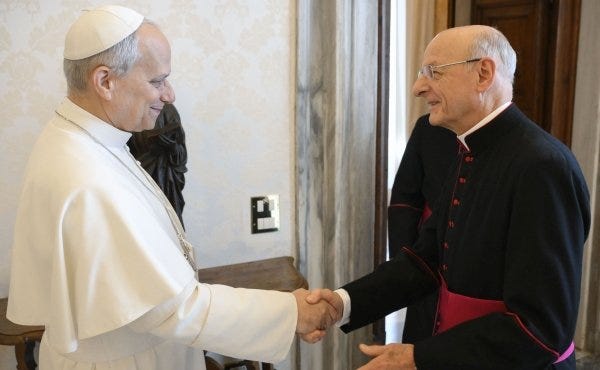
Msgr. Fernando Ocáriz and Msgr. Mariano Fazio, the prelate and auxiliary vicar of Opus Dei, met with the pope on Monday, with the prelature saying afterwards that there was no end in sight for the group’s ongoing canonical restructuring, which began under Pope Francis.
“The Holy Father said that the process of updating Opus Dei’s Statutes continues in its study phase and that no publication date can yet be foreseen,” said the prelature in a statement, raising speculation that Pope Leo is resetting the direction of the reforms.
The audience also dealt with recent allegations of abuse by former members in Argentina, with the prelature’s statement saying that Ocáriz had updated Leo on “the institutional perspective” regarding the “specific controversies.”
This is the first public acknowledgement of discussions between Opus Dei and the Vatican regarding the allegations of exploitation and human trafficking made by a group of former assistant numeraries in Argentina, which Opus Dei has repeatedly denied.
—
Opus Dei is an international Catholic institution founded in Spain in 1928 by St. Josemaría Escrivá de Balaguer, who was canonized in 2002.
The institution, originally a secular institute, was approved as the first and as yet only personal prelature in the Catholic Church in 1982 — a category created in the 1983 Code of Canon Law.
For the nearly 90,000 Catholics, lay and clerical, affiliated with the group, Opus Dei “aims at holiness in their ordinary lives, especially through their everyday work.”
In addition to clergy who are incardinated into the prelature and canonically under the jurisdiction of its prelate, Opus Dei also has various levels of affiliated laypeople — and clarifying the relationship of these laypeople to the prelature has been a key focus of the statutes’ revision process.
More than 90% of lay people affiliated with the prelature are supernumeraries, often married men and women who live with their families or by themselves.
Numeraries and associates make voluntary commitments of celibacy, with the former usually living together in houses of Opus Dei, and the latter by themselves or with family members. Most of the incardinated clergy of Opus Dei come from vocations among lay numeraries, while some associates have also been ordained as priests.
The female section of the prelature also has assistant numeraries who undertake the domestic tasks in Opus Dei houses as their profession.
There are also diocesan priests and bishops associated with Opus Dei, through an organization called the Priestly Society of the Holy Cross.
In 2022 and 2023, Pope Francis ] published two motu proprios initiating a canonical reform of Opus Dei.
The first, published in July 2022, stipulated that the prelature would be supervised by the Dicastery for Clergy rather than the Dicastery for Bishops and would need to submit a yearly report on its work, instead of a five-year report as had previously been required.
The 2022 motu proprio also stated that the prelate of Opus Dei should not be a bishop — as had previously been the case — with Pope Francis explaining that “a form of governance based on charism more than on hierarchical authority is needed” for Opus Dei.
A second motu proprio, published in August 2023, changed canon law to specify that personal prelatures would be “assimilated to public clerical associations of pontifical right with the faculty of incardinating clerics,” and that “the laity can dedicate themselves to the apostolic works of the personal prelature, but the manner of this organic cooperation and the main duties and rights connected with it shall be determined appropriately in the statutes.”
While the statutes of Opus Dei remain under review, the motu proprio prompted speculation among lay members — those recognized as such by the organization’s statutes — would in future not be considered members of the prelature properly speaking, but simply “organic cooperators.”
The vast majority of the individuals involved in its work are lay people. Only about 2% of those who have habitually considered themselves to be “members” are priests incardinated in the prelature, with any formal change posing a challenge to Opus Dei’s self-understanding as a predominantly lay institution.
Nearly all Opus Dei houses, schools, universities, and other apostolic works are run by laypeople associated with the prelature, with priests serving almost exclusively as chaplains. Within the prelature laypeople — usually numeraries and associates, but sometimes even supernumeraries — are also placed in charge of the formation and spiritual direction of other laypeople.
In an Oct. 2024 interview with The Pillar, Msgr. Fernando Ocáriz, prelate of Opus Dei, noted that “the law’s difficulty in framing new pastoral phenomena is evident… Maybe the protagonism the [Second Vatican] Council wished for the laity still has a long road ahead.”
“Law, which is so necessary, follows life, follows the incarnated message, to support and give continuity to life,” he added.
While there has been at times feverish speculation about the future canonical structure of Opus Dei, sources both in the Dicastery for the Clergy, which oversees the prelature, and Opus Dei have told The Pillar that the statutes are still being revised and no final decisions have been made.
Several sources involved in the canonical reform process have also said that the fact that Pope Leo is taking his time reviewing the proposed revisions to the statutes could prove significant.
“It means he’s not blankly approving everything in the proposal that was supposed to be presented to Francis originally,” one of the sources told The Pillar.
The pope has previously worked closely with affiliated clergy of the prelature. Prior to his election as pope last year and his previous appointment as prefect of the Dicastery for Bishops in 2023 by Pope Francis, as a bishop Robert Francis Prevost led the Peruvian Diocese of Chiclayo, which has a significant presence of Opus Dei. Bishop Prevost was also known to work closely and well with priests of the Society of the Holy Cross, several of whom served in senior diocesan leadership positions under Prevost.
—
Overshadowing the ongoing reform process is the issue of criminal complaints made by a group of 43 former assistant numeraries is an entirely different discussion.
The allegations originally started as a labor complaint in 2021 over the lack of payment of social security contributions and salaries to the group of women.
However, in 2024 it evolved into a criminal complaint of human trafficking, after an Argentinian prosecutor announced he had opened an investigation four Opus Dei priests who had served as authorities of the prelature in Argentina between 1991 and 2022 for “human trafficking under the form of reduction to servitude” after 43 women filed a criminal complaint against them. 40 of the cases have expired but the testimonies are being used as evidence for the cases that still stand.
Fr. Mariano Fazio, the current auxiliary vicar of Opus Dei, was also added to the investigation in 2025, as he also served as regional vicar of Opus Dei during part of the period in question.
The prosecutor’s text says that the prelature “lured” the complainants when they were between 12 and 16 years old through a plan that “consisted of presenting a false proposal related to the possibility of continuing and completing their primary and secondary education, as well as receiving vocational training to obtain job opportunities, all within a context of religious education.”
It adds that the alleged victims “devoted much of their lives to domestic service at the institution’s headquarters, facing exhausting working hours without receiving a salary… In some cases, they even received a payment which they had to return to those in charge of the places where they lived. They did not even have the possibility of effective rest or respect for any other labor rights, remaining trapped in a superstructure devoid of rights without any control or supervision that lasted for years.”
The text also mentions alleged methods of indoctrination based on psychological manipulation, a rigid belief system, and “discipline through punishment.” It adds that the women were ‘forced’ to be celibate, severe family ties, and submit to health treatments, including the administration of psychiatric medication.
“The testimonies of the women mix different stages of their lives as if they were one and the same reality… On the one hand, they refer to the training their parents chose for them through a solidarity socio-educational initiative called ICES, inspired by values promoted by Opus Dei… On the other hand, the women refer to a second stage of their lives, when they freely chose to be members of Opus Dei following a spiritual vocation within the Catholic Church as assistant numeraries,” the statement said in a 2024 statement.
The statement added that the decision to join the prelature was made freely.
“This choice of life requires, for those who choose it, to manifest their desire explicitly, on multiple occasions and in writing: every person who joins Opus Dei has to reaffirm their desire to be a member at least 8 times, during a period of time of at least 6 and a half years.”
“Most of their companions at ICES were never part of Opus Dei and developed [professionally] in various fields thanks to the formation they received there,” it added.
In an interview with The Pillar in 2024, the prelate, Msgr Ocáriz, said that Opus Dei “created the first office of healing and resolution to solve every individual conflict.”
“It was a cause for great joy for us to reach agreements with many people, which also helped us to offer a personal and concrete request for forgiveness,” he said. “The broad listening helped to relieve the pain of those who belonged to the institution for a while, or looked in it for help and accompaniment but could not find it. After this job, which is beginning a process of healing, we are creating similar procedures in other countries.”
Camila Torres, one of the members of the healing office established by Opus Dei, said in a 2023 interview that “as an institution, we must learn from our mistakes and continue to improve. Good intentions do not exempt us from errors, and we must accept this with humility.”
“While we believe that these experiences do not represent a widespread situation in Opus Dei, it is clear that there is pain in the women’s expressions… It is a significant failure for those of us who, as part of the Church, want to live a life guided by the Gospel.”
“We are hurt not only by the pain they have expressed, but also by our failure to see and understand it at the time,” said Torres.


Gianfranco Ghirlanda is not a happy man these days.