
Nuncio’s Pentagon meeting was ‘frank exchange of ideas,’ officials say
U.S. and Vatican officials described the meeting as ‘tense’ and ‘honest’ but dismiss reports of threats
Pentagon officials have insisted that a January meeting with the Vatican’s apostolic nuncio was a “cordial” and frank conversation, while some Vatican sources have told The Pillar that while no threats were implied or made by U.S. officials, the discussion between defense leaders and Cardinal Christophe Pierre was at times “tense.”
The comments came in response to an April 6 report from the Free Press, suggesting that Pierre had been summoned to the Pentagon for a dressing down, reportedly in response to a speech on world peace by Pope Leo XIV.
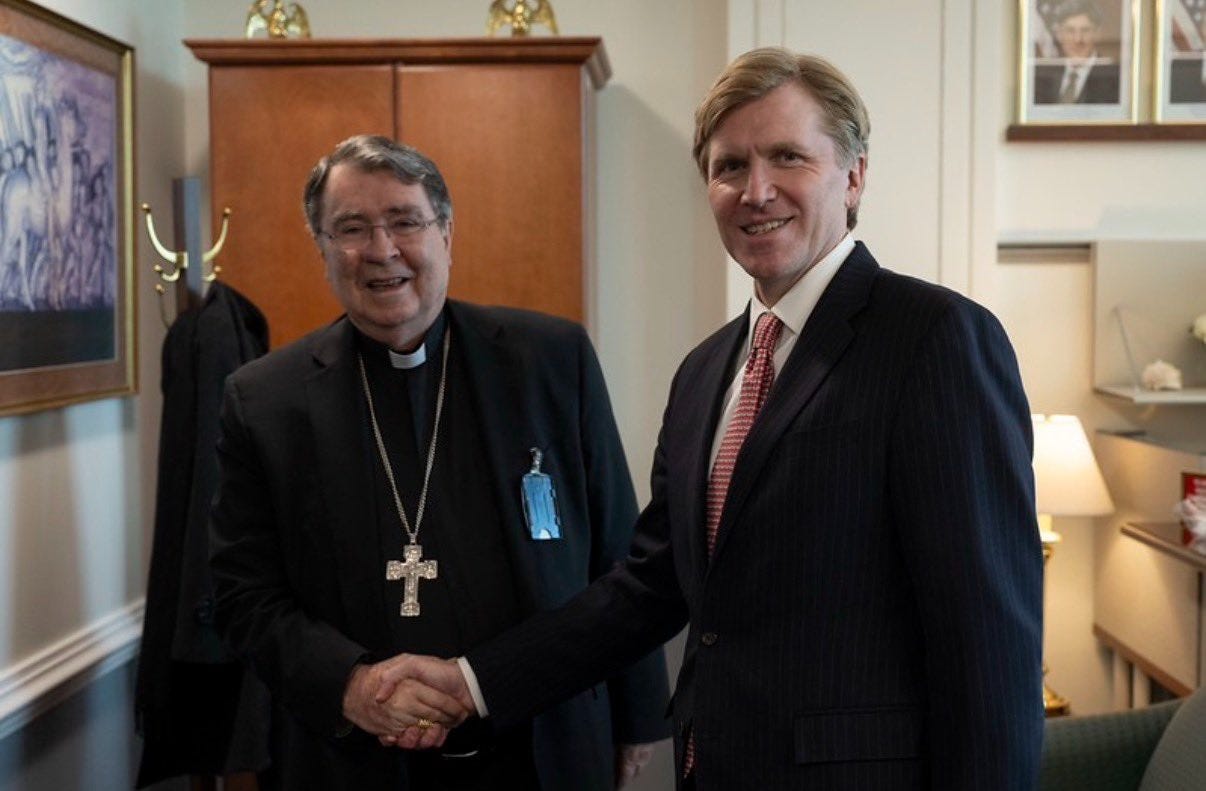
“Under Secretary Colby’s meeting with Cardinal Pierre was a productive, cordial meeting, and a chance for real dialogue on serious issues. They had an honest and respectful conversation. Reporting about threats or disrespect is false and scurrilous,” a senior defense department official speaking on background told The Pillar on Thursday.
Meanwhile, a Vatican official described the meeting as “tense” at times, characterizing some exchanges as “aggressive,” but confirmed that there was “no question of anyone threatening anyone,” despite suggestion in recent media reports.
The Free Press published April 6 a report stating that the Defense Department’s policy undersecretary Elbridge Colby had “summoned” the Holy See’s ambassador to the U.S., Cardinal Christophe Pierre, to the Pentagon.
According to the Free Press, defense officials were “enraged” by a speech made by Pope Leo XIV to the Vatican diplomatic corps earlier that month which was interpreted as a “hostile message directed at Trump’s policies.”
Citing Pentagon and Vatican sources briefed about the meeting, the article claimed “one U.S. official went so far as to invoke the Avignon Papacy, the period in the 1300s when the French Crown leveraged its military power to dominate the papal authority.”
Pentagon officials were, according to the Free Press, upset over a speech delivered by the pope to diplomats accredited to the Holy See, in which he criticized “a diplomacy based on force” – interpreted by the Pentagon officials as a direct criticism of U.S. policy.
Since becoming the first pope from the United States last year, Pope Leo has spoken out repeatedly against the use of violence in foreign policy, in remarks that have sometimes been seen as a direct commentary on U.S. military action, including recently in Venezuela and Iran.
“The reports of the meeting with Cardinal Pierre and his staff were wildly distorted and grossly exaggerated,” a senior Pentagon official speaking on background told The Pillar.
“The purpose of the meeting was a good faith effort to engage with the Vatican on a variety of foreign policy matters. It was an attempt to engage seriously and respectfully with the Holy See’s position on matters relevant to the Department of War.”
“The meeting discussed issues on Latin America, NATO, Europe issues, and Africa,” the official said. “In the context of the pope and senior Church officials talking about these issues, we decided to reach out to the nuncio to understand the Church’s perspective directly. The Pentagon deals with ambassadors all the time, so while it might be a relative first with the Vatican’s ambassador, it isn’t unusual from the department’s perspective.”
Pentagon sources also told The Pillar that in addition to specific issues, U.S. officials also wished to discuss the concept of just war and the nature and scope of legitimate military action.
That conversation, a senior Pentagon official told The Pillar, was “a frank exchange of ideas,” and “was very respectful.”
“There were somewhat different perspectives, but definitely no hostility or even hint of an attempt at coercion. That’s frankly just absurd and a calumny,” the official said.
Senior officials at the Holy See’s Secretariat of State in the Vatican also confirmed to The Pillar that the meeting took place, and that the discussion focused on public speeches and statements by Pope Leo about war and peace in the light of U.S. military action and priorities, but offered a different assessment of the meeting’s tone.
One senior official in Rome described the conversation as being “tense” at times and suggested that U.S. officials had been “aggressive” and “bullying” at points, but insisted that the conversation had been mutually forthright, with Cardinal Pierre “making himself heard, too.”
“There was no question of anybody threatening anyone,” the Vatican official said. No one at the Vatican Secretariat of State contacted by The Pillar could recall or confirm any reference to the Avignon papacy during the conversation.
In a response to the Free Press article published on twitter.com on April 9, the U.S. Department of Defense said that “recent reporting of the meeting is highly exaggerated and distorted.”
The department confirmed that the meeting had taken place between Pierre and Colby and their respective staffs on Jan. 22, 2026, but said that the meeting was “substantive, respectful, and professional.”
“During the cordial meeting, they discussed a range of topics, including issues of morality in foreign policy, the logic of the U.S. National Security Strategy, Europe, Africa, Latin America, and other topics. Cardinal Pierre expressed his appreciation for the outreach and both sides looked forward to continued open and respectful dialogue,” the department said.
The United States ambassador to the Holy See, Brian Burch, also released a statement Thursday, saying on social media that he had spoken with Cardinal Pierre, who now lives in Rome.
According to Burch, Pierre “confirmed that recent media characterizations of his meeting with Colby are ‘fabrications’ that were ‘just invented.’”
“I was likewise not surprised when His Eminence acknowledged there were no threats of any kind in the meeting. ‘It was a frank and cordial meeting that took place two months ago.’ Threat of Avignon? ‘None,’” said Burch.
Pope Leo accepted Cardinal Pierre’s resignation in March, after the cardinal turned 80, appointing in his place Archbishop Gabriele Giordano Caccia, who had been serving as the Holy See’s permanent observer to the United Nations.
I think this is actually a good thing. It means the US government actually cares about what the pope says, and they want to project a positive relationship. That’s a pretty undeniable acknowledgment of the power of the pope. And power is something Trump respects.
This account frankly sounds a lot more realistic than the Free Press article. Cdl Pierre doesn't strike me as the type who'd just sit there and be verbally threatened without clapping back or walking out.