Poll finds signs of a confession revival in France
Half of weekly Massgoers frequent the sacrament, researchers found.
A new poll suggests that the sacrament of confession may be experiencing a revival in France, at least among regular Massgoers.
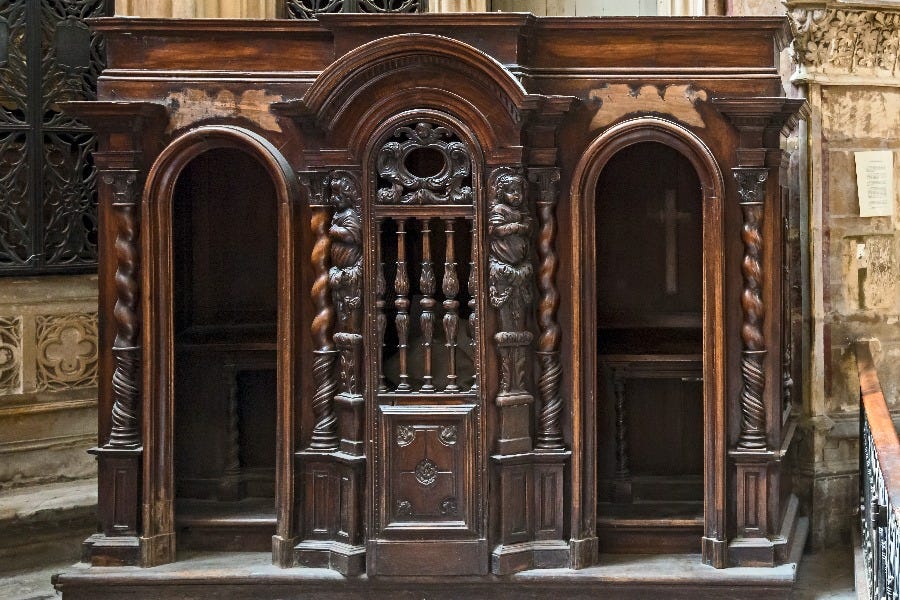
A survey conducted by the Ifop polling firm for Bayard-La Croix concluded that 50% of the country’s weekly Massgoers attend confession, also known as the Sacrament of Reconciliation.
The poll, whose results were published Dec. 8 by the Catholic daily newspaper La Croix, which is owned by Bayard Presse, also found that 36% of those who attend Mass at least once a month frequent the sacrament.
Among those who go to Mass less than once a month but are still engaged with the faith, 7% attend confession, compared with 12% among those who attend Mass mainly on special occasions.
La Croix noted that the survey did not state whether the figures were higher or lower than in previous years. But it said that anecdotal evidence suggested confession was “making a comeback” among French Catholics.
Canon Jean-Marc Pimpaneau, the pastor of the Church of Saint-Louis d’Antin in Paris, told the newspaper he was convinced more Catholics were attending confession.
“It’s in the air,” he said. “The return of traditional practices, prayer vigils, pilgrimages... and a certain awareness of sin.”
Priests hear confessions daily from 8 a.m. to 8 p.m. at Saint-Louis d’Antin, which is located near the capital’s most popular department stores. At the church’s entrance are two banners proclaiming: “Priests welcome you for confession seven days a week.”
France’s bishops called at a plenary meeting in November 2024 for the country’s dioceses to establish a body known as a pénitencerie diocésaine, or diocesan penitentiary, to provide training and support to priests who hear confessions. Pimpaneau helped to establish a pénitencerie diocésaine in the Archdiocese of Paris.
The results of the Ifop poll appear to challenge the widespread perception that confession is in terminal decline among Catholics in Western nations.
In the book “For I Have Sinned,” published in April 2025, author James O’Toole noted that the practice diminished dramatically in the U.S., beginning in the 1970s. Historian Guillaume Cuchet has suggested that a similarly sharp decline occurred in France from 1965 onward.
Attending confession at least once a year is one of the five precepts of the Church, a summary of Catholics’ essential obligations.
In recent years, the Catholic Church in France has bucked trends seen elsewhere in the Western world. The country has seen a rapid rise in adult baptisms, particularly among young people, a boom in Bible sales, and record-high participation in annual pilgrimages.
The Ifop study concluded that around three million French adults — 5.5% of the overall population — attend Mass at least once a month. A further 3.5 million — or 6.5% of the population — attend on rare occasions.
Researchers noted that Catholicism is an increasingly urban phenomenon in France, with almost one in three regular Massgoers living in the Paris region. Rural dioceses are struggling with the twin challenges of secularization and depopulation.
Among those surveyed, more than two-thirds said they had no objection to the Traditional Latin Mass, while 22% said they viewed it as a step backward.
La Croix said the figures pointed to “a certain normalization” of the Old Mass in France, despite Pope Francis’ 2021 motu proprio Traditionis custodes, which restricted celebrations of the Traditional Latin Mass.
The poll found that the average age of regular Massgoers was just under 50 and slightly more than half were men. The survey was based on interviews with 2,159 people, 1,004 of whom were regularly practicing and 1,155 occasionally practicing. The interviewees completed an online questionnaire on April 14-29, a period that covered the April 21 death of Pope Francis.
Commenting on the poll’s results, sociologist Yann Raison du Cleuziou told the La Croix: “French Catholicism is undergoing a major transformation. As it continues to decline in society, it is rebuilding itself around a core of extremely committed Catholics.”
“This homogeneity creates a supportive environment that explains the resilience of this ‘hard core’: these fervent Catholics reinforce each other.”
He said the recent success in French movie theaters of Sacré Cœur, a film exploring devotion to the Sacred Heart, illustrated the “ripple effect” among committed Catholics.
“Conversely, there has been an acceleration in religious detachment among irregular Catholics,” he commented.
“The knock-on effect also works in the other direction: the more they integrate into a society where religion is in decline, the more their faith becomes secondary in their lives. Only those who intensify their religious practices resist this distancing.”
Raison du Cleuziou said the sharp rise in adult baptisms marked “a small recovery” but did not compensate for a long-term decline in infant baptisms.
“This apparent ‘revival,’ which some say they also see in dynamic inner-city parishes, is mainly a magnifying effect,” he argued.
“Let’s take a concrete example: fervent Catholics, who used to be scattered at 10% in each parish, are now concentrated at 90% in inner-city churches. This creates a much more homogeneous atmosphere, with greater intensity of conviction and a very high level of enthusiasm.”
“This generates a feeling that the crisis is over, when in fact it is the effect of Catholicism becoming a minority: fewer in number but grouped together, Catholics appear more dynamic.”


I think this is great new! I get why sociologists, using the methods they are trained with, will poo poo “this apparent revival”, but that misses the point. The Holy Spirit is doing something here—God has not abandoned the eldest daughter of the Church. Rejoice!