
Pope Leo visited France this weekend, the first state trip to the country by a pope in nearly 20 years.
In a short trip, Leo traveled to Lourdes, addressed UNESCO, and visited Notre-Dame Cathedral, among other events on the papal agenda.
In case you missed it, here are some highlights from the trip:
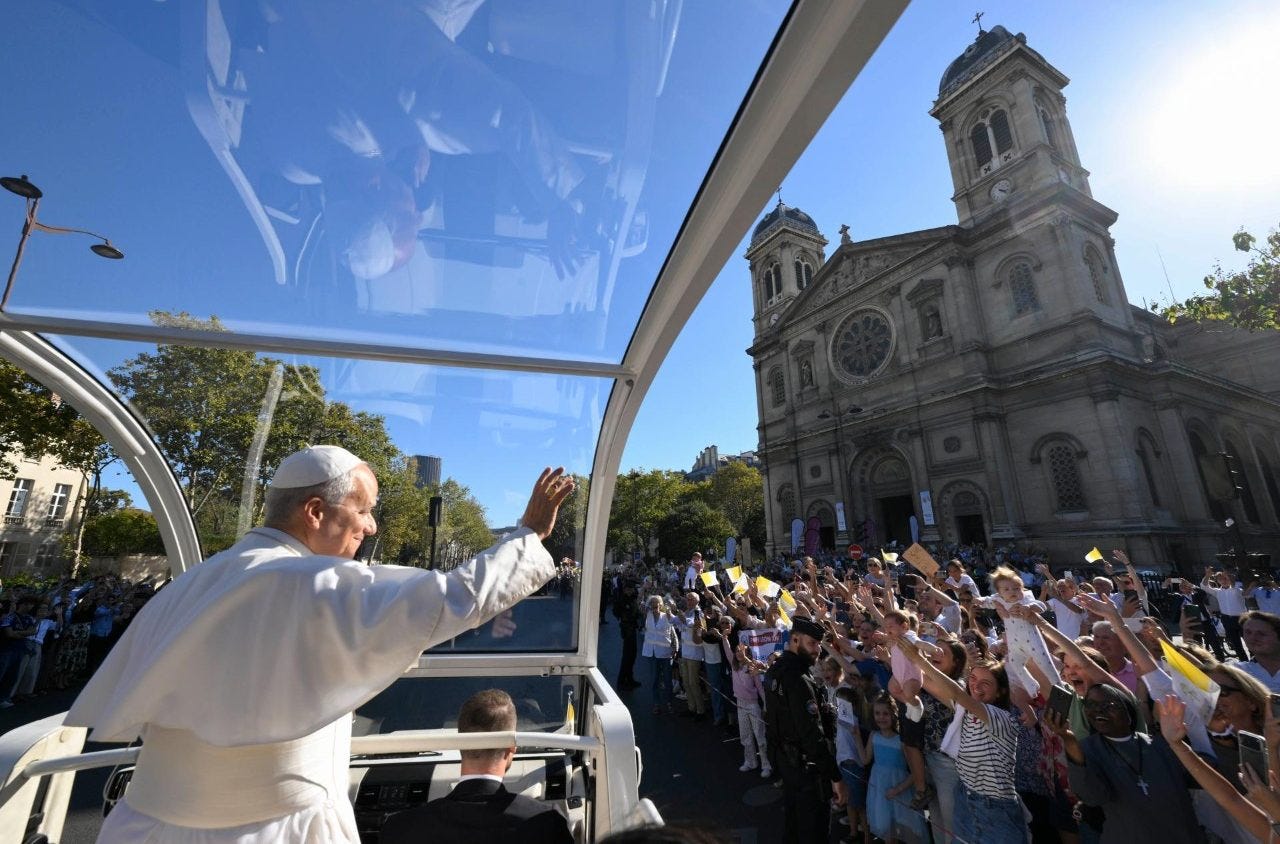
A warm welcome
Pope Leo was welcomed in France by large and enthusiastic crowds.
The country, in which fewer than 5% of Catholics attend Mass on Sunday, has seen a major surge in adult baptisms in recent years, as well as a rise in new seminarians.
According to Vatican estimates, more than 750,000 people attended a papal Mass in Paris on Saturday, roughly three times the size of the crowd at the last papal Mass in the French capital, which took place in 2008.
During his homily, Leo invited those present to re-center their lives on Christ.
“Brothers and sisters, we must acknowledge that nothing in this world can ever fully satisfy us,” he said. “Jesus Christ, the Good Shepherd, leads us, as a shepherd leads his sheep, to the source of happiness and peace.”
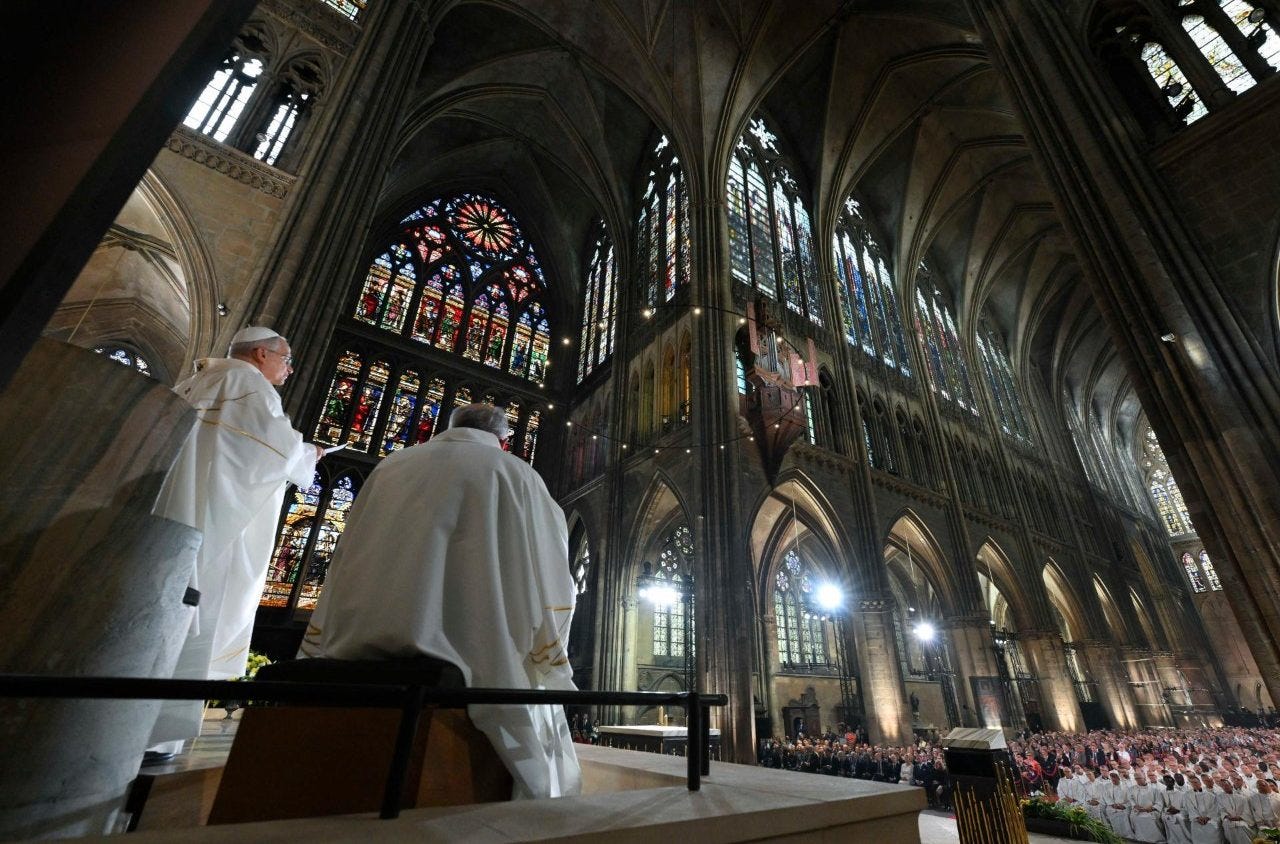
French President Emmanuel Macron made a last-minute decision to attend a separate papal Mass in Metz on Leo’s final day in the country, a decision that drew significant notice in local media, given the country’s strict secularization policy.
Lourdes: ‘A pilgrim among pilgrims’
Pope Leo spent a little over a day in Lourdes, where he described himself as “a pilgrim among pilgrims.”
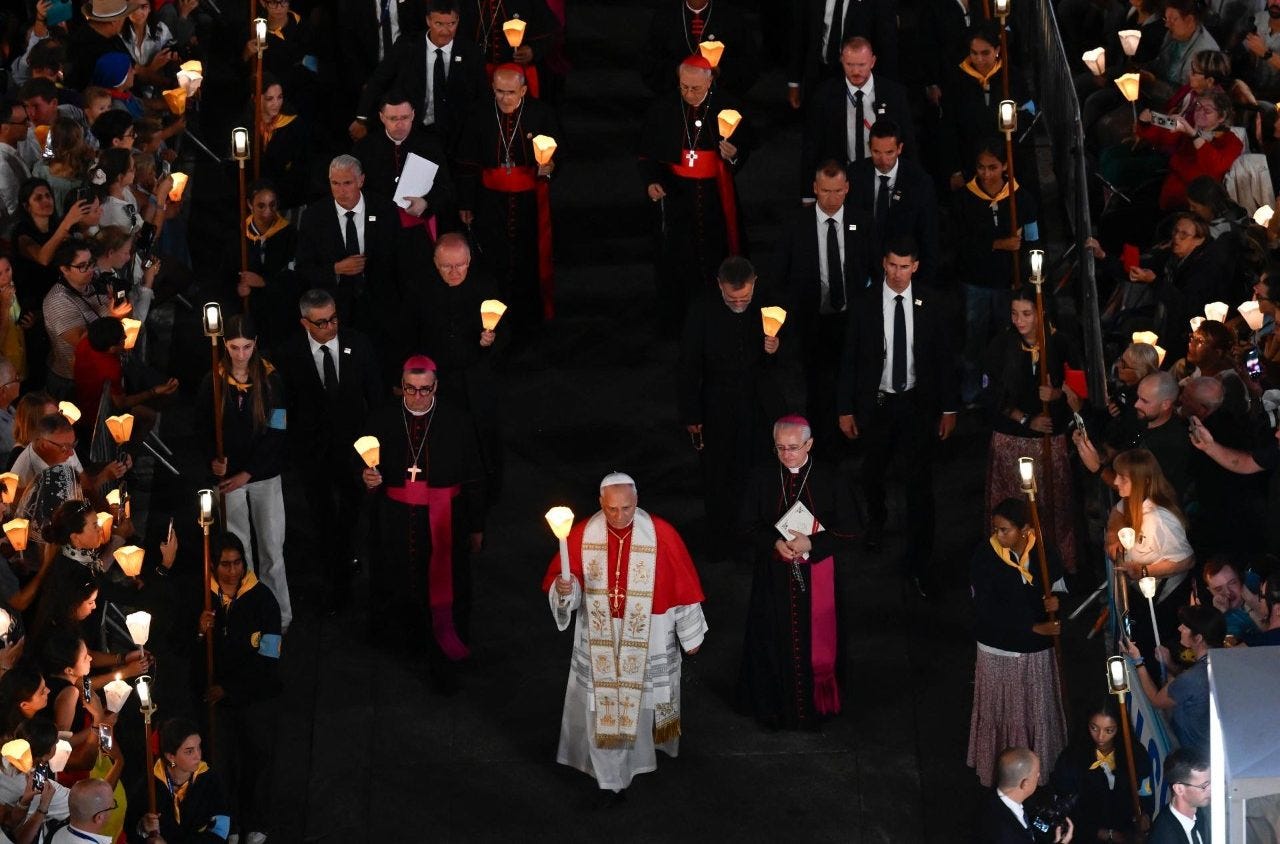
The pope prayed at the site of the famous Marian apparitions, celebrated Mass, met with the French bishops, and led a candle-lit procession. He encouraged penance as “an act of love” and emphasized that in Christ, it is possible to find “serenity and joy amidst suffering.”
The pope also met with a group of sick individuals at Lourdes, reaffirming their dignity and promising prayers on their behalf.
“Dear brothers and sisters who are sick, I want to tell you that you are not a burden. You are the beating heart of our humanity and a precious treasure for the Church,” he said.
He also warned against the practice of assisted suicide as a way to escape suffering. France adopted a law legalizing assisted suicide earlier this year.
“I know that for some of you, because of particular illnesses and, at times, terrible pain, your horizon may appear dark, uncertain and without hope,” the pope said. “But no human law should ever make you lose the certainty of your dignity. On the contrary, it is precisely in the name of this inalienable dignity of the human person that we must reject the temptation to cause death under the guise of false compassion.”
Artificial intelligence and a ‘paradise of machines’
Artificial intelligence – a recurrent emphasis of Leo’s developing papacy – was a theme in several of his speeches in France.
In a speech to civil authorities, the pope warned of the potential of “losing our humanity amid a ‘paradise of machines’ invading and conditioning our daily lives.”
He called for “education in ethical discernment and the capacity to acknowledge the moral good,” adding, “This is indispensable if we are to recognize the genuine good that enables human beings to flourish in accordance with their primordial vocation.”
In his UNESCO address, the pope also discussed AI, warning of the threat of dehumanization that accompanies technological developments.
“The paradox has become increasingly evident: while ‘intelligence’ is attributed to computational systems, we struggle to recognize the inalienable dignity of human persons, whose lives are judged according to the criterion of efficiency and, when deemed no longer productive, are rejected and discarded,” he said.
The pope’s UNESCO speech urged the agency to prioritize the dignity of the human person in its educational and cultural pursuits. He encouraged those present to grapple with the question of what it means to be human.
“Human beings cannot live without meaning. Meaning is the oxygen of the mind,” he said.
Notre-Dame: A sign of hope
Pope Leo met on Friday with clergy and consecrated men and women at Notre-Dame Cathedral. Recalling the massive fire that devastated the famous gothic cathedral in 2019, the pope said the rebuilding of the famous landmark is a sign of hope and renewal.
At the same time, he added, “we must not forget that this Cathedral, like every other church, was built for the purpose of prayer and the worship of God. It is the place where the Christian community celebrates the highest form of prayer and worship, renewing in the Eucharist the redemptive sacrifice of Christ. This Cathedral is not merely a stone structure to be admired; instead, it lives by the sacred mystery celebrated within it. Without the liturgy, it would lose its soul.”
The roots of Europe
During his trip, the pope repeatedly called Europe to look back to its roots in order to pursue peace and unity.
“We cannot speak of Europe,” he said in an address in the city of Metz, “without mentioning Christianity.”
He pointed to the “profound influence of St. Benedict and his monks,” highlighting their “care for the poor, the sick and the elderly; education of children and universities; hospitals and medicine; architecture and engineering; the development of the sciences; law and the organization of cities and States themselves.”
“Without this monastic tradition, European civilization as we know it would not exist,” he said.
Contemporary Europe, Leo said, must look back to its roots, while also remaining open to dialogue with others.
In another address, the pope encouraged the French bishops to be “a prophetic authority” in re-proclaiming Christ to the nation nicknamed “the eldest daughter of the Church.”
Robert Schuman
Pope Leo lauded Venerable Robert Schuman, a former French prime minister and foreign minister who helped create the Council of Europe and NATO in the post-War era.
Schuman is credited with help to pave the path that would eventually lead to the creation of the European Union. A devout Catholic, he was declared Venerable in 2021.
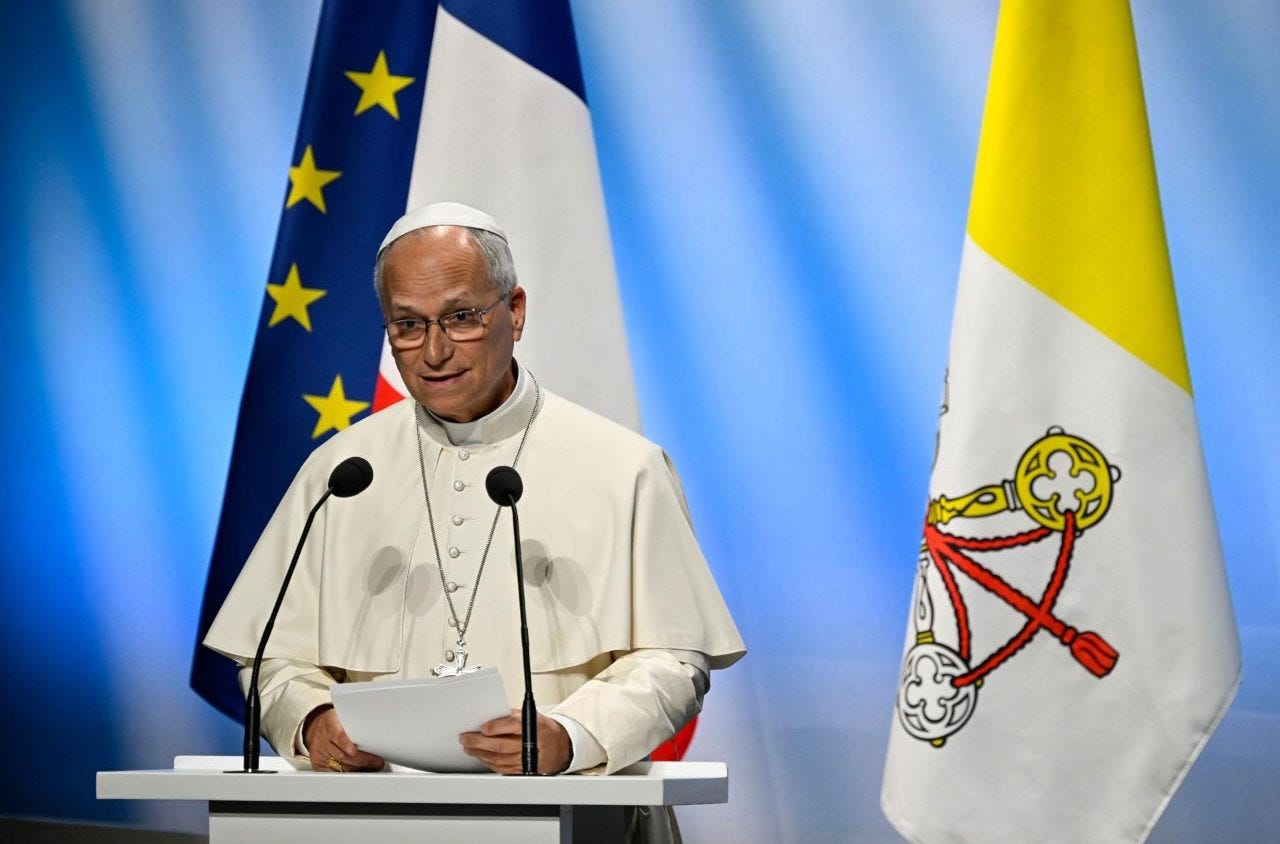
Pope Leo delivered two speeches at the Robert Schuman Conference Centre in Metz. He said Europe and the whole world should look to Schuman’s example of dialogue and the relentless pursuit of peace.
“Schuman reminds us that we must always be realistic and courageous,” the pope said. “We must never lose confidence in our ability to move forward, even when the steps we take are small and almost unnoticed.”
Meeting with youth
On Friday evening, Pope Leo led a prayer vigil with youth gathered at the national stadium. Some 80,000 people were estimated to be in attendance.
The pope answered questions from young people, and spoke about discernment, evangelization, and the importance of cultivating fraternity with those who do not follow Christ.
“Our battle is not a battle against others,” he said. “It does not employ the weapons of violence, contempt or oppression. Our only weapon is that of self-giving love.”
He also encouraged the youth to entrust their futures to God, and to realize that God is bigger than their anxieties and worries.
“Throughout the history of the world, there is no failure from which God cannot lift us up, for his mercy is our joy,” Leo said.
This was a blockbuster trip, one of those we will be talking about in years to come. The Stade de France resounding to the Salve Regina was a goosebump moment.
For me two more highlights:
1. The Pope blessing little Marie-Garance, a beautiful child in a blue dress who experiences severe disabilities. She was adopted by a Catholic mother and father who already had six children. Her mother said on French television that she has a sense that the Pope's blessing was also for Marie-Garance's biological parents who gave her life. I can't shake the feeling that many souls will be saved thanks to Marie-Garance.
2. The amount of people on X going "I'm not religious but... this really touched me/this man is amazing/the joy of the crowds has really thrown me."