Priestly ordinations rise in Germany, fall in France
Germany will see 30 new priests ordained, while France is expected to see 84.
The annual number of priestly ordinations is expected to rise in Germany and fall in France in 2026.
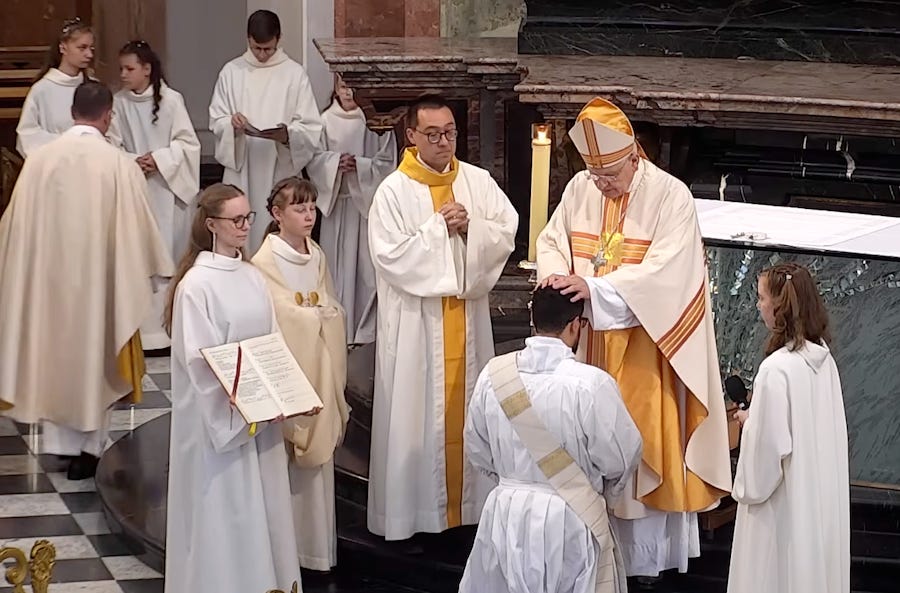
A total of 30 new priests will be ordained for Germany’s 27 dioceses in 2026, up from 25 in 2025 and 29 in 2024, the German Catholic news agency KNA reported June 26.
A total of 84 new priests are projected to be ordained in France in 2026, down from 90 in 2025 and 105 in 2024, the French bishops’ conference announced June 25.
The two countries’ figures are not directly comparable, because the German statistics do not include priests ordained for religious orders. Over the past three years, the German Church has recorded an average of seven new religious priests.
Excluding religious priests from the French figures, there will be 66 new diocesan priests in 2026, up from 64 in 2025, but down from 73 in 2024.
France will have more than twice as many new diocesan priests as Germany in 2026. But there are considerably more baptized Catholics in France than in Germany, as well as a higher number of Massgoers. This gives France a significantly larger pool of potential priests.
Within both countries, there are striking variations in the number of new priests between dioceses.
In Germany, the leading diocese is Rottenburg-Stuttgart, which will have five new priests in 2026. It is followed by Berlin with four ordinations, and Eichstätt, Cologne, and Munich and Freising with three each.
Münster, the German diocese with the largest Catholic population, will have no new priests in 2026. German bishops’ conference president Bishop Heiner Wilmer was installed June 21 as the new Bishop of Münster. His previous diocese, Hildesheim, will also have no priestly ordinations this year.
A total of 11 out of the 27 German dioceses will have no new priests in 2026. The Diocese of Limburg, led by former bishops’ conference president Bishop Georg Bätzing, has had no priestly ordinations for four years running.
In France, the highest 2026 priestly ordination figures are found in the Ecclesiastical Province of Paris, which covers the country’s most densely populated region. The province will gain 18 new priests.
The Archdiocese of Paris itself will have seven new priests, including three Assumptionists and one member of the Emmanuel Community. The seven will be ordained June 27 at Notre-Dame Cathedral, alongside two candidates who will be ordained for Vietnam’s Thanh Hóa diocese.
In second place among France’s ecclesiastical provinces is Marseille, with 14 ordinations. Ten of the Marseille province’s new priests come from the Diocese of Fréjus-Toulon, which was known as a hotbed of vocations under its previous Bishop Dominique Rey, who resigned in 2025. The Fréjus-Toulon diocese is now led by Bishop François Touvet.
Both France and Germany have experienced a steady decline in priestly numbers throughout the 21st century.
But the French bishops’ conference described as “an encouraging sign” an increase in the number of candidates enrolling in seminaries for a propaedeutic (preliminary) year of studies.
Between 2023 and 2025, propaedeutic year entries rose from 99 to 145, a 47% increase in two years.
The bishops’ conference said the propaedeutic year entries were “an important indicator of the momentum in vocations that the Catholic Church in France is experiencing.”
Meanwhile, a total of 196 new priests are scheduled to be ordained in Poland in 2026, more than in France and Germany combined.
Poland has a smaller overall population than France or Germany, but it has a larger number of baptized Catholics and a significantly higher Mass attendance rate than either country.
But Poland is also seeing a long-term decline in the annual number of new priests.

Great picture. Outside of actual ordained priests, almost exclusively girls helping on the altar.
Anyway, what were we saying about collapsing vocations to the priesthood?
I hope the number of priests ordained in Germany continues its steady increase.