What’s France’s new assembly on catechumens?
The staggering increase in adult baptisms will be the topic of a major gathering.
The staggering increase in adult baptisms in France will be the topic of a major gathering at the end of May.
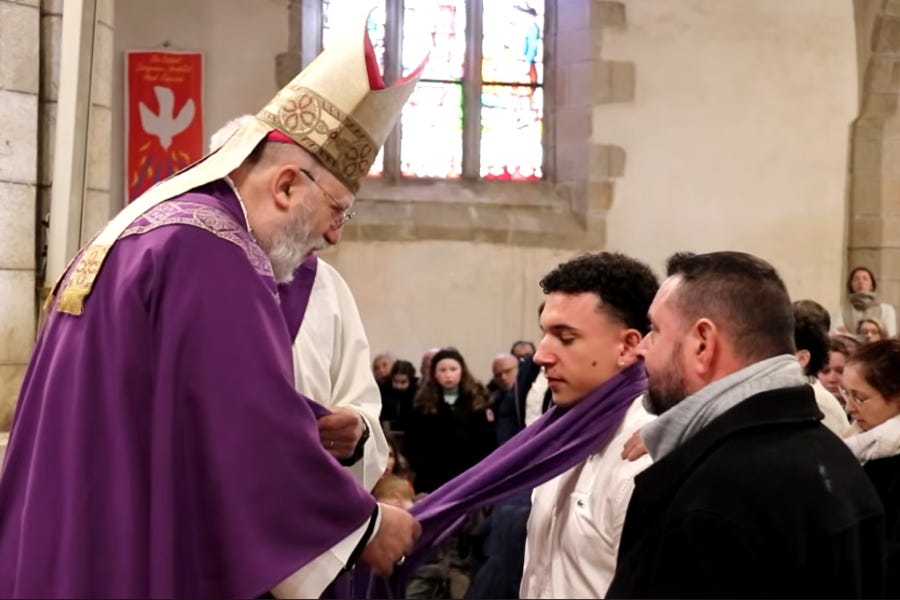
An ecclesial assembly on catechumens, or baptismal candidates, in the Ecclesiastical Province of Paris will be launched formally May 31, with an opening Mass at Notre-Dame Cathedral.
The event will bring together representatives of the eight territorial dioceses in the ecclesiastical province, as well as the Diocese of the French Armed Forces, which has also seen a spike in baptisms.
What’s the background to the gathering? And what exactly will it address?
What’s the background?
Unless you’ve been living in a cave, you’ve probably heard about France’s “baptism boom.”
From 2023 onward, the number of adolescents and adults seeking baptism in the country began to rise sharply. In 2023, the total figure was 8,416. By 2026, that had more than doubled to 21,386.
The surge took many French Catholics by surprise. To some, it seemed as if their parishes had filled overnight with young people eager to embrace the Catholic faith. Diocesan catechetical departments accustomed to preparing a few dozen baptismal candidates a year were now faced with hundreds of enthusiastic catechumens.
The increase was especially noticeable in the Paris region, a relatively small geographical area that’s home to around 18% of France’s 69 million population. Adult baptisms in the Ecclesiastical Province of Paris rose from 1,245 in 2022 to 3,184 in 2026.
Local dioceses did the best they could to welcome hundreds of extra new Catholics. But the influx presented challenges. The first one, arguably, was to understand who the catechumens were and why they were seeking baptism.
The answers were complex and sometimes unexpected, as the French journalist Antoine Pasquier documented in his groundbreaking book Enquête sur ces jeunes qui veulent devenir chrétiens (“Inquiry into Why Young People Want to Become Christians”). While Catholic online influencers certainly played a role, French teens were more likely to be drawn to the Catholic Church through personal Bible reading and inspired by the confident religious conviction of their Muslim friends.
Pasquier, a catechist in his local parish, noted that catechesis needed to be adapted to new catechumens’ distinctive pathways to the Church. For example, baptismal candidates tended to think of Lent as the “Christian Ramadan.” Catechists therefore had to stress that in Christianity the season of fasting is focused on inner conversion rather than outward observance.
Pasquier argued that the rise in adult baptisms should prompt a deep shift in the Catholic Church, away from a Church of managed decline to a “catechumenal Church” that regarded the integration of new adult Catholics as one of its fundamental tasks.
It was in this context that the dioceses of the Ecclesiastical Province of Paris announced in April 2025 that they would come together to discuss how best to respond to the new Catholics, who are known as neophytes after baptism.
Explaining the gathering’s rationale in a January 2026 interview, organizer Fr. Maximilien de La Martinière said: “The challenge lies in what comes after baptism. It is not just a matter of preparing for baptism, but of preparing for a Christian life.”
“The current model has reached its limits; we can no longer rely on a system where one or two parishioners are solely responsible for guiding the catechumens. We need to rethink the system and ensure that the entire community shares in this mission.”
What will happen at the assembly?
The bishops of the Paris region initially styled the gathering as a “provincial council,” a gathering that must meet certain precise criteria according to the Code of Canon Law.
The French Catholic daily La Croix reported this week that Rome had asked the Paris area bishops to rename the event a “provincial ecclesial assembly.” This is apparently because it didn’t fulfill the requirement in Canon 443 §4 that the number of invited participants must not exceed half the number of ex officio members.
A total of 319 people will take part in the assembly, consisting of 131 ex officio members (including the Paris region bishops), 144 invited members (16 per diocese), and 44 observers without voting rights (including three Protestants and three Orthodox Christians).
The event’s full title is “Catechumens and neophytes: new perspectives for the life of our Church in our dioceses.” It effectively began in January 2026 with a consultation phase involving catechumens, catechists, newly baptized Catholics, priests, and parishioners.
So far, almost 30,000 people have taken part, submitting 3,300 contributions. After the consultation closes in June, the results will be analyzed with the help of AI.
Following the opening Mass this month, celebrated by Paris Archbishop Laurent Ulrich, there will be three working sessions, in October 2026, January 2027, and May 2027.
The assembly itself will decide the event’s exact scope. But according to the official website, it is likely to address questions such as “how can parish communities be more involved in accompanying catechumens and incorporating neophytes?” and “how can we provide training not only for baptism but also for the Christian life?”
The assembly, which has its own dedicated prayer and hymn, will produce a final document at the May 2027 session that will be reviewed by the Paris region bishops and then submitted to Rome for approval.
If the Vatican gives the green light, the bishops will issue decrees in their dioceses implementing the assembly’s recommendations. The bishops hope the process will be completed by the fall of 2027.
