
‘Quo vadis, humanitas?’: A brief guide for busy readers
What’s the genesis of the ITC's new document? And what does it say?
Within the Vatican’s complex bureaucratic apparatus there is a body that acts as a kind of theological early warning system.
The International Theological Commission, founded in 1969, specializes in addressing complex topics years before they register at the grassroots level in the Catholic Church.
In 2018, for example, the ITC issued a document on the then exotic-sounding concept of synodality. Eight years and two synod on synodality sessions later, the text remains an important reference point.
The ITC is led by its Italian secretary-general Msgr. Piero Coda. It has 26 current members, who are serving a five-year term that will expire or be renewed in 2026. The U.S.-based members are the Catholic University of America professors Reinhard Huetter and Robin Darling Young.
At the beginning of March, the ITC issued a new document, which appeared this week in English translation. It’s called Quo vadis, humanitas? (“Humanity, where are you going?”).
What’s the genesis of the new document, subtitled “Thinking through Christian Anthropology in the Face of Certain Scenarios for the Future of Humanity”? And what does it say?
Here’s a brief guide for busy readers.
What’s the background?
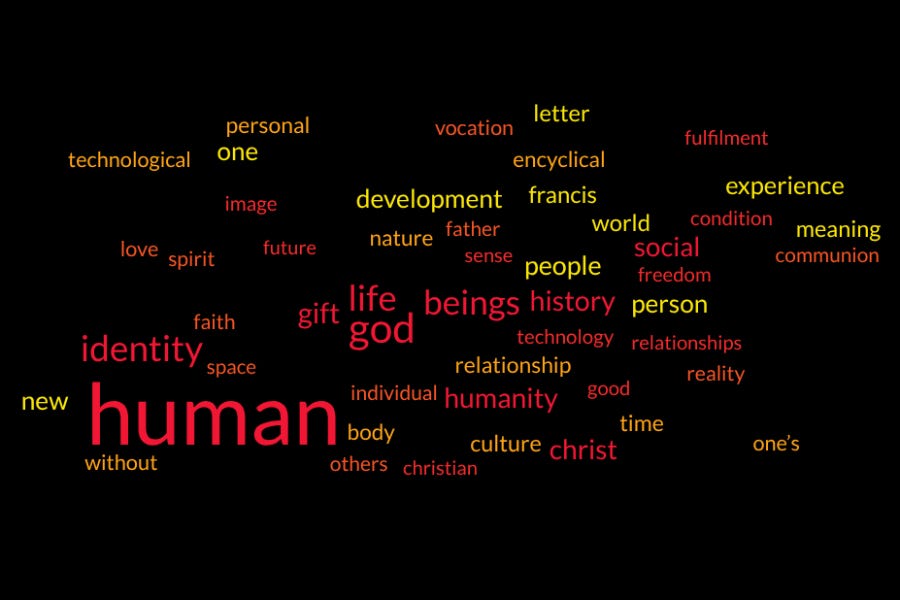
During its current five-year term, the ITC has focused on Christian anthropology — the study of human beings in relation to God — in light of contemporary cultural challenges.
It has looked at the topic through the lens of Gaudium et spes, a foundational document of Vatican Council II, whose 60th anniversary fell in 2025.
This project was driven by a subcommission with the following members:
🇪🇸 Fr. Javier Prades López (chairman)
🇺🇲 Reinhard Huetter
After three years of study and discussion, ITC members unanimously approved the text Quo vadis, humanitas? in 2025. It was submitted to the ITC’s president, Vatican doctrinal chief Cardinal Víctor Manuel Fernández, who in turn presented it to Pope Leo XIV.
With the pope’s approval, Fernández authorized the document’s publication on Feb. 9, 2026. It was published in Italian and Spanish on March 4.
What does it say?
The document argues that culture is changing so rapidly, due to technological advances, that previously stable notions of what it means to be human are at risk of being overthrown.
It suggests ways in which Catholics can convincingly proclaim the Christian understanding of humanity’s nature and purpose as the world is shaken by a series of cultural, economic, health, and military crises.
It argues that human life is defined by relationships — with nature, others, and above all God — and because human existence is a gift, it comes with certain constraints and responsibilities, but can open up to an awe-inspiring communion with God.
The text is around 28,000 words and takes an average reader roughly two hours to absorb. Its target audience is likely theologians, philosophers interested in Catholic thought, and laity who have previously studied theological texts. Its style is unusually clear for a Vatican document.
The text consists of an introduction, followed by four chapters, and a conclusion.
The 20-paragraph introduction sets the scene of a world in crisis where consensus on the nature of humanity has been shattered. It says that it aims to build on Gaudium et spes, which “systematically proposed a vision of the human being illumined by the mystery of Christ,” applying its insights to distinctively 21st-century questions.
It explains that it will do this by considering four “key categories,” which are highlighted with italics in the following sentence.
“It begins by considering the notion of development, which underpins many of the technological and social innovations currently underway,” it explains. “The need to ensure integral human development then leads to a reflection on the category of vocation as a key to anthropological understanding, which in turn refers to the question of human identity, on both a personal and social level. Finally, it explores the historical and free dramatic condition that characterizes human identity, understood as vocation, and its dialogue with new techno-scientific challenges.”
The document is responding to two rising schools of thought: transhumanism and posthumanism.
It defines transhumanism as “a philosophical movement that operates on the belief that human beings can and should use the resources of science and technology to overcome the physical and biological limitations of the human condition, in particular aging and even death.”
It says that posthumanism “criticizes traditional humanism, questioning the specificity of human beings and the existence of a ‘human form’ that, as such, deserves to be preserved because it carries a universally valid meaning.” It advocates a blurring of the boundaries between human beings and machines.
The document rejects both techno-utopianism — the idea that technological advances will render humanity’s perennial problems obsolete — and the “radical pessimism” that predicts human beings will be replaced by cyborgs. It offers a sustained critique of what it considers to be the fantasies and delusions of transhumanism and posthumanism.
The first chapter, Development: Humanism and posthumanism, which contains 42 numbered paragraphs, explores what qualifies as authentic human development, against the background of the race to create an artificial general intelligence, or AGI, that is “capable of replacing all computational and operational aspects of human intelligence thanks to extremely high computing speeds.”
The 28-paragraph second chapter, Life as vocation: The human person as an agent of history, highlights “some fundamental dimensions of human experience” that are in danger of being eclipsed by false ideas of progress found in transhumanism and posthumanism.
It calls for renewed attention on the historical and intersubjective dimensions of human experience. It says that reflecting on these dimensions can lead to a recognition that each human life has a distinct calling, or vocation, whose nature is revealed in a prayerful relationship with God.
The 22-paragraph third chapter, The gift of life and communion in the face of scenarios for the future of humanity, explores how authentic human identity can be recognized and distinguished from counterfeits. It defines identity as both “a gift and a task,” as it is freely given by God and requires responsible development.`
The 31-paragraph fourth chapter, Humanity affirmed, saved and elevated, argues that what humanity truly needs is not the “evolutionary leap” proposed by posthumanism, “but rather a saving relationship” with God. Life, it says, is unavoidably dramatic, requiring us to grow amid ever-present tensions.
“The Christian proclamation of salvation offers a completely human way, by grace, of living these polarities which is both healing and elevating,” it comments.
It explores tensions between the material and spiritual, man and woman, and individual and community, insisting they can only be properly understood in the light of God’s plan of salvation.
The six-paragraph conclusion, The gift of divinization as true humanization, returns to its title question: where is humanity heading?
It says: “Today more than ever, the anthropological and cultural proposal that Christianity offers involves the conception of life as a vocation, which makes possible a human way of inhabiting time and space and of conceiving intersubjective relationships, while at the same time becoming a prophetic judgment on the more disturbing aspects we cannot fail to recognise in transhumanism and posthumanism.”
It underlines that the ultimate goal of human life is accepting “the gift of divinization by grace.” This refers to the daring concept of theosis (divinization) found in the writings of the Church Fathers, who taught that human beings can become godly through God’s grace.
The text says: “The Christian proclamation identifies the appropriate way to go beyond (trans) the limits of human experience, with the deification (theosis) possible only to God, which is the exact opposite of transhumanist self-deification.”
The conclusion stresses that the risks associated with current technological changes are exceptionally high, especially for the poor and vulnerable, who “run the risk of becoming waste material, ‘collateral damage,’ swept away without mercy.”
It challenges Christians to be “humble sentinels” who are alert to the impact of social developments on the weakest.
“We must respond with a prophetic word and with generous involvement,” it says. “The authenticity of our faith and the human value of our lives are at stake.”
@Steven Umbrello @Alex Spieldenner @Ray Alex Williams @Donald Paul Maddox @Dylan Campbell @Jonathan Dunn @William E. @Thomas Salerno @J. A. Siemer @J. M. Terry @Nate Marshall @Wesley Walker @Eric Anderson check this out!
First, thank you for this summary. This is a great service to the Church. One concern is that this is just another step toward subjectivism, meaning philosophical Modernism, and away from an Aristotlian/Thomist objective and Natural Law based morality. Francis removed tenured faculty from the Pope John Paul II Institute (think Veritatis Splendor), gave it a new name and charter. Why? To move to a psychological subjective morality to usher in a new “pastoral” approach to same sexed ideology. What he should have done is start his own institute with his own name on it. I would be curious to see how many theologians are on both.