
Temperatures climbed so high in France this summer that wildfires forced mass evacuations, Champagne grapes were harvested exceptionally early, the Louvre closed in the afternoons, and the field at the historic Parc des Princes stadium turned brown.
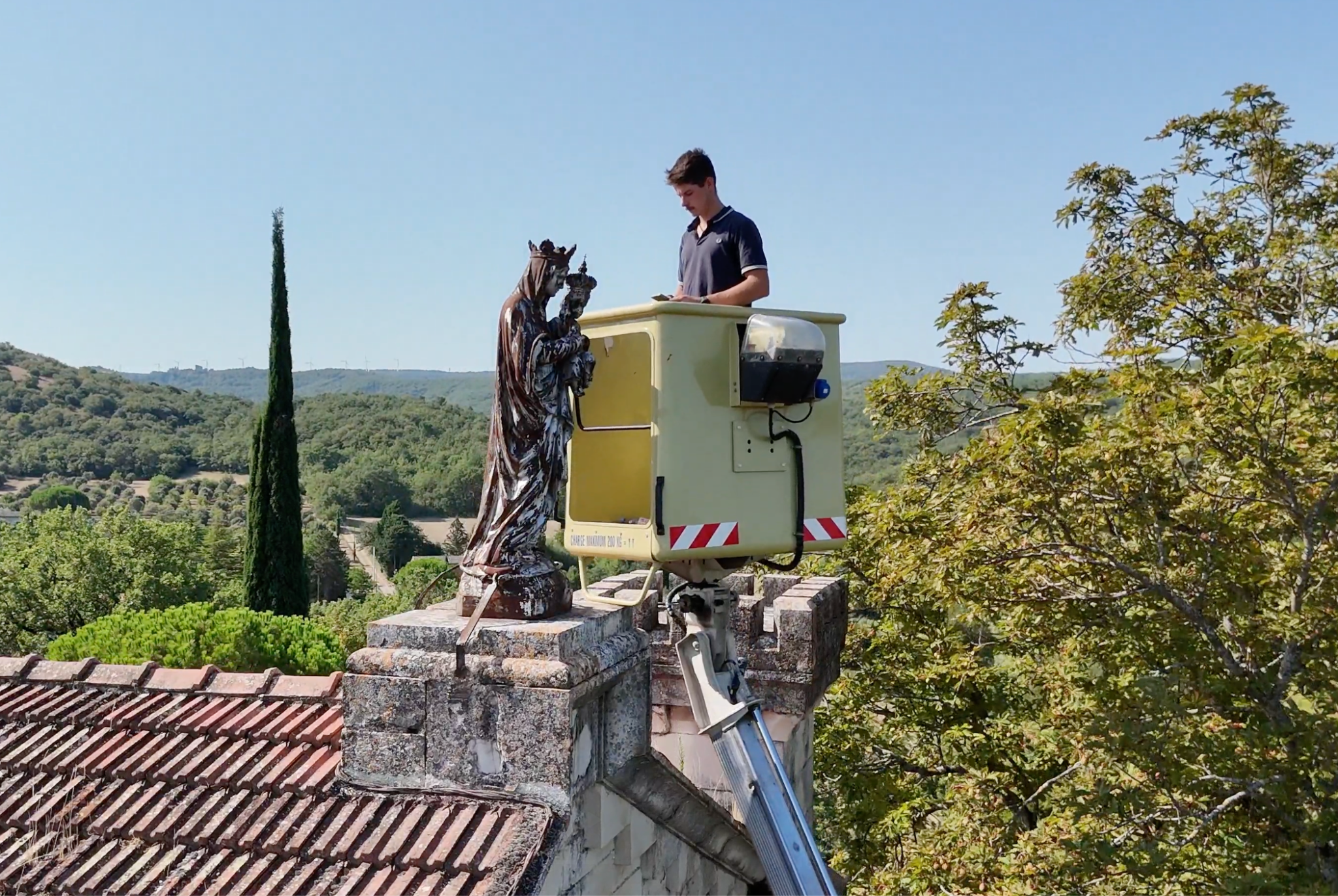
With the mercury peaking at 111 degrees Fahrenheit (44 degrees Celsius), only the brave would consider embarking on a month-long tour involving hours of manual labor in direct sunlight. But that is exactly what Raphaël Castex, a 23-year-old recent graduate, decided to do.
Castex spent August engaged in what he called a Tour de France du Patrimoine, or heritage tour of France. This involved traveling thousands of miles on a Honda motorcycle, stopping in towns and villages with the goal of renovating a total of 20 dilapidated religious statues over the month.
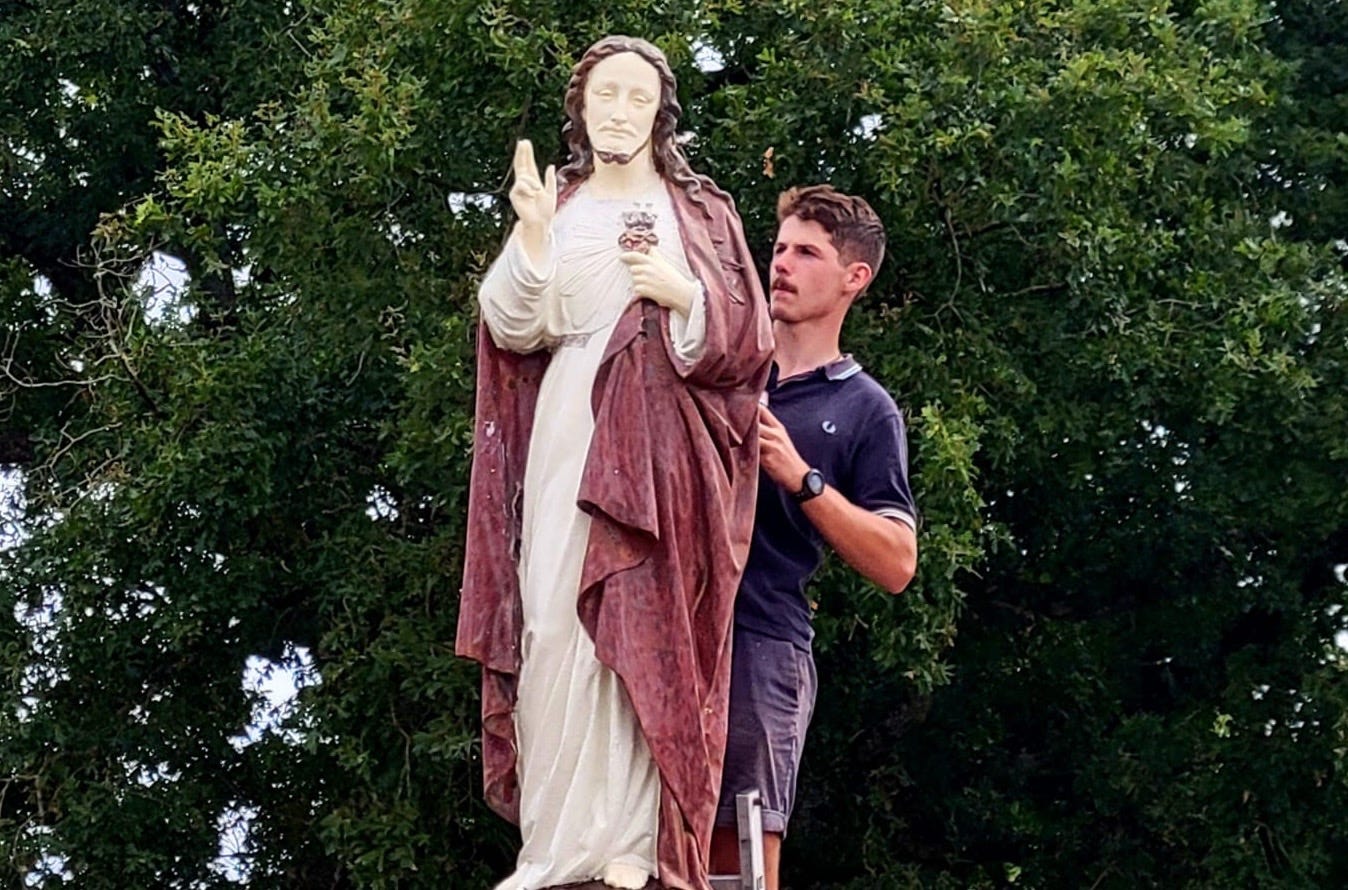
Castex, a calmly spoken figure with a fighter pilot mustache, is a co-founder of Rénove une Statue (Renovate a Statue), an association created in 2024 to restore the crumbling images of Christ, the Virgin Mary, and the saints that can be found all over France.
Today, the group has local chapters in Bordeaux, the Drôme, Paris, Toulouse, and the Vendée, meaning its youthful members can cover a substantial part of a country whose Catholic patrimony is vanishing at an alarming rate. (You can see them at work in this video, which shows the restoration of six statues in Thiviers, southwestern France, in 2025.)
In an email interview with The Pillar, Castex discussed how Rénove une Statue was born, the challenges he faced during his August tour, and how the initiative fits into the broader revival of faith among French youth.
Where did you grow up, and how did you develop the skills needed to restore statues?
I grew up in the Gers, in southwestern France. My parents worked in manual trades for about 10 years, so I was always surrounded by DIY projects and craftsmanship at home. From a very young age, I learned to work with my hands, starting with wood, which is still the material I enjoy working with the most.
Over time, I wanted to try working with other materials. I started by doing some restoration work on old buildings, and then I became interested in statues.
As I traveled around, I realized just how widespread this heritage is across France, and how much help it needs if it is not to disappear. I felt there was a real role to play, and I wanted to get directly involved on the ground to help preserve it.
What led you to co-found Rénove une Statue?
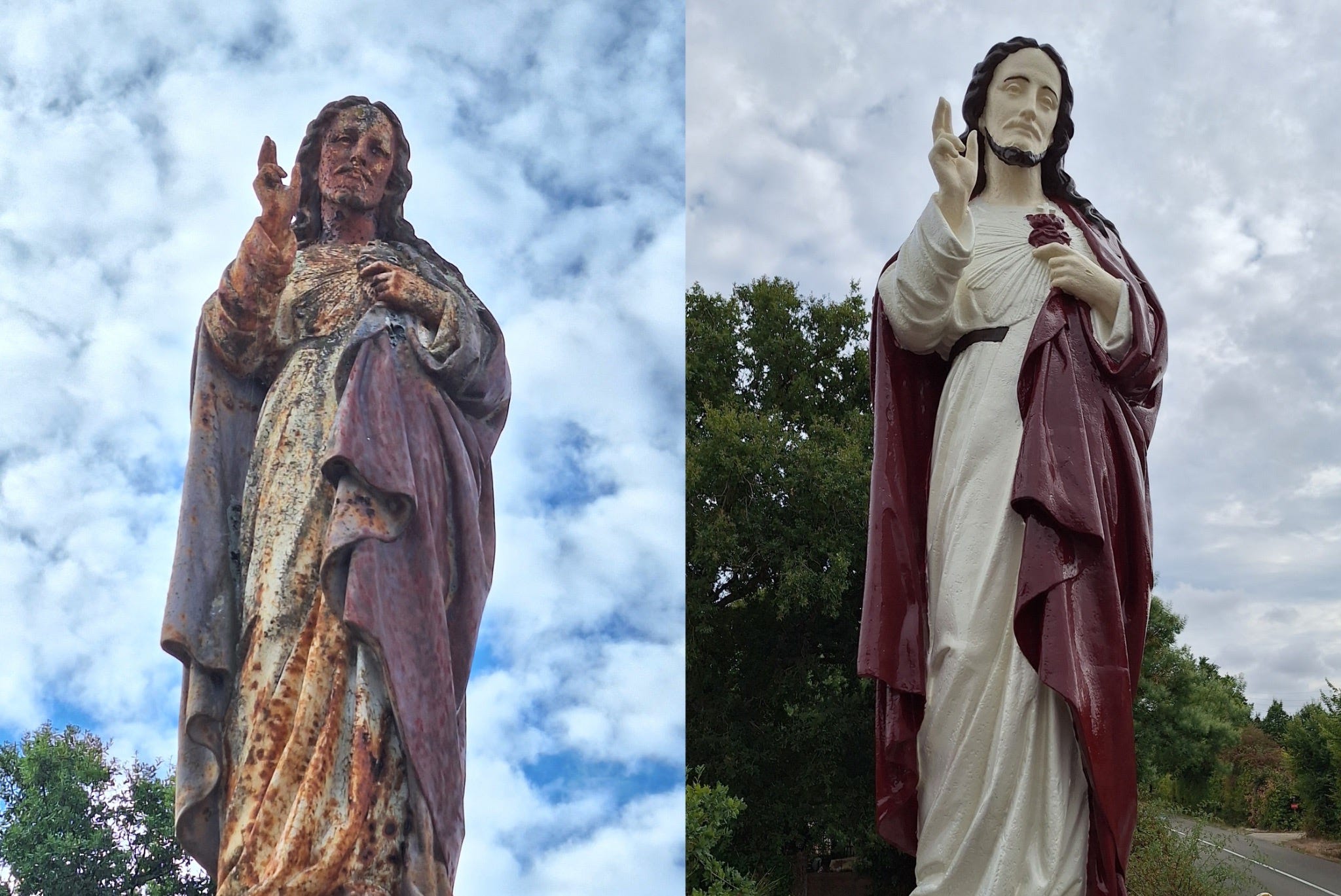
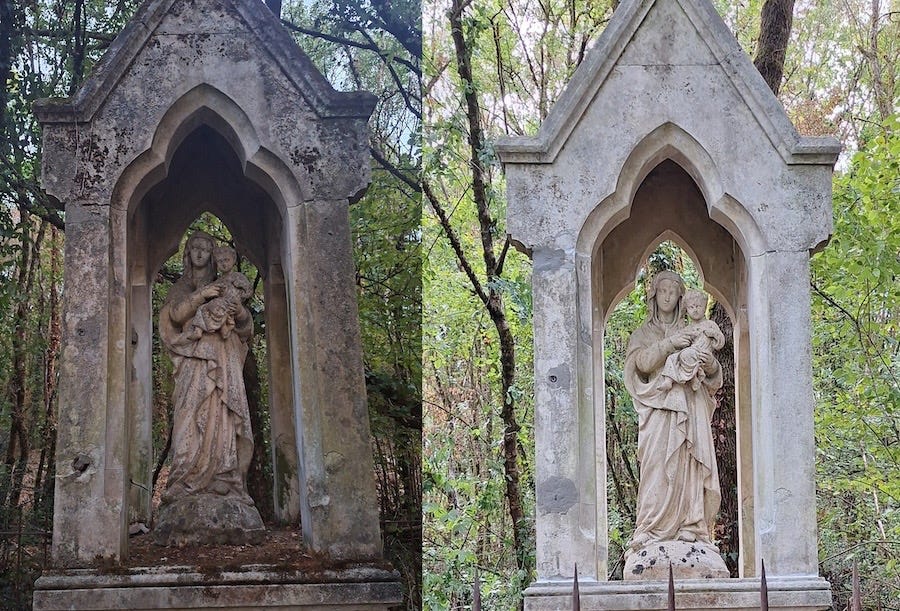
It came from a very simple observation while looking at the French countryside. In almost every village in France, whether at the end of a street or by the side of a road, you come across statues or roadside crosses. Over time, with rain and frost, many of them deteriorate and eventually fall into ruin if no one takes care of them.
We felt that we couldn’t simply stand by and watch. Someone has to roll up their sleeves, and young people have every reason to take part in this adventure. It’s a very direct way of taking care of our villages and our history.
In addition to restoring statues, you also designed and built a wooden chapel by yourself in the Gers. Could you explain how and why you undertook this project?
Two years ago, I built a 40-square-meter (430-square-foot) wooden chapel at my parents’ home in the Gers, with their permission. I already had this love of wood and carpentry, and I wanted to go further and challenge myself with a genuinely large project in order to improve my skills.
Alongside my studies, which were very intellectual and theoretical, I had a real need to work with my hands and create something tangible. It was also a very meaningful project for me spiritually: to offer this manual work, this time and this energy to a beautiful cause, to God, and to leave behind a place of prayer that would have meaning for the family.
Do you consider these projects to be an expression of your faith, or even a form of prayer?
Yes, absolutely. For me, restoring a statue or carving wood is a discreet, implicit form of prayer. When you do meaningful manual work, you physically give shape to what you carry in your heart. You use the talents and energy you have been given and put them at the service of what you believe in.
I think that is very important for young people today: faith should not remain purely intellectual. It also has to be expressed through action, and that strengthens it enormously.
Do you see Rénove une Statue as part of a renewal of faith among young people in France?
Yes, because it is something very concrete. Many young people need simple actions like these to awaken something within themselves and to remember that they are children of God.
Today, you can sense among quite a few young people a desire to rediscover solid foundations and roots, and that often goes hand in hand with a return to the Catholic faith. Getting involved directly on the ground to bring these statues back to life is a very healthy and living way of responding to that need for rootedness.
How did the idea for the Tour de France du Patrimoine come about?
The idea was to combine a great human adventure with restoration work. We wanted to spend a month traveling around France by motorcycle, enjoying the beauty of the French countryside, and being welcomed by local people in the villages we visited.
People often talk about “small heritage” [petit patrimoine, or everyday historical treasures, in contrast to grand patrimoine, or major monuments]. But for us, it is above all the heritage of our villages, the heritage that gives them their character and beauty every day. Traveling by motorcycle with our tools, restoring these statues while living day by day alongside local people, seemed like the most beautiful way to do it.
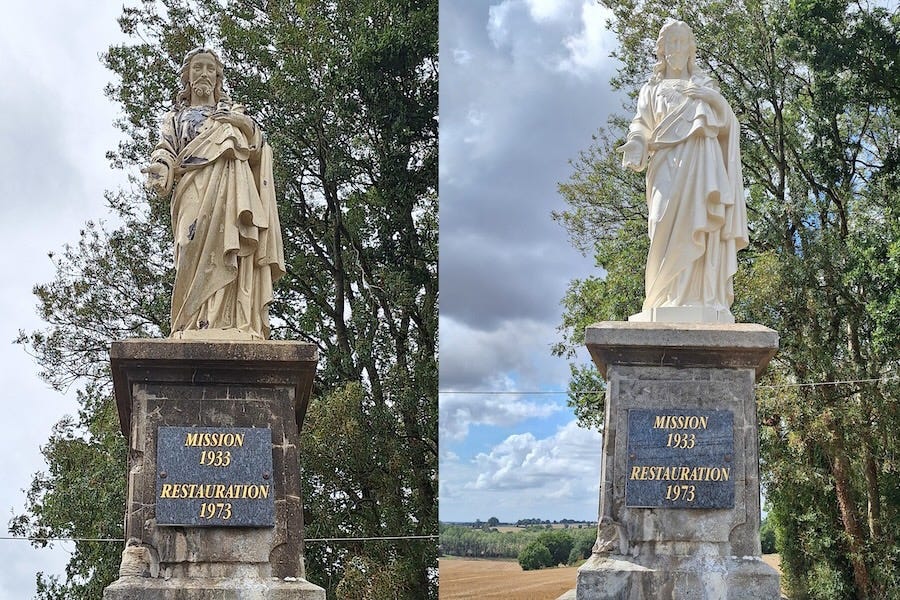
Could you describe the process of restoring a statue from the moment you arrive on site? How do you decide what work needs to be done?
Do you always have all the necessary tools and skills, or do you sometimes need help from other people?
Before we come, we always contact the owner of the statue, whether that is the local government, the parish, or a private individual. Often, these are statues that people have reported to us through our website, although sometimes we have spotted them ourselves while traveling.
When we arrive, we look at how the statue has aged: rust, cracks, deposits caused by rain and exposure to the weather. They are often made of stone or cast iron, materials designed for outdoor use. Depending on the condition of the statue, the work can take half a day or as much as one or two full days.
After restoring a number of them, you quickly learn to identify what needs to be done: brushing, cleaning, stripping old paint, repainting, or reinforcing damaged areas. Whenever the material is more fragile or complex, we ask craftsmen or conservation professionals for advice to make sure we use the right products without damaging the statue.
Most of the time, however, the work involves relatively simple techniques. That is really one of the principles behind the association: showing that almost anyone can lend a hand, even without being an experienced craftsman, provided they receive a little guidance.
What was the greatest difficulty during your journey across France to restore statues? Was the heat particularly difficult?
The hardest part was the pace. We had around 20 statues to restore during the month, so we spent very little time at each stop. We had to keep moving from the road to the worksite and then back on the road again.
As for the heat, I come from southwestern France, so I’m fairly used to it. And honestly, you forget the fatigue very quickly when local people stop to talk to us, encourage us, or simply thank us with a big smile when they see the statue getting its colors back.
Did you have any memorable encounters with local residents? Were there any unexpected events during the tour?
The people we met were really at the heart of the journey. Whether in the Drôme or the Vendée, local residents gave us an incredible welcome. They often gave us somewhere to stay and fed us as though we were part of the family.
As for unexpected events, when you travel that many miles by motorcycle carrying equipment, you inevitably have a few breakdowns along the way. But every time, local people or volunteers came to give us a hand, repair the bike, and help us get back on the road.
Those are the moments when you realise that the project creates bonds between people and brings communities together, far beyond the restoration work itself.
What are your ambitions for the future of Rénove une Statue?
We want to develop the association throughout France. There are thousands of statues in the French countryside that deserve to be cared for, and we simply cannot be everywhere at once.
The idea is to help create small local teams in other departments, provide them with the right tools and guidance, and enable them to carry out restoration work easily and quickly close to where they live.
Thank you for spotlighting Raphaël Castex and his group's work in restoring the statues and Catholic heritage throughout France! Very encouraging to see young people undertaking this task.