
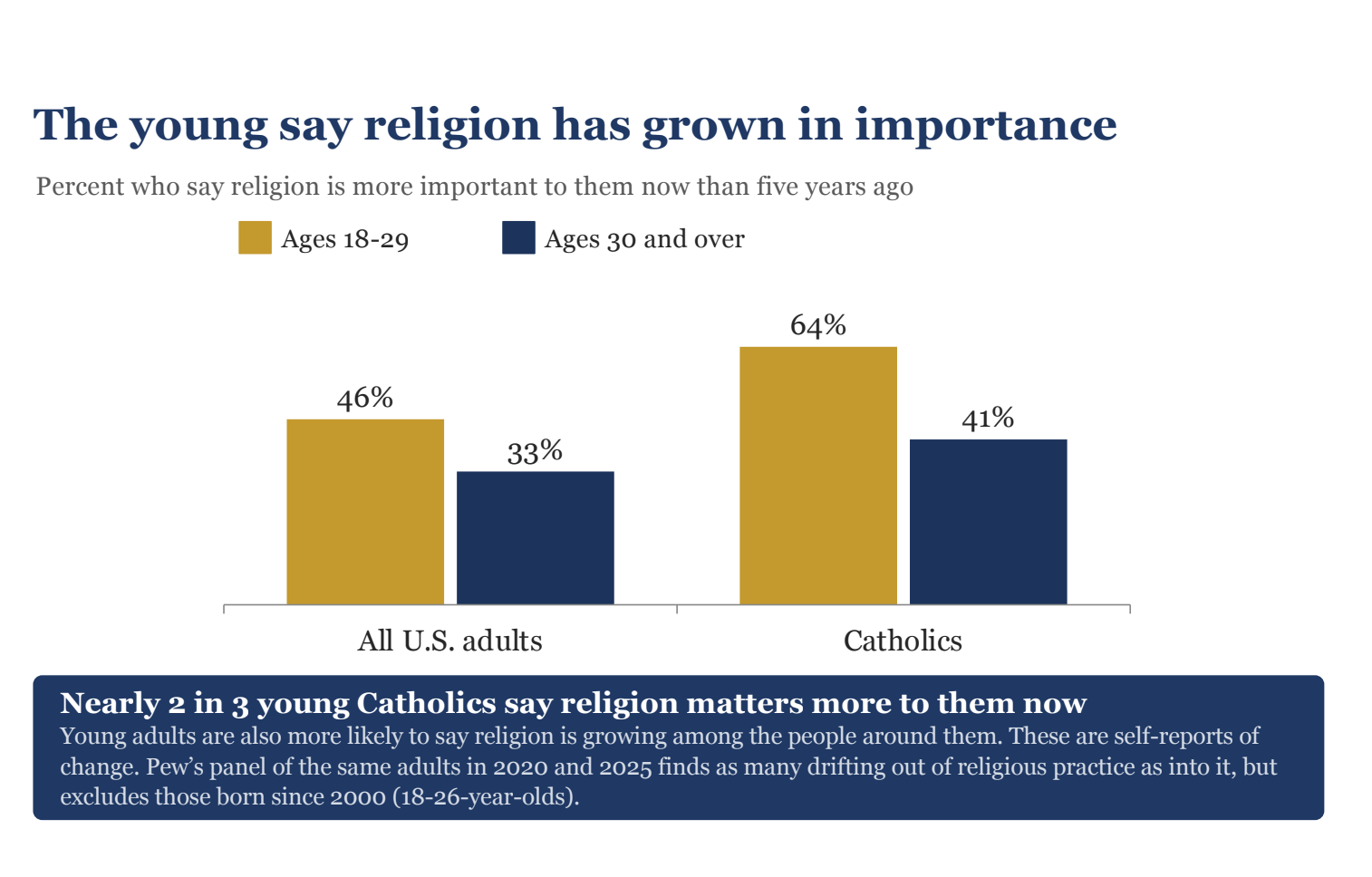
Young people in the United States, including young adult Catholics, say religion is becoming more important to them – but that conviction does not necessarily translate into practice, a new survey has found.
Among young adult Catholics who say religion has become more important to them in the last five years, more than 4 in 5 say beauty in liturgy and religious spaces was an important factor in that growth.
“It’s probably premature to say that there is a Catholic revival taking place, and yet the signs of new life are real,” said Brandon Vaidyanathan, sociology professor at The Catholic University of America.
He noted that although there are reports of increased numbers of adults entering the Catholic Church across the U.S. in recent years, there are many more adults leaving the Church – for every adult convert, 8.4 adults who were raised Catholic leave the Church.
Vaidyanathan was part of a panel giving a presentation to the fall gathering of the U.S. Conference of Catholic Bishops in Baltimore on Wednesday.
The presentation covered the findings of the “Beauty and Belief Survey,” conducted by Gallup in March and April 2026.
The survey included 5,000 adults in the U.S., including 1,165 young adults, ages 18-29 years old.
Among the key results of the survey was the finding that nearly 2/3 of young adult Catholics say religion has become more important to them in the last five years.
In addition, young people say they have a perception that the people around them are becoming more religious.
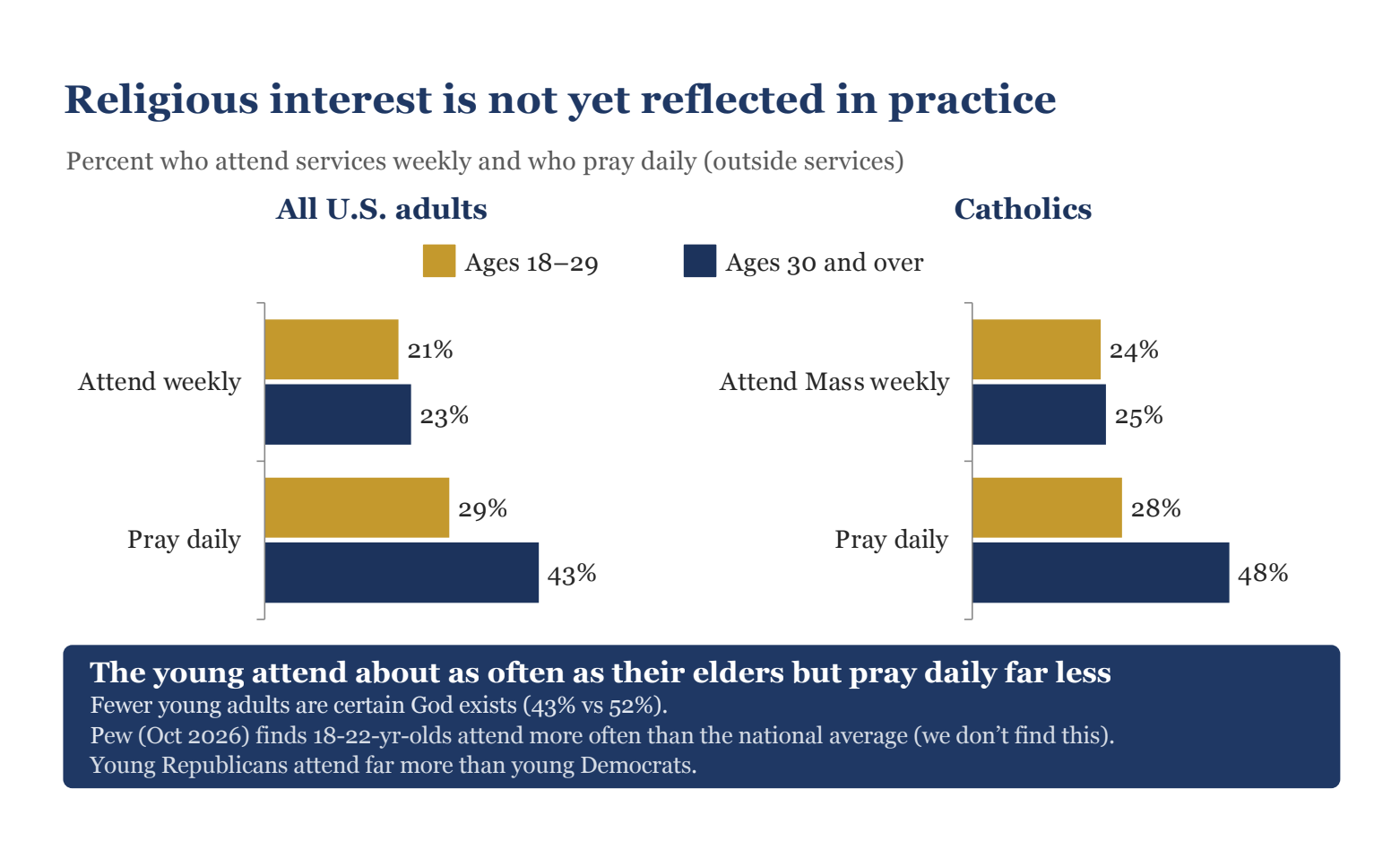
However, this renewed sense of religion is not necessarily reflected in practice, the survey found. Only a quarter of young adult Catholics reported attending Mass weekly, a rate nearly identical to that of older generations. And just 28% of young adult Catholics say they pray daily, compared to 48% of all Catholics.
Young adults who said religion has become more important to them cited the following factors: personal experiences or life events (89%), religious beliefs or teachings (86%), family or social relationships (82%), worship, music, ritual, and sacred spaces (75%) and finding beauty in religious spaces or rituals (74%).
Marrying or dating a Catholic appears to have decreased significantly as a reason for entering the Church, the data suggests.
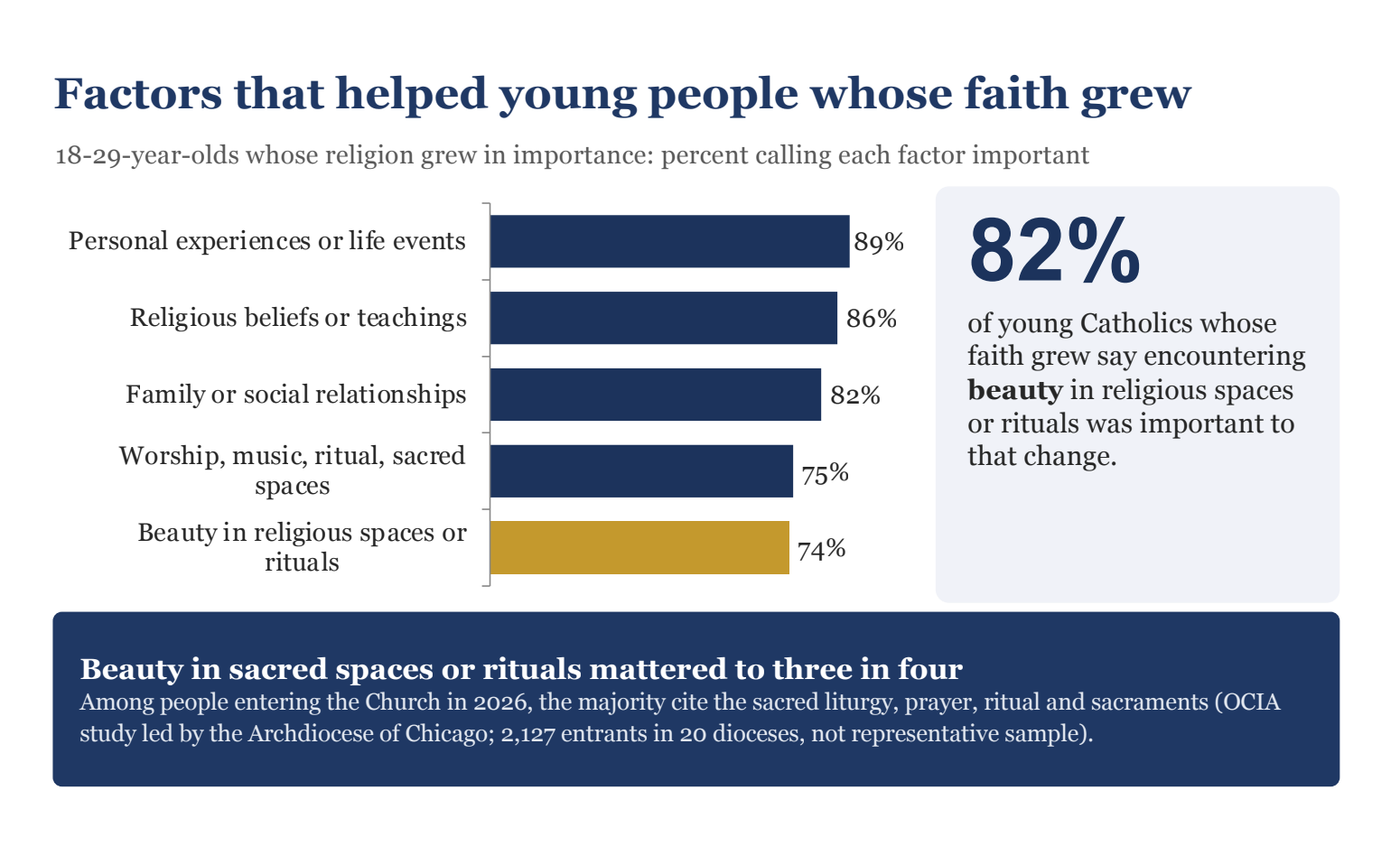
Among young Catholics who said their faith grew in importance, 82% said an important factor was an encounter with beauty in religious spaces or rituals.
Vaidyanathan noted another study which found that the majority of adults entering the Church in 2026 cited sacred liturgy, prayer, ritual and sacraments as important in making that decision.
The survey also found a generational shift in how U.S. adults describe themselves. While one-third of U.S. adults ages 30 and over describe themselves as “spiritual but not religious,” only one-quarter of young adults in the U.S. would use that descriptor.
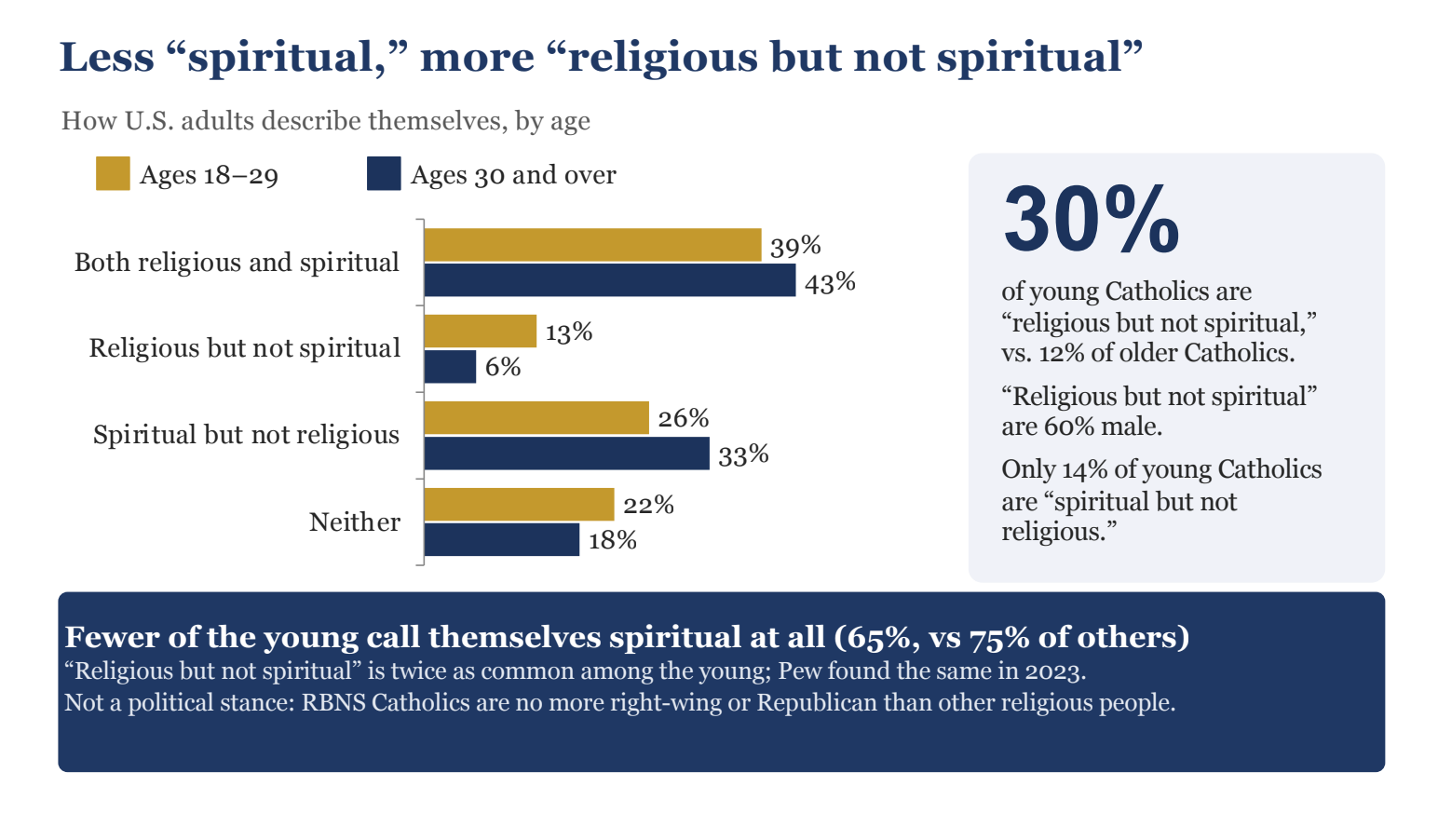
Thirteen percent of young adults would instead call themselves “religious but not spiritual,” twice the rate at which their older counterparts would use that label.
Meanwhile, 39% of young adults and 43% of older adults describe themselves as “both religious and spiritual.” And 22% of young adults and 18% of older adults say they are “neither religious nor spiritual.”
Among young Catholics, 30% say they are “religious but not spiritual,” compared to 12% of older Catholics. This “religious but not spiritual” cohort is 60% male.
The group that calls itself “spiritual but not religious” has plateaued, and seems to be disconnected from the younger adults in the United States, Vaidyanathan observed.
Young men and women have nearly identical rates of reporting that they are Christian, that they attend weekly religious services, and that religion has become more important to them in the last five years.
However, young women are much more likely than young men to say that they pray daily, if they reported a growth in the importance of religion. Fifty-four percent of young women in this situation say they pray daily, compared to just 35% of young men.
Young women are also more likely to call themselves “spiritual,” while young men are more likely to say they are “neither religious nor spiritual.”
“For men, it seems to be that religiosity has much more to do with identity, with…affiliating as religious and with attendance, and for women it’s much more about the interior life,” Vaidyanathan said.
Among young adults who reported being “religious,” 30% of women have utilized astrology, fortune telling or tarot cards in the past year, about twice the rate of men who did so. Among those who are “spiritual but not religious,” 42% turned to these things.
The survey also asked people what they are “longing for.” About 4 in 10 said they were “very much” or “extremely” longing for a relationship with God – and these numbers were consistent among different age cohorts.
However, young adults were much more likely (26%) than their older counterparts (16%) to say they were seeking guidance in knowing right from wrong. Young adults were also more likely (33%) than their older peers (20%) to say they were looking for a connection to community.
Young adults are more likely than older adults to say social media harms their mental health. And they are nearly twice as likely to say they find AI tools helpful for emotional support, despite the fact that the use of AI for emotional support is correlated with worse mental health.
Another finding of the survey is that the next generation of Catholics is mostly Hispanic. It found that 58% of young adult Catholics are Hispanic, compared to 29% of older adult Catholics.
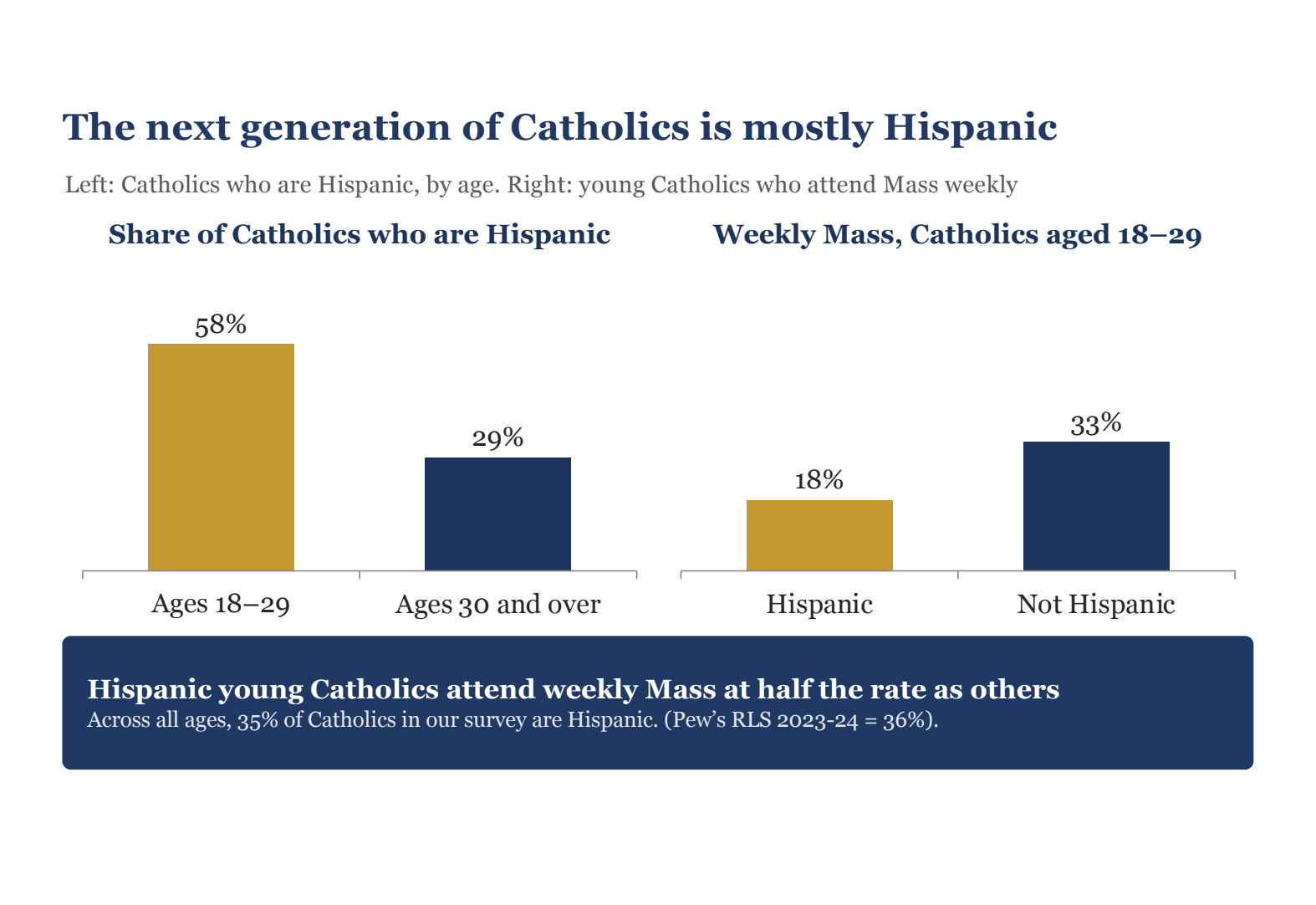
However, among young adults, Hispanics are less likely than non-Hispanics to attend Mass weekly, with just 18% of Hispanic young adults saying they do so, compared to 33% of non-Hispanic young adults.
Am I the only one whose reaction to these surveys is “Obviously, Patrick”? Those of us who have worked with young adults have known for decades that they are drawn to beauty, transcendence, and an authentic encounter with the living God. This is hardly a new discovery.
We also shouldn’t be particularly surprised that this desire does not translate into greater Mass attendance. That’s because this truth still hasn’t been discovered by the aging post-conciliar iconoclasts, as well as many bishops and priests who work hard to make sure to make the modern gerontocracy happy.
The real story is not a recent awareness of beauty by young adults. The real story is that those who have the ultimate responsibility for the liturgy actively make it very difficult to allow priests to offer liturgies that can communicate beauty and an encounter with the living God. Until that changes, the desire for beauty will not often translate into Mass attendance.
That’s because many/most Masses aren’t beautiful.