
Authorities in the Swiss canton of Ticino have voiced hopes that Pope Leo XIV will end the Diocese of Lugano’s four-year wait for a new bishop, in a case that highlights the complexities of Switzerland’s federal system.
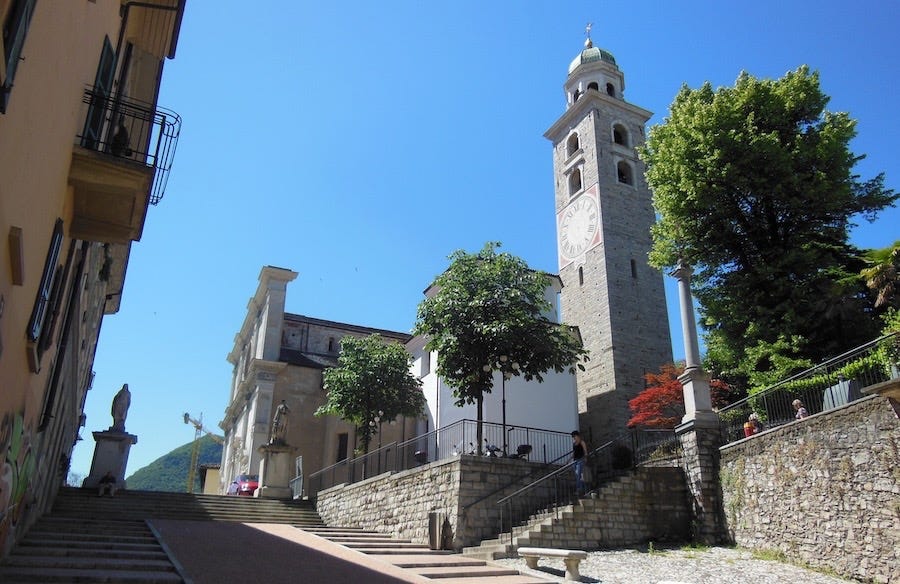
The predominantly Italian-speaking diocese has been vacant since Bishop Valerio Lazzeri resigned at the age of 59 on Oct. 10, 2022, citing “inner fatigue.”
Since October 2022, Bishop Alain de Raemy, an auxiliary bishop of Lausanne, Geneva, and Fribourg, has served as apostolic administrator of the diocese, which serves roughly 218,000 Catholics and covers the canton of Ticino in southern Switzerland.
According to Swiss Catholic media, the Ticino government expressed its opinion on the episcopal vacancy in response to a formal question submitted by Franco Gianoni, a lawyer from Bellinzona, the canton’s capital.
Gianoni, a former member of the Grand Council of Ticino for the Christian Democratic People’s Party, called on the Ticino government to ask Switzerland’s Federal Department of Foreign Affairs to intervene with the Holy See.
The lawyer argued that the Vatican should honor the terms of a treaty between the Holy See and the Swiss Federal Council, the country’s seven-member federal executive.
The treaty, signed on July 24, 1968, established the Apostolic Administration of Lugano as an independent diocese, separating it from the Diocese of Basel. The agreement states that the Bishop of Lugano must be “chosen from among the priests who are citizens of Ticino.”
De Raemy, a former Swiss Guard chaplain, would not be eligible to be appointed Bishop of Lugano unless he became a Ticino citizen.
In an October 2026 interview, the 67-year-old said that acquiring Ticino citizenship was “a possibility that remains open.”
To take the step, de Raemy would need to demonstrate that he had lived for three years in Ticino, including two uninterrupted years in the same municipality, had successfully integrated into Ticinese society, and was proficient in Italian, among other requirements.
Gianoni told the Corriere del Ticino newspaper that respecting the 1968 agreement was important because it concerned Ticino’s identity as a canton with its own political institutions.
He said that for this reason he also approached the Vatican Secretariat of State through Cardinal Giovanni Battista Re, the former dean of the College of Cardinals, but had not received a reply.
Gianoni received a response to his formal question on Oct. 14 from Ticino’s Council of State, the canton’s five-member executive authority.
It noted that as apostolic administrator, de Raemy “has many of the prerogatives of a diocesan bishop, but not all of them, since when the see is vacant certain bodies of the diocese cease to exist under canon law.”
The Council of State described this as “a situation which gives rise to difficulties that could be overcome by the appointment of a diocesan bishop.”
While stressing that it did not seek to influence the procedure for appointing a new bishop, it said: “The Council of State also hopes that the period during which the episcopal see remains vacant will not be prolonged further and that a diocesan bishop will finally be appointed in accordance with the convention of July 24, 1968.”
The Corriere del Ticino did not specify whether the Council of State addressed Gianoni’s request for the Federal Department of Foreign Affairs to raise the matter with the Holy See.
In his October 2026 interview, de Raemy was asked if he would like to live in Ticino as a Ticinese.
He said: “Yes, absolutely, because I’ve had the privilege of getting to know this region and its people through my episcopal ministry, which has allowed me to discover its soul and its diversity.”
He added: “Even if I were to leave Ticino, I would ask for citizenship before departing, out of affection for the canton.”
The bishop noted that the Lugano diocese is preparing for a diocesan synodal assembly on May 22-23, 2027.
He said: “I am pleased to be part of the synodal process that will culminate in the diocesan assembly in May 2027. The shepherd of the Diocese of Lugano, whoever that may be, will have in his hands a wonderful testimony and a valuable working document that can serve as a pastoral plan.”
Asked about the delay in appointing a new bishop, de Raemy commented: “It must be said that this prolonged period of waiting is not an isolated case. It has happened and continues to happen in other dioceses around the world.”
“Moreover, changes are also expected in Switzerland regarding the leadership of the dioceses of Sion and Chur. Returning to the situation in our diocese, I am confident that the path we have taken so far will lay the foundation for a stable and hopeful future.”
Bishop Jean-Marie Lovey of Sion submitted his resignation to Pope Leo XIV in August 2025. The pope accepted it, but the 76-year-old will remain in office until a successor is appointed.
Bishop Joseph Maria Bonnemain of Chur, who is 78 years old, announced in January 2026 that Pope Leo XIV had granted his request for an auxiliary bishop. In July 2026, local media reported that Benedictine Fr. Andri Tuor was the candidate. The Vatican had not announced the appointment as of Nov. 10.
Switzerland’s three other diocesan bishops are Bishop Felix Gmür, 60, of Basel, Bishop Charles Morerod, 65, of Lausanne, Geneva, and Fribourg, and Bishop Beat Grögli, 56, of St. Gallen.
A commenter on another article was asking what's going on with US bishop appointments; this article echoes a similar concern (albeit more legally complex). I respect Leo's caution navigating Vatican politics and making moves with discernment. But sometimes the pace seems absolutely glacial.